If you’re learning Korean, you’ve probably wondered how to say you in Korean language. It seems simple at first—but Korean is a language that values respect. The way you refer to a “person” can change completely based on age, relationship, and the social situation.
In this guide, we’ll break down the most common forms of you in Korean word, provide clear examples, and explain when to use (or avoid) each one to ensure your you in Korean translation is always polite.
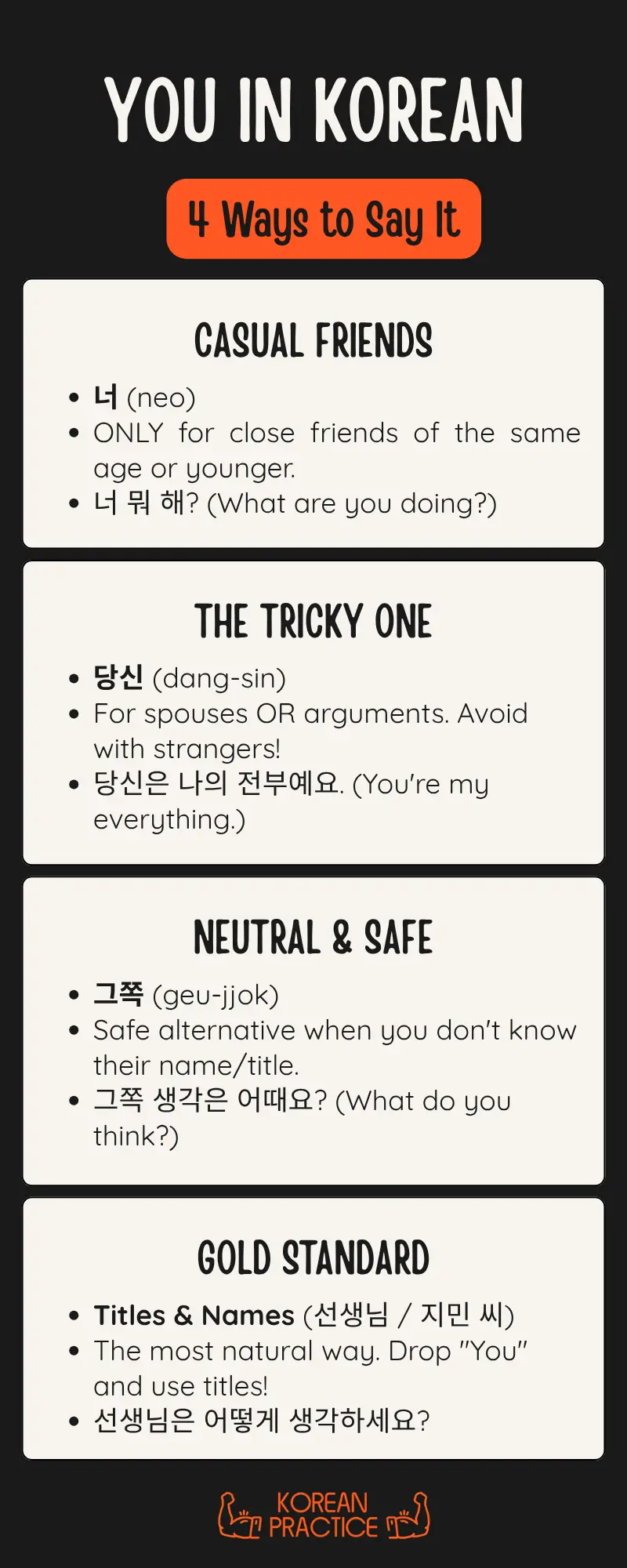
Table of Contents
Casual “You” for Friends: 너 (Neo)
너 (Neo) is the most basic you in korean informal form. It is used between close friends or when speaking to someone younger than you.
✅ How to use “너”
Usage: Close friends, siblings, or children.
Caution: Never use this with strangers or people older than you!
Original Korean Sentence
너 뭐 해?
Pronunciation Guide
너 (neo) 뭐 (mwo) 해 (hae)?
Meaning and Context
너 (you; casual/informal) 뭐 (what) 하 (to do) 해 (are; I’m asking you casually).
Pronunciation Patterns for Conjugations
⊳ 하 changes to 해
Grammar
너: Informal form of “you,” used with close friends or someone younger.
뭐: Shortened form of 무엇, meaning “what.”
해: Present tense informal conjugation of 하다.
English Translation
What are you doing?
Literal Translation
You what doing?
Original Korean Sentence
너는 내 친구야.
Pronunciation Guide
너는 (neo-neun) 내 (nae) 친구야 (chin-gu-ya).
Meaning and Context
너 (you; casual/informal) 는 (topic marker; I’m going to talk about me) 내 (my) 친구 (friend) 야 (are; I’m telling you casually).
Grammar
내: “My” – informal possessive
English Translation
You are my friend.

The Tricky Formal “You”: 당신 (Dangsin)
Textbooks often list 당신 (Dangsin) as the standard you in korean formal translation, but in real life, it’s used very carefully.
✅ When to use “당신”
Romantic context: Between married couples (meaning “honey” or “dear”).
Confrontational context: In an argument (to sound distant or aggressive).
Translation/Poetry: In songs or written literature.
🚀 Quick Learning
Original Korean Sentence
당신은 나의 전부예요.
Pronunciation Guide
당시는 (dang-si-neun) 나에 (na-e) 전부예요 (jeon-bu-ye-yo).
English Translation
You are my everything.
Literal Translation
You (formal/romantic) my everything are.
Quick Reference
당신은 (You) 나의 (my) 전부예요 (are everything).
🔍 Deep Learning
Meaning and Context
당신 (you)
→ A formal or romantic way to say “you.” In this context, it expresses deep affection.
은 (topic marker)
→ Sets “you” as the topic of the sentence.
나의 (my)
→ 나 (I/me) + 의 (possessive particle).
전부 (everything)
예요 (am/are/is)
→ The polite and friendly ending (이다) used when the noun ends in a vowel.
Real-Life Usage
The Romantic “You”: While you should avoid 당신 with strangers, it is a beautiful way to address a spouse or partner. It sounds much more devoted than the casual 너.
Pattern Practice
음악은 나의 전부예요.
당신은 나의 영웅이에요.
너는 나의 전부야.
가족은 나의 힘이에요.
“Stop planting seeds on frozen soil.”
Most platforms just throw “seeds” at you—random vocabulary and grammar. But without tilling your Brain Soil, nothing grows.
Our Original Story Style Breakdown™ melts the ice and tills your soil through structural understanding.
Once the ground is ready, our high-intensity Brain Rewiring™ turns that knowledge into an instant speaking reflex.
Stop playing house with “easy” methods. Install the Korean Engine in your brain. Till your soil, train your mind, and finally start speaking with power.
Polite & Neutral “You”: 그쪽 (Geu-jjok)
When you don’t know someone’s name or title, 그쪽 (Geu-jjok) is a safe, polite way to refer to “you” in business or neutral settings.
Original Korean Sentence
그쪽 생각은 어때요?
Pronunciation Guide
그쪽 (geu-jjok) 생가근 (saeng-ga-geun) 어때요 (eo-ttae-yo)?
Meaning and Context
그쪽 (you; polite, neutral, original meaning is there, that way) 생각 (opinion/thought) 은 (my topic is your opinion) 어때 (how is it) 요 (is; I’m asking you polite and friendly)?
Grammar
* 어떻다 → 어때요; Polite question asking for someone’s opinion or condition.
English Translation
What do you think?
Literal Translation
How is you(r) opinion?
Speaking to Someone Younger: 자네 (Jane)
This form is somewhat old-fashioned. It’s used by older people (like a father-in-law or an old boss) toward someone younger in a respectful but superior way.
Original Korean Sentence
자네는 어떻게 생각하나?
Pronunciation Guide
자네는 (ja-ne-neun) 어떳케 (eo-tteot-ke) 생각카나 (saeng-gak-ka-na)?
Meaning and Context
자네 (you – older speaking to younger, somewhat old-fashioned) 는 (my topic is you) 어떻게 (how) 생각하 (to think) 나 (is; I’m wondering in a casual way)?
English Translation
What do you think?
Literal Translation
How you think?
Addressing a Group: 너희 (Neo-hi)
When you want to say “you guys” in an informal setting, use 너희.
Original Korean Sentence
너희 지금 어디야?
Pronunciation Guide
너희 (neo-hi) 지금 (ji-geum) 어디야 (eo-di-ya)?
Meaning and Context
너희 (you guys; plural informal) 지금 (now) 어디 (where) 야 (are; I’m asking you guys casually)?
English Translation
Where are you guys now?
The Most Natural Way: Titles and Names
Koreans actually avoid using a direct word for “you” whenever possible. Instead, they use the person’s Title or Name + 씨 (ssi). This is the gold standard for you in korean formal communication.
✅ Using a Title (선생님, 사장님, etc.)
Original Korean Sentence
선생님은 어떻게 생각하세요?
Pronunciation Guide
선생니믄 (seon-saeng-ni-meun) 어떳케 (eo-tteot-ke) 생각카세요 (saeng-gak-ka-se-yo)?
Meaning and Context
선생님 (you; original meaning is teacher) 은 (my topic is you) 어떻게 (how)
생각하 (to think) 세요(are; I’m asking you honorific style)?
English Translation
What do you think, teacher?
Literal Translation
How do teacher (you; not real teacher) think?
✅ Using Name + 씨
Original Korean Sentence
지민 씨 생각을 말해 주세요.
Pronunciation Guide
지민 (ji-min) 씨 (ssi) 생가글 (saeng-ga-geul) 말해 (mal-hae) 주세요 (ju-se-yo).
Meaning and Context
지민 (name) 씨 (Mr, Mrs, Ms; I call your name in a polite way) 생각 (thoughts) 을 (my object is what you think) 말하 (to tell) 해 주세요 (please).
Pronunciation Patterns for Conjugations
⊳ 하 changes to 해
English Translation
Please tell me what you think, Jimin.
Literal Translation
Please tell Jimin thoughts.
Summary: Pro Tips for Using “You” in Korean
To avoid sounding rude, remember these three golden rules:
Avoid “You” if possible: Use a name or a title instead.
Check the Age: Age defines which you in korean word is appropriate.
Status Matters: In business, always use a professional title.

FAQs (What You Might Still Wonder About)
1. Why do Koreans seem to avoid the word “you” in conversation?
It’s a cultural nuance. In Korea, referring to someone directly can often feel too blunt or even confrontational. Instead of a pronoun, using a person’s title or their name with a polite suffix creates a much more respectful and natural flow.
2. When is it truly safe to use “Neo” (너)?
Only when you are 100% sure the relationship is casual. This includes close friends of the same age, younger siblings, or children. If there’s even a slight doubt about age or social hierarchy, it’s always better to lean toward a more polite form.
3. Is “Dangsin” (당신) really used between married couples?
Yes, but it is more common among the older generation. While it is a romantic way to address a spouse, using it with a stranger can actually sound confrontational or overly distant. In modern daily life, most Koreans prefer using titles like “Honey” (Yeobo) or parental titles rather than “Dangsin.”
4. What should I do if I don’t know someone’s name or job title?
In those neutral or slightly formal situations, “Geu-jjok” (그쪽) is a handy alternative. It literally translates to “that side,” allowing you to address someone politely without needing to know their specific background or position.
5. Can I use drama-style “you” expressions in business meetings?
Probably not. K-Dramas often use highly emotional or informal language to heighten the tension. In a professional setting, sticking to titles like Sajang-nim (CEO) or Team-jang-nim (Team Leader) is the gold standard for respectful communication.
6. How do I address a group of people without sounding rude?
If it’s a formal setting, “Yeoreobun” (everyone) is your best friend. Save “Neo-hi” (you guys) for when you’re hanging out with a group of close friends in a relaxed environment.
7. Is there a shortcut to mastering all these different social layers?
At KoPra (Korean Practice), we believe the shortcut isn’t more memorization—it’s exposure. Our story-based training is designed to help you develop an instinctive “Neural Lock” on social context, so you stop overthinking and start reacting naturally to the person standing in front of you.
Final words
The word you in Korean language is not just a translation—it’s a system of respect. Unlike English, where “you” is universal, Korean requires a “Neural Lock” on social context.
At KoPra (Korean Practice), we don’t just teach you grammar charts. We help you build the muscle memory to use these expressions naturally through story-based training.