Mastering vocabulary related to everyday life is a crucial step in your Korean learning. Understanding Korean household items is a great place to start because these are the things you touch and use every single day.
In this guide, we will explore Korean home essentials and furniture in Korean language, focusing on how they are actually used in a real Korean home. Let’s make you feel right at home!
Table of Contents
1. 냉장고 (Refrigerator)
The 냉장고 is arguably the most important of all Korean household appliances. In Korea, it’s not just for milk and eggs; it’s a sanctuary for Kimchi and various Banchan (side dishes).
Many Korean households even have a second, specialized refrigerator just for Kimchi! Because Korean food involves many fermented items, having a high-quality refrigerator is a top priority when moving into a new 집 (Jip).
Original Korean Sentence
냉장고 안에 음식이 많이 있어요.
Pronunciation Guide
냉장고 (naeng-jang-go) 아네 (a-ne) 음시기 (um-si-gi) 마니 (ma-ni) 잇써요 (it-sseo-yo).
Meaning and Context
냉장고 (refrigerator) 안 (inside) 에 (in) 음식 (food) 이 (my subject is food) 많이 (a lot) 있 (there is) 어요 (I’m telling you polite and friendly).
English Translation
There is a lot of food in the refrigerator.
Literal Translation
There is a lot of food (in) inside refrigerator.
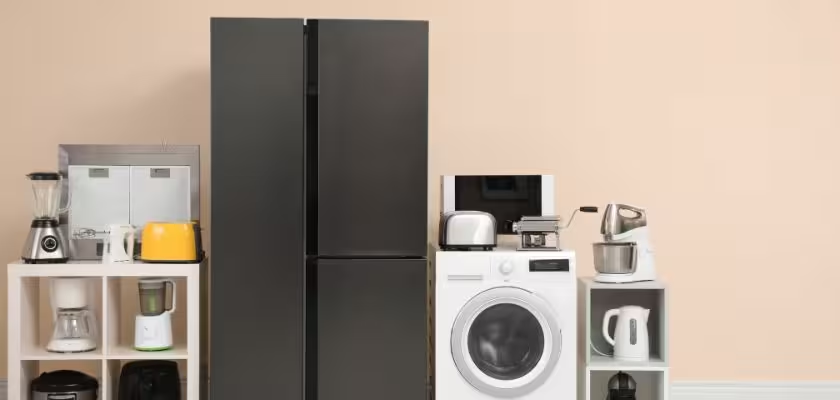
2. 가스레인지 (Gas Stove)
While many modern apartments are switching to induction, the 가스레인지 is still a staple in most Korean kitchens. Koreans love “fire taste” (bul-mat), and many traditional stews (Jjigae) are thought to taste best when boiled over a real flame.
You’ll often see a gas stove used not just for cooking, but for gathering around to eat hot pot dishes right at the table.
Original Korean Sentence
가스레인지 위에 냄비를 놓았어요.
Pronunciation Guide
가스레인지 (ga-seu-re-in-ji) 위에 (wi-e) 냄비를 (naem-bi-reul) 노앗써요 (no-at-sseo-yo).
Meaning and Context
가스 (gas) 레인지 (range) 위 (top) 에 (on) 냄비 (pot) 를 (my object is the pot) 놓 (to put on) 았 (past tense) 어요 (I’m telling you polite and friendly).
English Translation
I put the pot on the gas stove.
Literal Translation
(I) put pot on top of gas stove.
Taste in Korean: Complete Guide to 5 Flavors
Stop playing house with “easy” methods that don’t work.
Isolated vocabulary and grammar won’t help you speak. You need to understand the core structure first.
1. Breakdown: Master Korean sentence structure with our Story Style Breakdown™.
2. Training: Turn that knowledge into an instant reflex through Brain Rewiring™.
Install the Korean Engine in your brain. Move beyond simple memorization and start speaking with confidence.
3. 전자레인지 (Microwave)
The 전자레인지 is a lifesaver for busy students and office workers in Korea.
With the amazing variety of high-quality “Home Meal Replacements” (HMR) available at Korean convenience stores, the microwave is used daily to heat up everything from instant rice (Haetban) to sophisticated frozen stews.
It’s a true Korean home essential for the modern, fast-paced lifestyle.
Original Korean Sentence
전자레인지에 국을 데웠어요.
Pronunciation Guide
전자레인지에 (jeon-ja-re-in-ji-e) 구글 (gu-geul) 데웟써요 (de-wot-sseo-yo).
Meaning and Context
전자 (electron) 레인지 (range) 에 (in) 국 (soup) 을 (my object is the soup) 데우 (to heat up) 었 (past tense) 어요 (I’m telling you polite and friendly).
Pronunciation Patterns for Conjugations
⊳ 우 + 었 = 웠
When rapidly pronounced, ‘우’ and ‘었’ naturally combine to form ‘웠’.
English Translation
I heated up the soup in the microwave.
Literal Translation
(I) heated up soup in microwave.
Jewelry in Korean: 5 Beautiful Words You’ll Love to Learn
4. 싱크대 (Kitchen Sink)
In Korea, the 싱크대 is often the heart of the “Kitchen lifestyle.” Because Korean meals involve many small side dishes (Banchan), there are usually a lot of dishes to wash!
Korean sinks are typically designed to be deep and wide to accommodate large pots used for soup. For many, including myself, the time spent at the sink doing Seol-geoji (dishes) is a daily ritual of keeping the home organized.
Original Korean Sentence
싱크대에서 설거지를 했어요.
Pronunciation Guide
싱크대에서 (sing-keu-dae-e-seo) 설거지를 (seol-geo-ji-reul) 햇써요 (haet-sseo-yo).
Meaning and Context
싱크 (sink) 대 (stand) 에서 (at) 설거지 (to do the dishes) 를 (my object is to do the dishes) 했 (did) 어요 (I’m telling you polite and friendly).
English Translation
I did the dishes at the kitchen sink.
Literal Translation
(I) did the dishes at kitchen sink.
Sajangnim Meaning: Why Koreans Call the Boss This Unique Word
5. 냄비 (Pot)
If you enjoy Korean food, you know that soup is essential. A 냄비 comes in all sizes, but every home has that one special pot for cooking Ramyun or Kimchi-jjigae.
In Korea, some pots are made of nickel-silver (Yang-eun naembi), which heats up incredibly fast—perfect for that quick midnight snack!
Original Korean Sentence
냄비 뚜껑 어디 있어?
Pronunciation Guide
냄비 (naem-bi) 뚜껑 (ddu-ggeong) 어디 (eo-di) 잇써 (it-sseo)?
Meaning and Context
냄비 (pot) 뚜껑 (lid) 어디 (where) 있 (to be) 어 (I’m asking you casually)?
English Translation
Where is the pot lid?
Literal Translation
Where is pot lid?
대박 Meaning: The Korean Word That Means “Awesome!”
6. 리모컨 (Remote Control)
Koreans are famous for their love of TV dramas and variety shows. The 리모컨 is often the “center of power” in the living room!
Whether it’s switching between a high-stakes K-drama or a baseball game, the remote is always within arm’s reach. Because it’s so small, it’s also the most common item to go missing in a Korean household!
Original Korean Sentence
리모컨이 또 없어졌어!
Pronunciation Guide
리모커니 (ri-mo-keo-ni) 또 (ddo) 업써졋써 (eop-sseo-jyeot-sseo)!
Meaning and Context
리모컨 (remote control) 이 (my subject is the remote control) 또 (again) 없어지 (to be missing) 었 (past tense) 어 (I’m telling you casually)!
Pronunciation Patterns for Conjugations
⊳ 지 + 었 = 졌
When rapidly pronounced, ‘지’ and ‘었’ naturally combine to form ‘졌’.
English Translation
The remote control is missing again!
Literal Translation
Remote control was missing again!
Teacher in Korean: The 5 Correct Ways to Address Teachers (Avoid These Common Mistakes!)
7. 옷장 (Wardrobe)
In Korea, the 옷장 is a vital piece of furniture in Korean language studies because Korea has four distinct seasons. This means Koreans have a lot of clothes!
A wardrobe isn’t just for hanging coats; it’s where we swap out heavy winter puffers for light summer linens. Organizing the Ot-jang is a major task for Koreans whenever the seasons change.
Original Korean Sentence
옷장 색깔이 예뻐요.
Pronunciation Guide
옷짱 (ot-jjang) 색까리 (saek-gga-ri) 예뻐요 (ye-bbeo-yo).
Meaning and Context
옷 (clothes) 장 (closet) 색깔 (color) 이 (my subject is the color of the wardrobe) 예쁘 (to be pretty) 어요 (is; I’m telling you polite and friendly).
Pronunciation Patterns for Conjugations
⊳ 쁘 + 어 = 뻐
When rapidly pronounced, ‘쁘’ and ‘어’ naturally combine to form ‘뻐’.
English Translation
The color of the wardrobe is pretty.
Literal Translation
Wardrobe color is pretty.
Konglish: The Fun Mix of Korean and English

FAQs (What You Might Still Wonder About)
1. Why do many Korean homes have two refrigerators?
If you visit a Korean home, you might see a second, smaller fridge. This is a specialized Kimchi refrigerator. It is designed to maintain a very specific, constant temperature to mimic the environment of a traditional clay jar buried underground, keeping the Kimchi perfectly fermented for a long time.
2. Is it true that Koreans often sit on the floor instead of chairs?
Yes, traditional Korean culture is “floor-based” (Jwasik). Because of the underfloor heating system called Ondol, the floor is the warmest place in the house! This is why you will often see low dining tables and floor cushions instead of high tables and heavy sofas in many Korean living rooms.
3. What should I do if I can’t find a microwave in a rental home?
In Korea, most modern studio apartments (officetels) come with a stove, but a microwave is often something you need to buy yourself. If you are staying in a guest house and don’t see one in the kitchen, it might be located in a common area or hidden inside a built-in cabinet to save space.
4. How do Koreans manage their trash at home?
This is a very important part of daily life! Korea has a strict recycling system. You must separate your trash into general waste, food waste, and recyclables (plastic, paper, cans). Most households have a designated corner for different bins to keep the kitchen organized.
5. Is it okay to wear shoes inside a Korean house?
Never! Taking off your shoes at the entrance (Hyeongwan) is the most basic rule of a Korean home. It keeps the floor clean, which is essential since the floor is used for sitting and sometimes sleeping. Most homes provide indoor slippers for guests to wear instead.
6. Why are Korean wardrobes (Ot-jang) so large?
Since Korea has four very distinct seasons, people need a wide variety of clothing—from thin summer linens to heavy, long winter paddings. Because winter coats take up so much space, having a large, organized wardrobe is a necessity for every household.
Final words
Knowing the word for home in Korean (집) is just the beginning. By learning these household items in Korean, you are learning how Koreans live, eat, and relax.
Which of these items do you use the most in your own home? Practice by labeling the items in your room with their Korean names—it’s the fastest way to memorize them!