Are you tired of memorizing boring grammar rules? If you want a fun, effective way to start your learning, a Korean short story for beginners is the perfect solution.
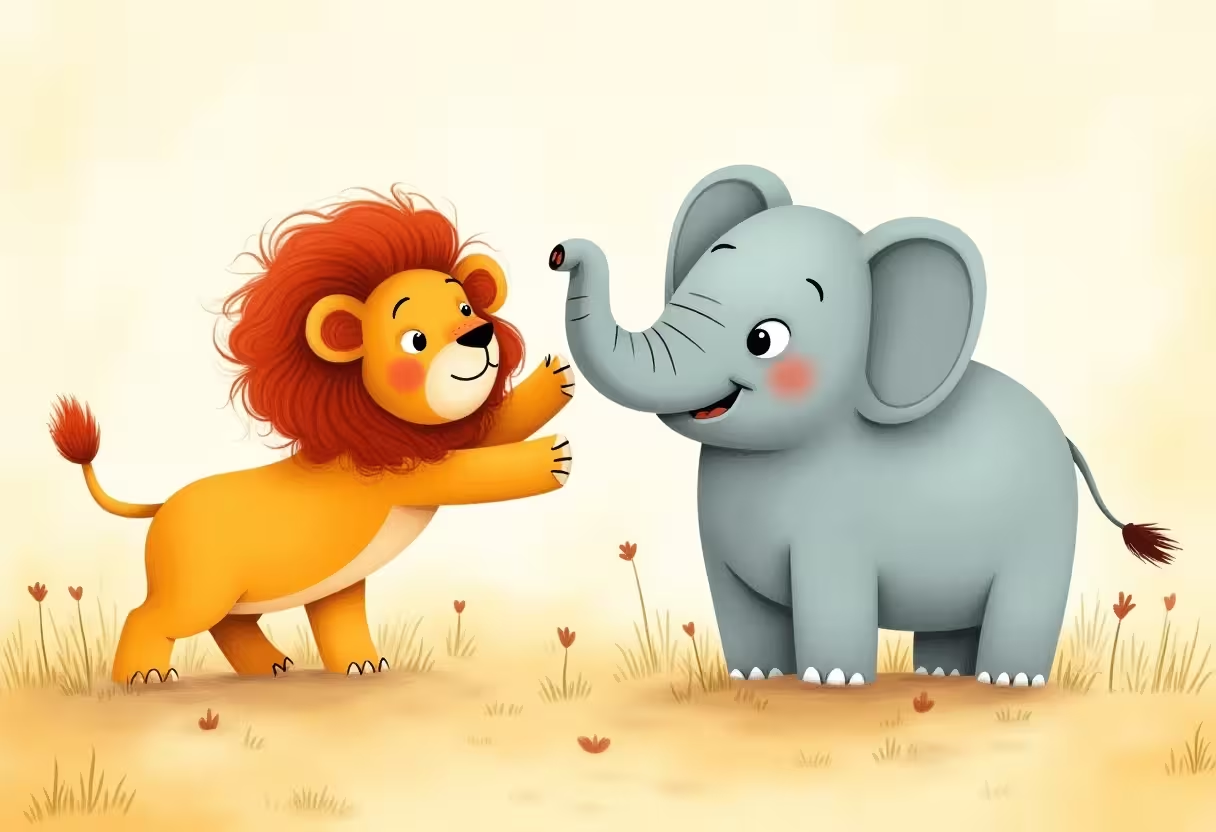
Meet our newest Korean story course: “Jungle Wildlife.” This isn’t just a lesson; it’s a chaotic jungle adventure featuring a clumsy elephant and a hungry Papa Lion. Through their story, you will master the Korean present tense naturally.
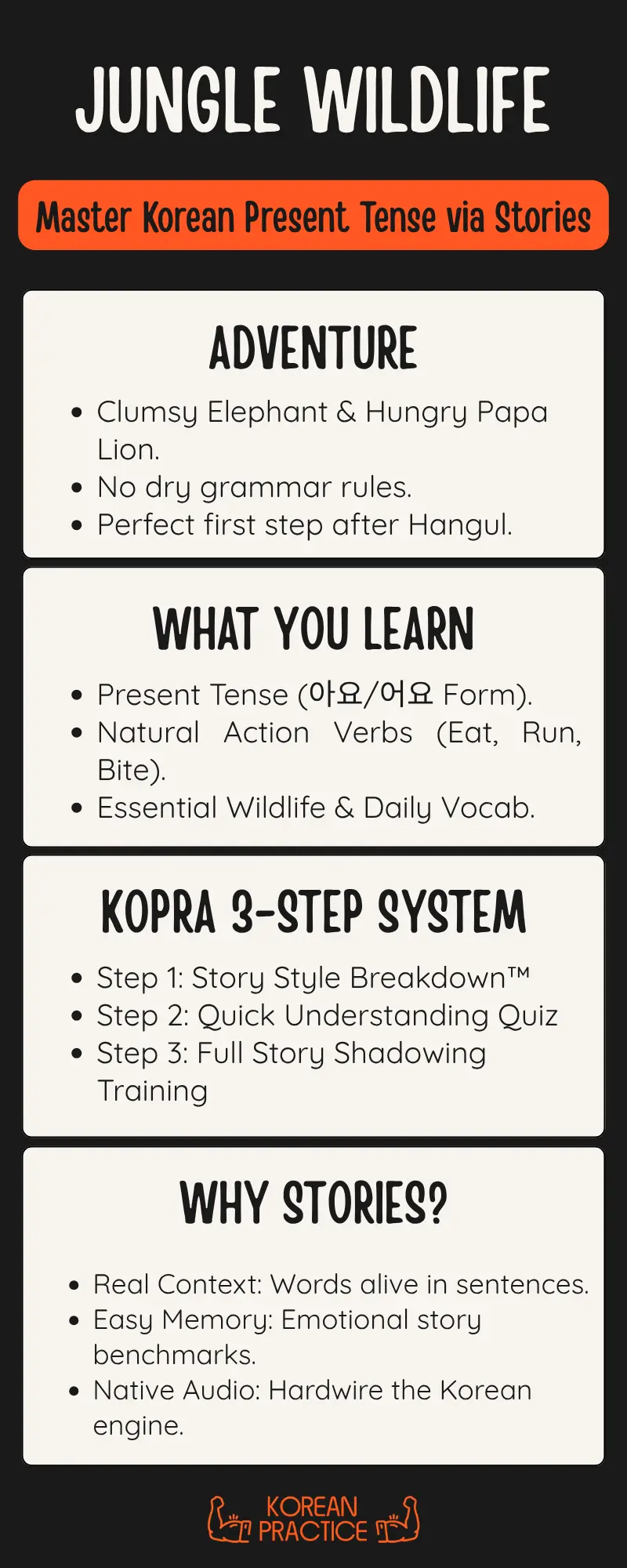
Table of Contents
Why Learn Korean with Stories?
Traditional textbooks often feel like a chore. However, when you learn Korean with stories, the language becomes alive.
Context is King: You see exactly how words are used in real situations.
Better Retention: Stories create emotional benchmarks that help you remember vocabulary longer.
Natural Rhythm: Through Korean reading practice, you absorb the sentence structure without even trying
Course Overview: Jungle Wildlife
This course is designed as the perfect first step after learning Hangul. We focus on the 아요/어요 form—the most essential part of the Korean present tense.
Level: Beginner 1 (Post-Hangul)
Topic: Nature, Wildlife, and Daily Life
Goal: Master present tense conjugation naturally
Content: 6 Engaging Episodes
The KoPra Learning System
We don’t just show you a story; we train your brain using our proprietary Story Style Breakdown™ method.
Story Dive: Immerse yourself in the narrative with a complete breakdown of every single sentence.
Quick Quiz: A fast, fun way to check your understanding after each episode.
Final Master: Conquer the “Ultimate Quiz Trio” (Vocab, Grammar, Listening) and achieve total immersion.
🦁 A Sneak Peek into the Jungle
What happens when a fierce predator tries to eat flowers because he’s hungry? Or when a crab decided to catch a lion instead?
🚀 Quick Learning
Original Korean Sentence
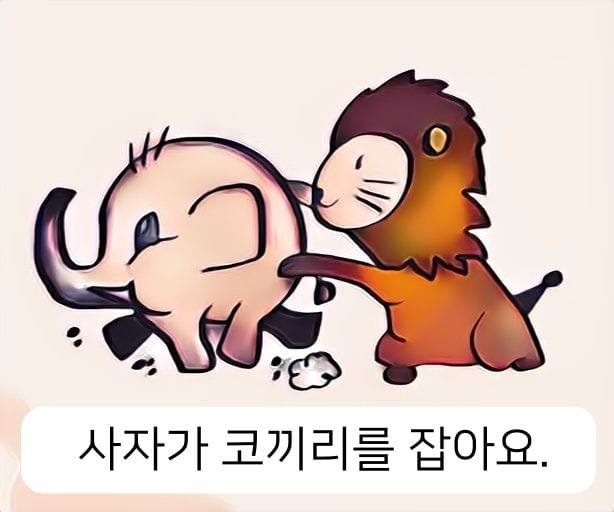
사자가 코끼리를 잡아요.
Pronunciation Guide
사자가 (sa-ja-ga) 코끼리를 (ko-ggi-ri-reul) 자바요 (ja-ba-yo).
English Translation
The lion catches the elephant.
Literal Translation
Lion catch elephant.
Quick Reference
사자가 (lion) 코끼리를 (elephant) 잡아요 (catch).
🔍 Deep Learning
Meaning and Context
사자 (lion)
가 (subject marker)
→ Points out that the lion is doing the action.
코끼리 (elephant)
→ The one the action is done to.
를 (object marker)
→ Shows that the elephant is the object being caught.
잡 (to catch, grab, take; stem of 잡다)
아요 (polite ending)
→ I’m telling you this in a polite and friendly way.
Real-Life Usage
잡아요 is common when talking about catching or holding something.
Pattern Practice
1. 사자가 토끼를 잡아요.
2. 고양이가 쥐를 잡아요.
3. 아이가 공을 잡아요.
4. 강아지가 공을 잡았어요.
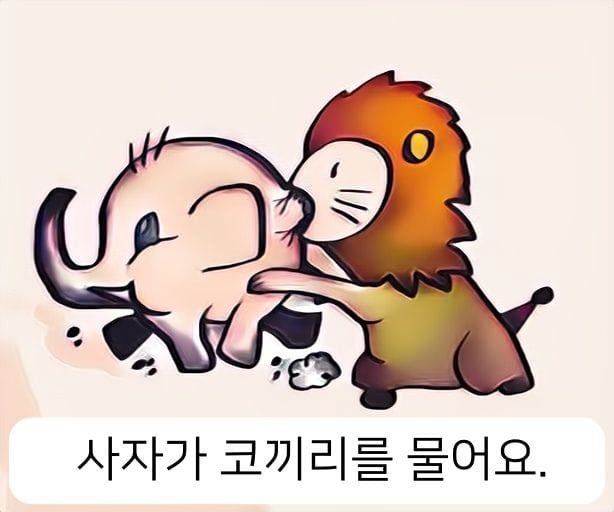
🚀 Quick Learning
Original Korean Sentence
사자가 코끼리를 물어요.
Pronunciation Guide
사자가 (sa-ja-ga) 코끼리를 (ko-ggi-ri-reul) 무러요 (mu-reo-yo).
English Translation
The lion bites the elephant.
Literal Translation
Lion bite elephant.
Quick Reference
사자가 (lion) 코끼리를 (elephant) 물어요 (bite).
🔍 Deep Learning
Meaning and Context
사자 (lion)
가 (subject marker)
→ Points out that the lion is doing this action.
코끼리 (elephant)
를 (object marker)
→ Shows that the elephant is the object of the action.
물 (to bite; stem of 물다)
어요 (polite ending)
→ I’m saying it politely and warmly.
Pattern Practice
1. 아기가 사과를 물어요.
2. 강아지가 내 손을 물어요.
3. 고양이가 장난감을 물어요.
4. 새가 열매를 물어요.
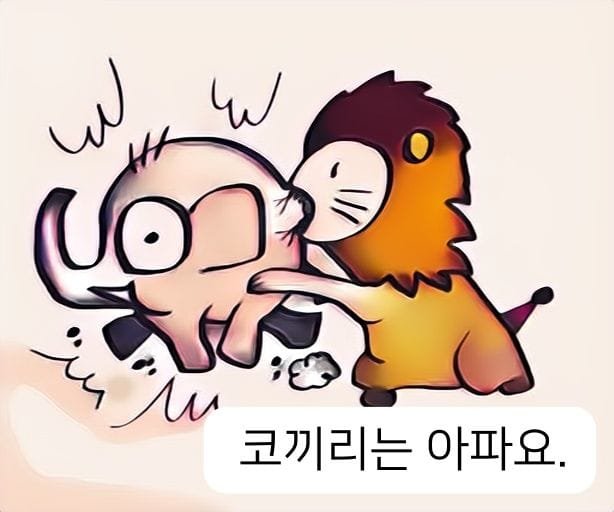
🚀 Quick Learning
Original Korean Sentence
코끼리는 아파요.
Pronunciation Guide
코끼리는 (ko-ggi-ri-neun) 아파요 (a-pa-yo).
English Translation
The elephant is in pain.
Literal Translation
Elephant is painful.
Quick Reference
코끼리는 (elephant) 아파요 (is painful).
🔍 Deep Learning
Meaning and Context
코끼리 (elephant)
는 (topic marker)
→ Highlights the elephant as the topic of this sentence.
아프 (to be painful, hurt; stem of 아프다)
아요 (is; polite ending)
→ I’m telling you polite and friendly.
Pronunciation Flow Tip
아프 + 아요 = 아파요: When rapidly pronounced, ‘프’ and ‘아’ naturally combine to form ‘파’, not 아프아요.
Real-Life Usage
아파요 can describe both physical pain and emotional hurt. You might hear it often if someone is unwell.
Grammar
The ending 아요 doesn’t mean “is” on its own — it isn’t the same as is in English. But because it works together with the verb like a be verb (helping express a state in the present), I wrote it as is to make it easier to understand.
Pattern Practice
1. 아이가 아파요.
2. 할아버지가 아파요.
3. 마음이 아파요.
4. 다리가 아파요.
What Will You Learn?
By joining this Korean story course, you will gain practical skills you can use immediately:
Real Present Tense: Learn to say “Eat, Sleep, and Run” naturally.
Essential Vocab: Master nature and animal words, from giant elephants to pinchy crabs.
Asking & Answering: Practice basic “Where?” and “Why?” questions.
Daily Expressions: Learn how to express struggles and successes through the Lion family’s story.
Stop Studying, Start Training!
The Brutal Truth: Korean is a unique system. You cannot master it by memorizing isolated rules. Traditional methods often lead to exhaustion without results.
Our Solution:
Concise Theory: We skip boring lectures and get straight to the point.
Immediate Practice: No more passive listening—start training your brain right away.
Hardwiring through Stories: We focus on embedding the language into your brain through immersive storytelling.
Ready to help Papa Lion find dinner?
Don’t let grammar hold you back. Experience the best Korean reading practice and see how fast you can progress when you learn korean with stories.
Most Korean courses stop at grammar. Mine goes further—stories, breakdowns, and actual practice to make you speak.
🌟 [Enroll Now: Learn with Stories & Practice]
FAQs (What You Might Still Wonder About)
1. Is this “Jungle Wildlife” course suitable for absolute beginners?
Yes! This Korean short story for beginners is specifically designed for those who have just finished learning Hangul. We use simple sentence structures and clear vocabulary to ensure you don’t feel overwhelmed while you learn Korean with stories.
2. How much of the Korean present tense will I master?
By the end of this Korean story course, you will comfortably use the 아요/어요 polite ending. You’ll move beyond just memorizing “eat” or “run” and actually understand how the Korean present tense functions in real, flowing sentences.
3. Does this course include any Korean reading practice?
Absolutely. Each of the 6 episodes serves as a focused Korean reading practice session. With our Story Style Breakdown™ method, you aren’t just glancing at words; you are deeply analyzing and absorbing the rhythm of the language.
4. Why should I choose a Korean story course instead of a textbook?
Traditional textbooks focus on isolated rules. When you learn korean with stories, you see grammar in its natural habitat. This context makes the Korean present tense much easier to remember and apply to your own conversations.
5. Are there audio materials for pronunciation?
Yes, every Korean short story for beginners in our curriculum is recorded by professional native voice actors. This ensures you are exposed to clear, natural, and accurate intonation from the start. By combining your Korean reading practice with these professional recordings, you’ll be able to perfect your pronunciation and sound just like a native speaker.
6. What makes the KoPra (Korean Practice) method different from other apps?
Most apps stop at simple flashcards. Our Korean story course focuses on “training” rather than just “studying.” By breaking down stories like Jungle Wildlife, we help you hardwire the language into your brain so that the Korean present tense becomes a reflex, not a calculation.
Final words
Learning a new language shouldn’t feel like a chore. By choosing to learn Korean with stories, you are giving yourself the gift of an immersive and enjoyable experience. Our Korean story course, “Jungle Wildlife,” is more than just a series of lessons; it’s a proven gateway to mastering the Korean present tense through engaging narratives and professional native audio.
Whether you’re looking for consistent Korean reading practice or a reliable Korean short story for beginners to start your journey, KoPra is here to guide you every step of the way. Stop struggling with dry textbooks and start training your brain to think in Korean naturally.
Are you ready to join Papa Lion and his jungle friends? Let’s turn your Korean goals into reality together. See you inside the course!