Ever heard “신경 쓰지 마” or “신경 써” in K-dramas? If you are looking up the 신경을 쓰다 meaning, you are in the right place.
Understanding how to say 신경을 쓰다 is one of the most practical steps in mastering real-life Korean. Instead of flipping through heavy grammar charts, you just need to understand the structural logic behind it.
In this guide, we’ll break down the exact 신경을 쓰다 meaning in English using our signature Story Style Breakdown™ method, complete with 신경을 쓰다 examples you can use immediately.
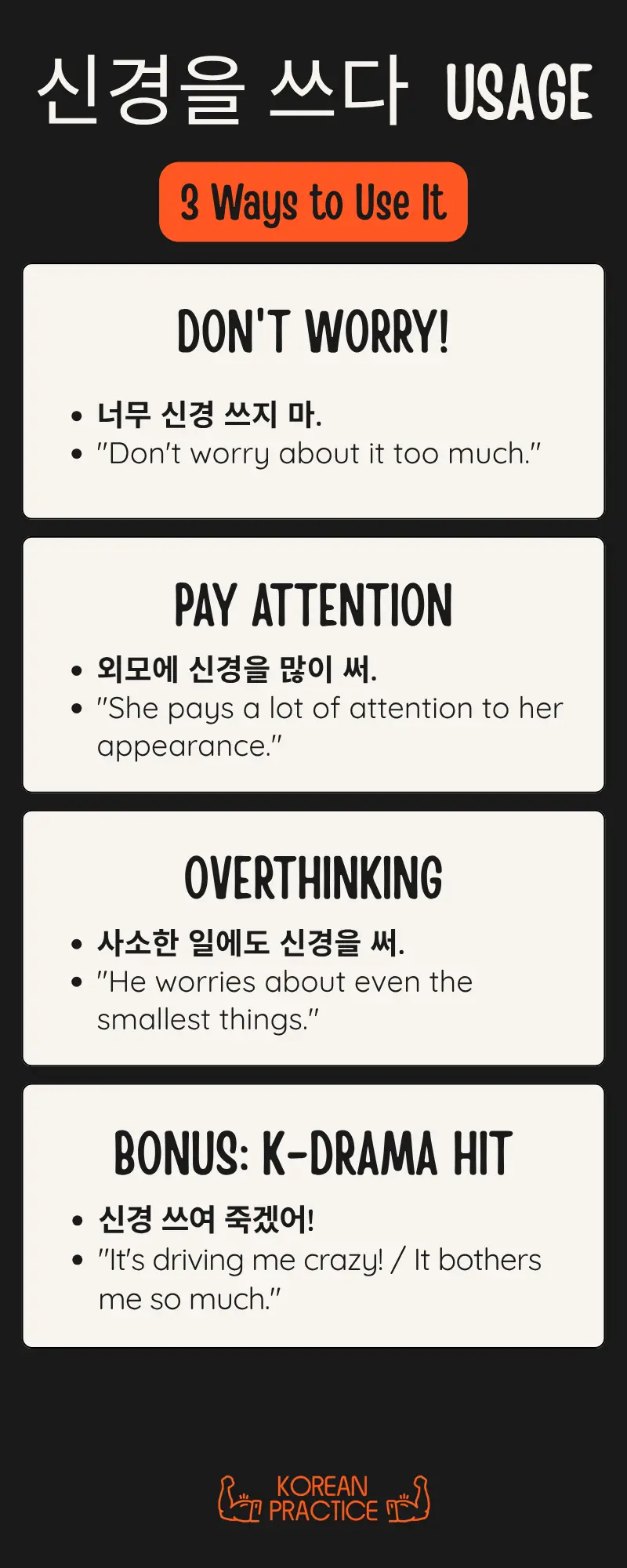
Table of Contents
What is “신경을 쓰다”?
Before jumping into the phrases, let’s look at the literal engine inside this expression:
✅ 신경 (sin-gyeong): Nerves / Attention
✅ 쓰다 (sseu-da): To use
So, the literal 신경을 쓰다 meaning is “to use one’s nerves.” In English, this naturally translates to “to pay attention to,” “to care about,” or even “to worry about.”
Let’s see how this phrase transforms based on social context.
3 Real-Life 신경을 쓰다 Examples
Nuance 1: Don’t Worry! (Worry or Concern)
Original Korean Sentence
너무 신경 쓰지 마.
Pronunciation Guide
너무 (neo-mu) 신경 (sin-gyeong) 쓰지 (sseu-ji) 마 (ma).
Meaning and Context
너무 (too much) 신경 (worry/concern, original meaning is nerves) 쓰 (to use) 마 (don’t; in a casual way).
Grammar
지 마: Negative command. “Don’t do [verb]”
쓰지 마: “Don’t use/pay [attention].”
English Translation
Don’t worry about it too much.
Literal Translation
Don’t use nerves too much.

Nuance 2: Careful Attention (Focusing on Details)
Original Korean Sentence
그는 사소한 일에도 신경을 써.
Pronunciation Guide
그는 (geu-neun) 사소한 (sa-so-han) 이레도 (i-re-do) 신경을 (sin-gyeong-eul) 써 (sseo).
Meaning and Context
그 (he) 는 (my topic is him) 사소한 (trivial/small) 일 (thing) 에도 (even to) 신경 (care/attention) 을 (my object is attention) 쓰 (to pay/put thought into) 어 (I’m telling you casually).
Pronunciation Patterns for Conjugations
⊳ 쓰 + 어 = 써
When rapidly pronounced, ‘쓰’ and ‘어’ naturally combine to form ‘써’.
Grammar
에도: 에 (to/at) + 도 (even). Means “even to/for.”
English Translation
He worries about even the smallest things.
Literal Translation
He use nerves even to small thing.
Nuance 3: Effort for Others (Being Thoughtful)
Original Korean Sentence
그녀는 외모에 신경을 많이 써.
Pronunciation Guide
그녀는 (geu-nyeo-neun) 외모에 (oe-mo-e) 신경을 (sin-gyeong-eul) 마니 (ma-ni) 써 (sseo).
Meaning and Context
그녀 (she) 는 (topic marker) 외모 (appearance) 에 (to/with regard to) 신경 (attention/care) 을 (object marker) 많이 (a lot) 쓰 (to pay/uses energy/thought) 어 (I’m telling you casually).
Pronunciation Patterns for Conjugations
⊳ 쓰 + 어 = 써
When rapidly pronounced, ‘쓰’ and ‘어’ naturally combine to form ‘써’.
Grammar
에: Indicates the direction or target
English Translation
She pays a lot of attention to her appearance.
Literal Translation
She use nevers a lot to appearance.

FAQs (What You Might Still Wonder About)
1. What is the difference between “신경 쓰다” and “신경 쓰이다”?
While the basic 신경을 쓰다 meaning is to actively pay attention or choose to care about something, “신경 쓰이다” (passive form) means something is bothering you or on your mind automatically, even if you don’t want it to.
2. Is “너무 신경 쓰지 마” polite enough to use with everyone?
Not quite. Because it ends in “-지 마” (casual negative command), it is strictly informal. If you want to say 신경을 쓰다 as “Don’t worry about it” to someone older or in a business setting, you should politely say, “너무 신경 쓰지 마세요.”
3. Why do Koreans use the word “nerves” (신경) to express caring or worrying?
It’s a beautiful cultural nuance! In Korea, deeply caring about someone or focusing on a hard task is seen as investing your mental energy and “nerves.” That’s why 신경을 쓰다 meaning in english carries a much deeper tone of mindfulness than just a casual “I care.”
4. Can I use “신경 써서” to thank someone for their effort?
Yes, absolutely! It sounds incredibly natural. For example, if someone put a lot of thought into your gift, you can say, “신경 써 주셔서 감사합니다” (Thank you for putting so much thought/effort into this). It is one of the most polite 신경을 쓰다 examples you can use in daily life.
5. How do I say “Mind your own business” using this phrase?
If someone is bothering you too much, you can say “너나 신경 써” (casual) or “당신 일이나 신경 쓰세요” (formal/confrontational). It literally means “Use your nerves on your own business,” which is a perfect real-life application of the 신경을 쓰다 word.
6. Is the particle “을” in “신경을 쓰다” always necessary?
In written textbooks, you will see the full phrase 신경을 쓰다. However, in fast-paced everyday Korean conversations and K-dramas, native speakers almost always drop the particle and just say “신경 쓰다” to keep the speech flowing naturally.
Final words
Mastering the 신경을 쓰다 meaning is a game-changer for your Korean journey. Unlike English, where “to care” or “to worry” are separate words, Korean combines these emotions into a single, deeply expressive phrase.
By understanding the 신경을 쓰다 meaning in english through real-life context rather than dry textbook translation, you can finally grasp how native speakers naturally protect, worry about, or pay attention to one another.
Don’t just memorize these 신경을 쓰다 examples. Instead, try observing how characters use them the next time you watch a K-drama. You’ll be amazed at how often you hear it!