Have you ever wondered how to say this, that, these, or those in Korean? These small words, known as Korean demonstrative pronouns, are the “linguistic signposts” that help you point to specific objects or locations.
Mastering these words is essential for natural communication. Today, we will break them down into three easy categories based on distance.
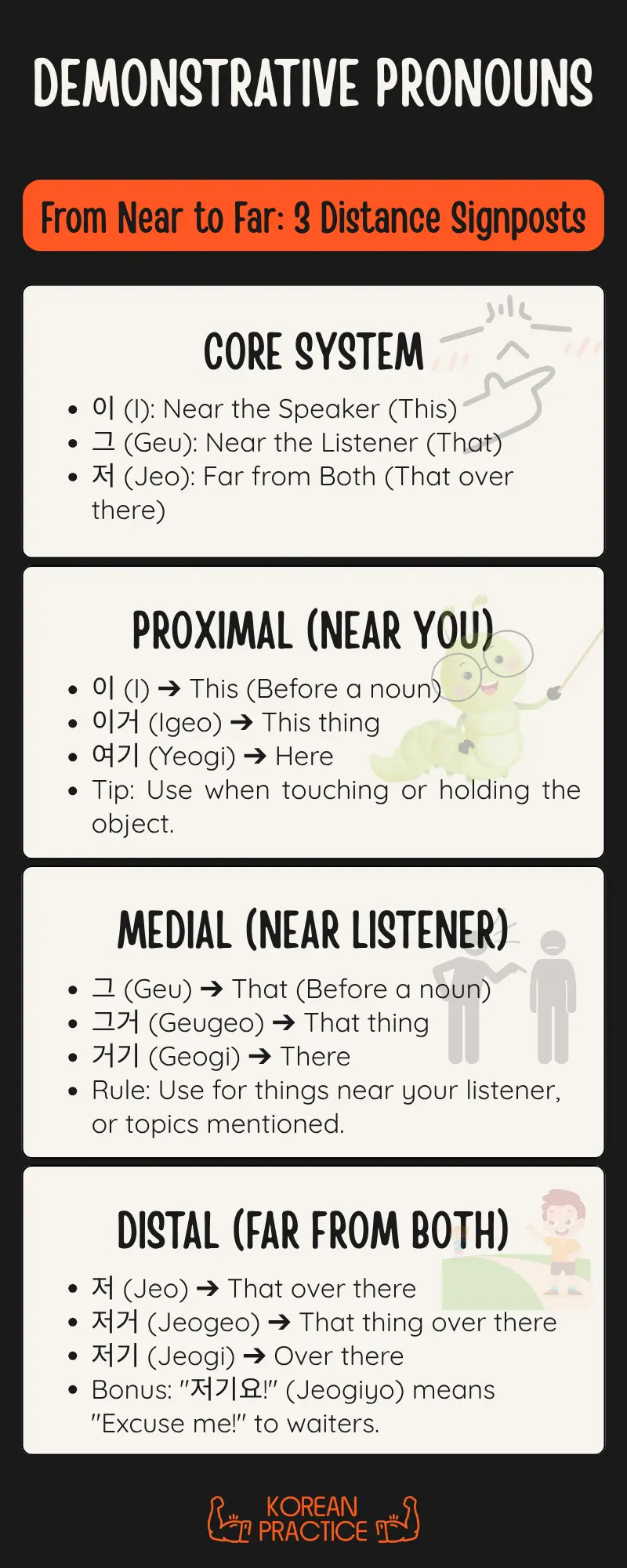
Table of Contents
Proximal: Near the Speaker (This / Here)
When an object is close to you (the speaker), you use words starting with 이 (i). This is the foundation for learning this in Korean.
이 (I): This (used before a noun).
이거 (Igeo): This thing.
여기 (Yeogi): Here in Korean.
Using ‘이’ (This)
Original Korean Sentence
A: 이 음식 맛있어요? B: 네, 아주 맛있어요.
Pronunciation Guide
A: 이 (i) 음식 (eum-sik) 맛있어요 (ma-sit-sseo-yo)? B: 네 (ne), 아주 (a-ju) 맛있어요 (ma-sit-sseo-yo).
Meaning and Context
A: 이 (this) 음식 (food) 맛있 (to be delicious) 어요 (is; I’m asking you polite and friendly)? B: 네 (yes; in a formal way), 아주 (very) 맛있 (to be delicious) 어요 (is; I’m telling you polite and friendly).
English Translation
A: Is this food delicious? B: Yes, it’s very delicious.
Literal Translation
A: Is this food delicious? B: Yes, (it)’s very delicious.
Using ‘이거’ (This thing)
Original Korean Sentence
A: 나 이거 필요해. B: 나도 이거 필요한데.
Pronunciation Guide
A: 나 (na) 이거 (i-geo) 필요해 (pi-ryo-hae). B: 나도 (na-do) 이거 (i-geo) 필요한데 (pi-ryo-han-de).
Meaning and Context
A: 나 (I) 이 (this) 거 (thing; colloquial style of 것) 필요하 (to need) 해 (I’m telling you casually). B: 나 (I) 도 (too) 이 (this) 거 (thing; colloquial style of 것) 필요하 (to need) ㄴ데 (but..).
Pronunciation Patterns for Conjugations
* 하 changes to 해,
* 필요하 + ㄴ데 = 필요한데
When rapidly pronounced, ‘하’ and ‘ㄴ’ naturally combine to form ‘한’.
English Translation
A: I need this. B: I need this too.
Literal Translation
A: I need this thing. B: I need this thing too, but..
Using ‘여기’ (Here)
Original Korean Sentence
A: 저기요. 여기가 어디예요? B: 여기는 인천 역 광장이에요.
Pronunciation Guide
A: 저기요 (jeo-gi-yo). 여기가 (yeo-gi-ga) 어디예요 (eo-di-ye-yo)? B: 여기는 (yeo-gi-neun) 인천 (in-cheon) 역 (yeok) 광장이에요 (gwang-jang-i-e-yo).
Meaning and Context
A: 저기요 (excuse me). 여기 (here) 가 (my subject is here) 어디 (where) 예요 (is; I’m asking you polite and friendly)? B: 여기 (here) 는 (as for here) 인천 (In-cheon) 역 (station) 광장 (plaza) 이에요 (is; I’m telling you polite and friendly).
English Translation
A: Excuse me. Where am I? B: This is Incheon Station Plaza.
Literal Translation
A: Excuse me. Where is here? B: As for here, (it) is Incheon Station Plaza.
7 Ways to Say “And in Korean”: Complete Guide for Beginners
Medial: Near the Listener (That / There)
When something is far from you but close to the person you are talking to, you use words starting with 그 (geu).
그 (Geu): That (used before a noun).
그거 (Geugeo): That thing.
거기 (Geogi): There (near the listener).
Using ‘그’ (That)
Original Korean Sentence
A: 그 옷 예뻐요. B: 고마워요. 어제 시장에서 샀어요.
Pronunciation Guide
A: 그 (geu) 옷 (ot) 예뻐요 (ye-bbeo-yo). B: 고마워요 (go-ma-wo-yo). 어제 (eo-je) 시장에서 (si-jang-e-seo) 샀어요 (sat-sseo-yo).
Meaning and Context
A: 그 (that) 옷 (clothes) 예쁘 (to be pretty) 어요 (are; I’m telling you polite and friendly). B: 고맙 (thank you) 어요 (I’m telling you polite and friendly). 어제 (yesterday) 시장 (market) 에서 (at) 사 (to buy) 았 (past tense) 어요 (I’m telling you polite and friendly).
Pronunciation Patterns for Conjugations
* 예쁘 + 어요 = 예뻐요, 고맙 + 어요 = 고마워요, 사 + 았 = 샀
When rapidly pronounced, ‘쁘’ and ‘어’ naturally combine to form ‘뻐’.
When rapidly pronounced, ‘맙’ and ‘어’ naturally combine to form ‘마워’.
When rapidly pronounced, ‘사’ and ‘았’ naturally combine to form ‘샀’.
English Translation
A: Those clothes are pretty. B: Thank you. I bought them at the market yesterday.
Literal Translation
A: That clothes are pretty. B: Thank you. (I) bought (them) at market yesterday.
Where in Korean: 9 Essential Expressions Every Beginner Must Know
Using ‘그거’ (That thing)
Original Korean Sentence
A: 그거 어디에서 샀어? B: 동대문 시장에서 샀어.
Pronunciation Guide
A: 그거 (geu-geo) 어디에서 (eo-di-e-seo) 샀어 (sat-sseo)? B: 동대문 (dong-dae-mun) 시장에서 (si-jang-e-seo) 샀어 (sat-sseo).
Meaning and Context
A: 그 (that) 거 (thing; colloquial style of 것) 어디 (where) 에서 (at) 사 (to buy) 았 (past tense) 어 (I’m asking you casually)? B: 동대문 (a major shopping district and market area in Seoul) 시장 (market) 에서 (at) 사 (to buy) 았 (past tense) 어 (I’m telling you casually).
Pronunciation Patterns for Conjugations
* 사 + 았 = 샀
When rapidly pronounced, ‘사’ and ‘았’ naturally combine to form ‘샀’.
English Translation
A: Where did you buy that? B: I bought it at Dongdaemun Market.
Literal Translation
A: At where did (you) buy that? B: (I) bought (it) at Dongdaemun Market.
7 Must-Know Ways to Say “Because in Korean” + Easy Examples
Using ‘거기’ (There)
Original Korean Sentence
A: 거기에 가지 마. 위험한 곳이야. B: 알았어요. 안 갈게요.
Pronunciation Guide
A: 거기에 (geo-gi-e) 가지 (ga-ji) 마 (ma). 위험한 (wi-heo-man) 곳이야 (go-si-ya). B: 알았어요 (a-rat-sseo-yo). 안 (an) 갈게요 (gal-gge-yo).
Meaning and Context
A: 거기 (there) 에 (to) 가 (to go) 지 마 (don’t; in a casual way). 위험한 (dangerous) 곳 (place) 이야 (is; I’m telling you casually). B: 알 (to know) 았 (past tense) 어요 (I’m telling you polite and friendly). 안 (not) 가 (to go) ㄹ게 (will) 요 (I’m telling you polite and friendly).
English Translation
A: Don’t go there. It’s a dangerous place. B: I understand. I won’t go.
Literal Translation
A: Don’t go to there. (It)’s dangerous place. B: (I) knew. (I) won’t go.
11 Simple Korean Adjectives You’ll Use Every Day (With Easy Tips!)
Distal: Far From Both (That Over There)
When an object or place is far away from both the speaker and the listener, you use words starting with 저 (jeo). This is how you say over there in Korean.
저 (Jeo): That over there (before a noun).
저거 (Jeogeo): That thing over there.
저기 (Jeogi): Over there in Korean (distant location).
Using ‘저’ (That over there)
Original Korean Sentence
A: 저 사진 예쁘다. B: 산과 들이 아름다워.
Pronunciation Guide
A: 저 (jeo) 사진 (sa-jin) 예쁘다 (ye-bbeu-da). B: 산과 (san-gwa) 들이 (deu-ri) 아름다워 (a-reum-da-wo).
Meaning and Context
A: 저 (that (over there)) 사진 (photo) 예쁘 (to be pretty) 다 (is; wow). B: 산 (mountain) 과 (and) 들 (field) 이 (my subject is the mountains and fields) 아름답 (to be beautiful) 어 (are; I’m telling you casually).
Pronunciation Patterns for Conjugations
* 아름답 + 어 = 아름다워
When rapidly pronounced, ‘답’ and ‘어’ naturally combine to form ‘다워’.
English Translation
A: That photo is beautiful. B: The mountains and fields are gorgeous.
Literal Translation
A: That photo is pretty. B: Mountain and field are beautiful.
Korean Verbs List – 11 Easy Examples Guide
Using ‘저거’ (That thing over there)
Original Korean Sentence
A: 저거 뭐예요? B: 저거는 시계탑이에요.
Pronunciation Guide
A: 저거 (jeo-geo) 뭐예요 (mwo-ye-yo)? B: 저거는 (jeo-geo-neun) 시계탑이에요 (si-gye-ta-bi-e-yo).
Meaning and Context
A: 저 (that; over there) 거 (thing; colloquial style of 것) 뭐 (what) 예요 (is; I’m asking you polite and friendly)? B: 저 (that; over there) 거 (thing; colloquial style of 것) 는 (as for that) 시계 (clock) 탑 (tower) 이에요 (is; I’m telling you polite and friendly).
English Translation
A: What is that? B: That is a clock tower.
Literal Translation
A: What is that thing (over there)? B: As for That thing (over there), (it) is clock tower.
7 Comprehensive Korean Pronouns List
Using ‘저기’ (Over there)
Original Korean Sentence
A: 저기에 뭐가 있어? B: 저기에 가면 강이 있어.
Pronunciation Guide
A: 저기에 (jeo-gi-e) 뭐가 (mwo-ga) 있어 (it-sseo)? B: 저기에 (jeo-gi-e) 가면 (ga-myeon) 강이 (gang-i) 있어 (it-sseo).
Meaning and Context
A: 저기 (over there) 에 (at) 뭐 (what) 가 (my subject is what) 있 (to exist) 어 (I’m asking you casually)? B: 저기 (over there) 에 (to) 가 (to go) 면 (if) 강 (river) 이 (my subject is a river) 있 (there is) 어 (I’m telling you casually).
English Translation
A: What’s over there? B: If you go over there, there’s a river.
Literal Translation
A: What exist at over there? B: If (you) go over there, there’s a river.
Powerful Korean Possessive Pronouns: 6 Ways to Elevate Your Korean Learning
Quick Summary Table
| Distance | Pronoun (This/That) | Thing (This/That thing) | Location (Here/There) |
| Near You | 이 (I) | 이거 (Igeo) | 여기 (Yeogi) |
| Near Listener | 그 (Geu) | 그거 (Geugeo) | 거기 (Geogi) |
| Far Away | 저 (Jeo) | 저거 (Jeogeo) | 저기 (Jeogi) |

FAQs (What You Might Still Wonder About)
1. Is there a difference between “이것” and “이거”?
Yes, but mostly in formality! 이거 (Igeo) is the colloquial (spoken) version of 이것 (Igeot). In daily conversation, Koreans almost always use 이거, 그거, and 저거. Use the “것” version in formal writing or speeches.
2. How do I say “these” and “those” in Korean?
To make a Korean demonstrative pronoun plural, you simply add the plural marker 들 (deul).
이것들 (I-geot-deul) = These things
그것들 (Geu-geot-deul) = Those things
저것들 (Jeo-geot-deul) = Those things over there
3. Can I use “그” (that) to refer to a person?
You should be careful! While 그 (geu) can mean “he” in literature, in spoken Korean, it’s more natural to say “그 사람” (that person) or “그분” (that person – formal). Using just the pronoun for a person can sometimes sound a bit cold or unnatural.
4. When exactly should I switch from “거기” to “저기”?
Think of 거기 (geogi) as “there” (near the listener or a place you both just talked about). Use 저기 (jeogi) for over there in Korean when the place is physically far from both of you or requires you to point your finger toward the distance.
5. Why do Koreans say “저기요” (Jeogiyo) to call a waiter?
Great catch! Since 저기 means over there in Korean, adding “요” makes it a polite way to say “Over there, please!” or “Excuse me.” It’s used to get someone’s attention from a distance, like a server in a restaurant.
6. Is “이” (this in Korean) always followed by a noun?
Yes. 이, 그, and 저 are demonstrative adjectives, meaning they must be followed by a noun (e.g., 이 책 – this book). If you want to use the word alone as a pronoun, you must use the “thing” version: 이거, 그거, or 저거.
7. Are there formal versions of “here” and “there”?
In very formal or business settings, you might hear 이곳 (i-got), 그곳 (geu-got), and 저곳 (jeo-got). These are formal ways to say here in Korean or “that place,” often used in news reports or written announcements.
Final words
Understanding the subtle differences between this, that, and over there in Korean is a major step toward fluency. By practicing these 9 Korean demonstrative pronouns, you will be able to navigate locations and identify objects with confidence.
Want to see these words in action? My “Story Style Breakdown™” method helps you understand these concepts naturally through simple stories and real practice.
I’m currently updating my Shadowing Course to help you practice the perfect pronunciation of these pronouns, so stay tuned for more!