When you learn teacher in Korean, you will quickly realize it goes far beyond the classroom. The standard word 선생님 (seon-saeng-nim) changes completely depending on social context, respect, and hierarchy.
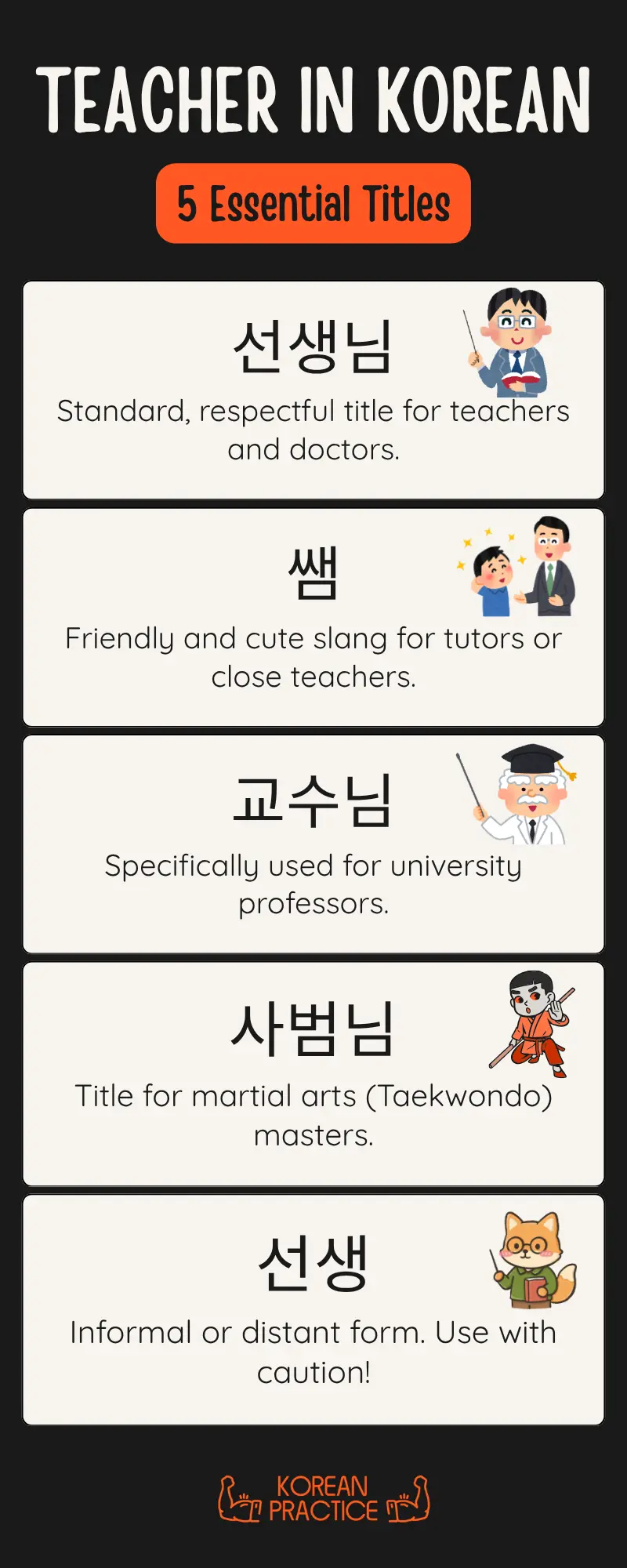
Before diving into the details, check out this quick visual guide to master the 5 essential titles from formal to trendy slang!
Quick Warm-up Quiz!
Test your skills before diving into the blog post! 🧩 See if your Korean intuition is right on track.
Table of Contents
How to Say Teacher in Korean
The most common word for teacher in Korean is:
선생님 (seon-saeng-nim)
This is the polite and respectful way to say it. The ending -님 is an honorific. It shows respect.
For example:
우리 선생님 (uri seonsaengnim) = our teacher
영어 선생님 (yeongeo seonsaengnim) = English teacher
김 선생님 (Kim seonsaengnim) = Teacher Kim
So if you want to call your teacher, you don’t just say their name. You usually add 선생님 after their last name.
Original Korean Sentence
저는 선생님을 만날 거예요.
Pronunciation Guide
저는 (jeo-neun) 선생님을 (seon-saeng-ni-meul) 만날 (man-nal) 거예요 (geo-ye-yo).
Meaning and Context
저 (I; humble form) 는 (topic marker; the sentence is about “I”) 선생님 (teacher; polite, respectful form) 을 (object marker; teacher is the object) 만나 (to meet; stem of 만나다) ㄹ 거 (will) 예요 (polite ending; I’m telling you polite and friendly).
English Translation
I will meet the teacher.
Literal Translation
I will meet teacher.
👉 Call your boss like a local: What “사장님 (Sajangnim)” really means (and when to use it)
How to Pronounce Teacher in Korean
The pronunciation of 선생님 is:
[seon-saeng-nim]
선 (seon) sounds like “sun” but softer.
생 (saeng) rhymes with “sang.”
님 (nim) sounds like “neem.”
Together: seon-saeng-nim.
If you are practicing Korean pronunciation, try saying it slowly: seon… saeng… nim. Then speed up until it sounds natural.
Teacher in Korean: Formal vs. Informal
Like many Korean words, the word teacher can change depending on formality.
Formal way
- 선생님 (seonsaengnim) → The polite, respectful way.
Use this at school, in class, or with any adult who is teaching.
Informal way
- 선생 (seonsaeng) → Without 님.
This sounds more casual and is usually not used directly to the teacher’s face. You might hear it in old books or between friends.
For example:
Formal: “우리 선생님은 한국 사람이에요.” (Our teacher is Korean.)
Informal: “선생은 학생을 가르친다.” (A teacher teaches students.)
Original Korean Sentence
선생, 요즘 많이 바빠?
Pronunciation Guide
선생 (seon-saeng), 요즘 (yo-jeum) 많이 (ma-ni) 바빠 (ba-ppa)?
Meaning and Context
선생 (teacher; less polite form without 님) 요즘 (these days, recently) 많이 (a lot, very) 바쁘 (to be busy; stem of 바쁘다) 아? (casual form; I’m asking you casually).
English Translation
Teacher, are you very busy these days?
Literal Translation
Teacher, very busy these days?
Like in Korean: A Super Simple Guide for Beginners

Cultural Meaning of Teacher in Korean
In Korean culture, the word 선생님 does not only mean someone who teaches in school. It is also used as a title of respect.
For example:
A doctor can be called 선생님.
An artist can be called 선생님.
A lecturer or trainer can be called 선생님.
So, if you go to a hospital in Korea, you might hear people calling the doctor 선생님 instead of “doctor.” It is a way to show honor and respect.
Original Korean Sentence
선생님, 배가 아파요.
Pronunciation Guide
선생님 (seon-saeng-nim), 배가 (bae-ga) 아파요 (a-pa-yo).
Meaning and Context
선생님 (teacher/honorific title; here used for a doctor, since doctors are also called “선생님” in Korea) 배 (stomach) 가 (subject marker) 아프 (to hurt; stem of 아프다) 아요 (polite ending; I’m telling you polite and friendly).
English Translation
Doctor, my stomach hurts.
Literal Translation
Teacher, stomach hurts.
Konglish: The Fun Mix of Korean and English
Common Phrases with Teacher in Korean
Now let’s learn some useful expressions with the word teacher in Korean. Here is how to create common, everyday phrases step by step.
Hello teacher in Korean
선생님, 안녕하세요. (Seonsaengnim, annyeonghaseyo.)
선생님 (teacher) + 안녕하세요 (hello; polite form).
Good morning teacher in Korean
선생님, 좋은 아침이에요. (Seonsaengnim, joeun achim-ieyo.)
Note: Koreans don’t say “good morning” as often as English speakers, but this is a perfectly friendly way to start the day.
Thank you teacher in Korean
선생님, 감사합니다. (Seonsaengnim, gamsahamnida.)
감사합니다 means “thank you” in a polite, formal way.
I am a teacher in Korean
저는 선생님이에요. (Jeoneun seonsaengnim-ieyo.)
저 (I; humble) + 는 (topic marker) + 선생님이에요 (am a teacher).
7 Ways to Say “And in Korean”: Complete Guide for Beginners
Teacher in Korean Taekwondo
If you are practicing martial arts, you might wonder how to call your teacher in Korean Taekwondo.
In a traditional Korean dojang (martial arts studio), students usually do not use the word 선생님 (seonsaengnim). Instead, the correct term for a Taekwondo teacher in Korean is:
사범님 (sa-beom-nim) = Martial arts master / Chief instructor
The word 사범 (sabeom) means coach or instructor, and adding -님 (nim) shows high respect to your master.
However, many foreign students still casually use 선생님 because it is the most famous word for “teacher.” While your master will understand what you mean, using 사범님 will make you sound like a true martial artist who truly respects Korean culture.
Here is a quick tip on how to greet your Taekwondo teacher in Korean:
Original Korean Sentence
사범님, 감사합니다! 차렷, 경례.
Pronunciation Guide
사범님 (sa-beom-nim), 감사합니다 (gam-sa-ham-ni-da)! 차렷 (cha-ryeot), 경례 (gyeong-nye).
Meaning and Context
사범님 (Taekwondo teacher; respectful title for a master) 감사합니다 (Thank you; polite, formal form) 차렷 (Attention!; standard Taekwondo command) 경례 (Bow!; standard Taekwondo command for showing respect)
English Translation
Thank you, Master! Attention, bow.
대박 Meaning: The Korean Word That Means “Awesome!”
Teacher in Korean Slang
Sometimes, young people or TV shows use the word 쌤 (ssaem).
This is a short form of 선생님. It is slang and very casual.
Students may call their private tutor or a friendly teacher 쌤.
So, if you want to be respectful, always use 선생님. If you are talking to close friends about a teacher, you might say 쌤.
Original Korean Sentence
쌤, 커피 사 주세요!
Pronunciation Guide
쌤 (ssaem), 커피 (keo-pi) 사 (sa) 주세요 (ju-se-yo)!
Meaning and Context
쌤 (teacher; casual slang form, short for 선생님) 커피 (coffee) 사 (to buy; stem of 사다)
아 주세요 (please give me; polite request form)
English Translation
Ssaem, please buy me coffee!
Literal Translation
Ssaem, please buy coffee (and give me)!
White Day in Korean Culture 🍬 → Who gives candy—and why it matters.
Why Teacher in Korean Is Special
The word “teacher” in Korean is not just about a job. It is about respect. In Korean culture, teachers are seen as guides, mentors, and people who help shape your life.
There is even a special day in Korea called 스승의 날 (Seuseung-ui nal) = Teacher’s Day. On this day, students give flowers and gifts to their teachers to say thank you.
So when you say 선생님, you are not just calling someone by their job. You are showing honor and respect.
Bonus: What about “Gyosa (교사)” and “Gangsa (강사)”?
You might run into these two words while translating “teacher” in Korean, but here is the catch: they are job titles, not terms of address!
교사 (Gyo-sa): Refers to a certified school teacher (like a licensed profession). You use it when saying, “My dream is to become a teacher (교사).” But you never call your teacher “Gyosa-nim!”—you still call them 선생님.
강사 (Gang-sa): Refers to an instructor or lecturer at a private academy (Hagwon) or university. Again, it’s a job title. When speaking to them directly, you should use 선생님 or 교수님.

FAQs (What You Might Still Wonder About)
1. Is “teacher in Korean” always 선생님, or are there other words?
Not always. While 선생님 (seonsaengnim) is the most common word, there are others. For example, a Taekwondo instructor is often called 사범님 (sabomnim), and a professor at a university is usually called 교수님 (gyosunim) instead of 선생님.
2. How do you say thank you teacher in Korean in a very formal way?
Besides 선생님, 감사합니다, you can also say 선생님, 진심으로 감사드립니다 (sincerely, thank you, teacher). This is very formal and respectful, often used in ceremonies like Teacher’s Day speeches.
3. Can you call your boss or mentor teacher in Korean?
Yes! In Korea, the word 선생님 can sometimes be used for people who are not school teachers. For example, if someone taught you an important life skill or mentored you, you might still call them 선생님 out of respect.
4. How do kids usually say hello teacher in Korean?
Young children might just wave and say 쌤, 안녕! (Hi, teacher!) using the slang form 쌤. It’s playful and casual, very different from the polite 선생님, 안녕하세요 that older students use.
5. What is the difference between teacher in Korean informal and teacher in Korean slang?
Informal → 선생 (seonsaeng), which feels old-fashioned or less polite.
Slang → 쌤 (ssaem), which is modern, cute, and often used by students with close teachers or tutors.
6. Why do people call doctors teacher in Korean?
In Korea, doctors are often called 선생님 instead of “doctor.” This shows respect, similar to how teachers are honored. So when you say 선생님, 배가 아파요, you could be speaking to a doctor, not a classroom teacher.
Final words
Learning how to say teacher in Korean is more than just memorizing one word. It helps you understand Korean culture, respect, and communication styles.
Remember:
Always use 선생님 to show respect.
Use 쌤 only in casual situations.
Teachers, doctors, artists, and even trainers can all be called 선생님 in Korea.
Next time you meet a Korean teacher, you will know exactly what to say:
“선생님, 안녕하세요!”