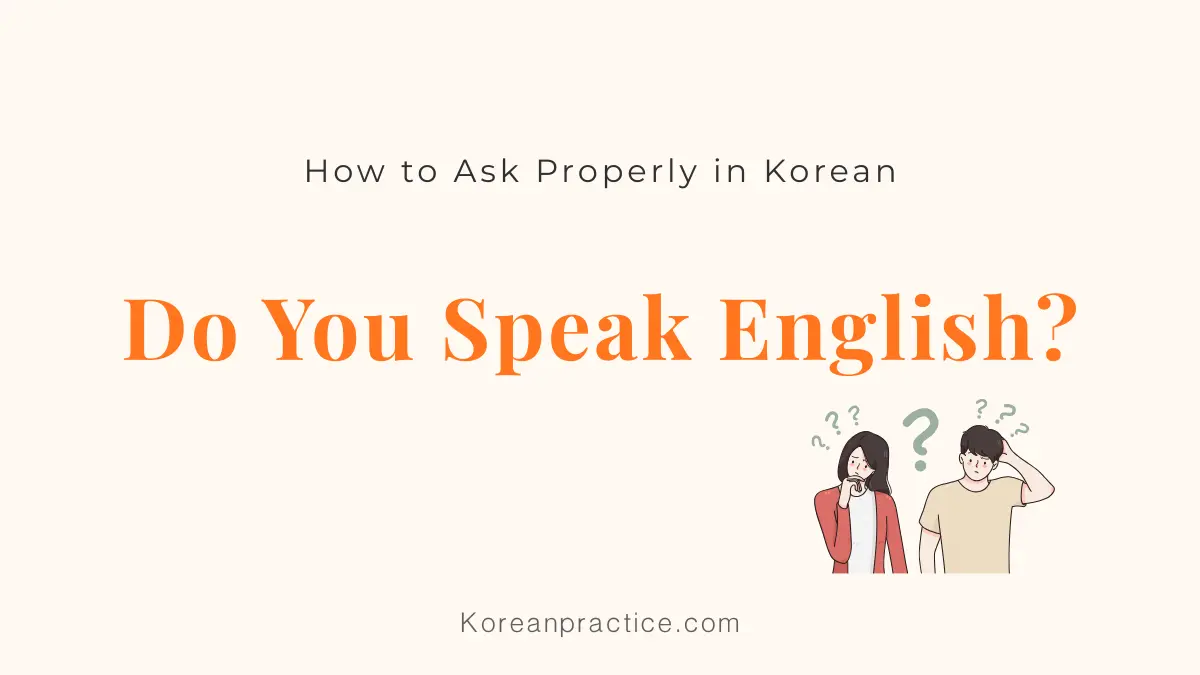
If you’re traveling to Korea, knowing how to ask “Do you speak English?” can be a lifesaver. While there are a few different ways to say it depending on who you are talking to, you can easily master the core pattern.
The standard and safest way to ask “Do you speak English” in Korean is 영어 할 줄 알아요? (yeongeo hal jul arayo?). Because Korean language uses different politeness levels, choosing the right version will help you get a much warmer response from locals.
👉 Check out this quick visual guide to master the core pattern of “Do you speak English” in Korean instantly!
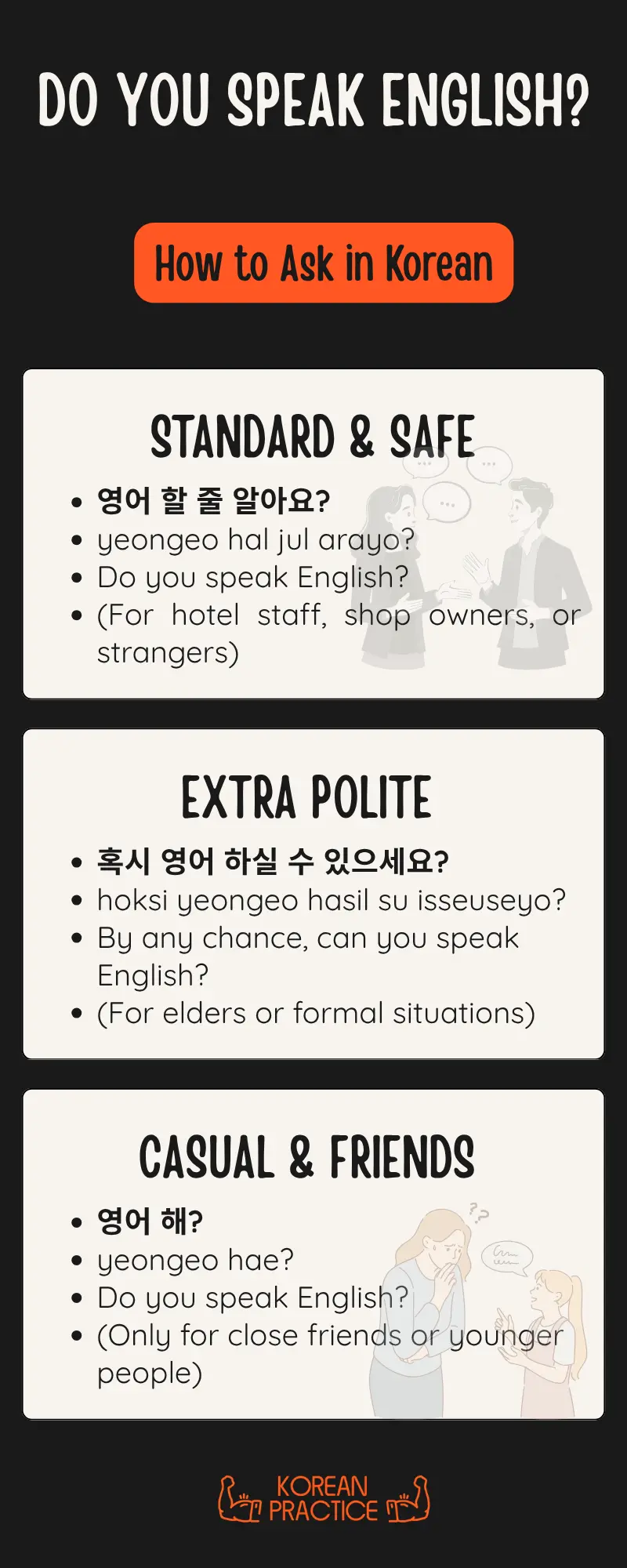
Table of Contents
Main Phrase: Do You Speak English in Korean
The most direct phrase is:
영어 할 줄 알아요?
(yeongeo hal jul arayo?)
= Do you speak English?
This phrase is polite and safe for most situations. If you say this with a smile, people will understand right away what you mean.
Original Korean Sentence
영어 할 줄 알아요?
Pronunciation Guide
영어 (yeong-eo) 할 (hal) 줄 (jul) 알아요 (a-ra-yo)?
Meaning and Context
영어 (English) 하 (to do) ㄹ 줄 알 (can) 아요 (I’m asking you polite and friendly)?
English Translation
Do you speak English?
Literal Translation
Can (you) do English?
👉 Did You Eat in Korean? Why This Greeting Means More Than Food
How to Say “Do You Speak English in Korean”
There’s more than one way to say this, depending on who you’re speaking to. Another common version is:
영어 해요?
(yeongeo haeyo?)
= Do you speak English?
This version is shorter and easier for beginners.
How to Ask “Do You Speak English in Korean” (Polite Approach)
When asking strangers, it’s best to soften your tone. Koreans often add the word 혹시 (by any chance):
혹시 영어 하실 수 있으세요?
(hoksi yeongeo hasil su isseuseyo?)
= By any chance, do you speak English?
This version shows extra politeness and sounds gentle.
Original Korean Sentence
저기요. 혹시 영어 하실 수 있으세요?
Pronunciation Guide
저기요 (jeo-gi-yo). 혹시 (hok-si). 영어 (yeong-eo) 하실 (ha-sil) 수 (su) 있으세요 (i-sseu-se-yo)?
Meaning and Context
저기요 (excuse me, polite way to call someone) 혹시 (by any chance) 영어 (English) 하 (to do) 시 (I show you respect) ㄹ 수 있 (can) 으세요 (I’m askjing you politely)?
English Translation
Excuse me. By any chance, can you speak English?
Literal Translation
Excuse me. By any chance, can (you) speak English?
👉 I See in Korean: 3 Real Phrases Koreans Use (Not Just ‘그렇구나’!)
“Excuse Me, Do You Speak English in Korean?”
Before asking a stranger, it’s polite to start with 실례합니다 (excuse me).
실례합니다. 영어 하세요?
(sillyehamnida. yeongeo haseyo?)
= Excuse me, do you speak English?
This feels respectful and is perfect for public places like stations or shops.
“Can You Speak English in Korean?”
Sometimes you want to ask if someone can speak English, not just if they usually do. For that, you can say:
영어 할 수 있어요?
(yeongeo hal su isseoyo?)
= Can you speak English?
This phrase is useful when you’re hoping the other person has some ability to help.
Original Korean Sentence
네, 조금 할 수 있어요.
Pronunciation Guide
네 (ne). 조금 (jo-geum). 할 (hal) 수 (su) 있어요 (i-sseo-yo).
Meaning and Context
네 (yes) 조금 (a little) 할 수 있어요 (can do, polite).
English Translation
Yes, I can speak a little.
Literal Translation
Yes, (I) can do a little.
👉 23 Empowering Directions in Korean! You’ll never be lost with me.
“Do You Know English in Korean?”
If you want to check whether someone knows English at all, you can ask:
영어 알아요?
(yeongeo arayo?)
= Do you know English?
This is simple and friendly, though it’s not as common as “영어 해요?”.
“Do You Understand English in Korean?”
Another helpful phrase is:
영어 이해해요?
(yeongeo ihae haeyo?)
= Do you understand English?
This is great if you’ve already spoken some English and want to check if they understood.
Do You Speak English in Korean (Informal Version)
If you’re talking to a friend or someone younger, you can use the informal form:
영어 해?
(yeongeo hae?)
= Do you speak English?
This is casual and should only be used with people you’re close to.
Do You Speak English in Korean (Formal Version)
For very respectful situations, such as speaking with elders or in an official setting, use:
영어 하십니까?
(yeongeo hasimnikka?)
= Do you speak English?
This version sounds professional and is suitable when you want to be extra polite.
Original Korean Sentence
죄송합니다. 영어 못 해요.
Pronunciation Guide
죄송합니다 (joe-song-ham-ni-da). 영어 (yeong-eo) 못 (mot) 해요 (hae-yo).
Meaning and Context
죄송합니다 (I’m sorry, formal) 영어 (English) 못 해요 (cannot do; polite ending).
English Translation
I’m sorry. I can’t speak English.
Literal Translation
I’m sorry. (I) can’t do English.
👉 38 Powerful Emotions in Korean
Comparing All Versions
Here’s a quick overview of how the level of speech changes:
| Level | Korean | Pronunciation | English Meaning |
|---|---|---|---|
| Informal | 영어 해? | yeongeo hae? | Do you speak English? |
| Polite | 영어 해요? | yeongeo haeyo? | Do you speak English? |
| Respectful | 영어 하실 수 있으세요? | yeongeo hasil su isseuseyo? | Do you speak English (politely)? |
| Formal | 영어 하십니까? | yeongeo hasimnikka? | Do you speak English (formal)? |
Why These Phrases Matter
In Korea, the level of politeness in your speech really matters. Using the right version of “Do you speak English in Korean” shows cultural awareness and helps you get a warmer response.
Use formal when showing high respect.
Use polite with strangers.
Use informal only with friends.
Extra Beginner Tips
If someone answers “네, 조금요” (Yes, a little), it usually means they can help a bit but not fluently.
If they say “아니요” (No), they probably don’t speak English at all.
Koreans often feel shy about their English skills, so even if they know some, they may hesitate.
Wrap-up Pop Quiz!
Let’s see if you mastered today’s lesson! Can you solve this quick puzzle? 🧩

FAQs (What You Might Still Wonder About)
1. What’s the difference between “영어 해요?” and “영어 할 수 있어요?”
Both mean “Do you speak English?”, but the nuance varies slightly. 영어 해요? focuses on whether they habitually use or speak English in daily life. On the other hand, 영어 할 수 있어요? focuses directly on their ability to speak it. Both are perfectly polite, but 영어 해요? sounds a bit softer and more natural to local ears.
2. Is it rude to use the casual form “영어 해?”
Yes, it can sound quite impolite if you say it to a stranger or an older person. In Korean culture, language levels reflect social boundaries. You should only use 영어 해? with close friends, language exchange partners of the same age, or people younger than you. For safety, always stick to polite forms with locals.
3. When should I use the formal version “영어 하십니까?”
This formal version is best suited for official, corporate, or military settings. You might hear it from hotel staff, flight attendants, or in business meetings. While you can use it with elders, in daily travel situations, the polite forms like 영어 할 줄 알아요? or 영어 하실 수 있으세요? sound much more natural and less stiff.
4. How can I ask without sounding too direct or abrupt?
The best trick is to soften your approach by adding a couple of polite “cushion words.” Start with 실례합니다 (sillyehamnida / Excuse me) and slide in 혹시 (hoksi / by any chance). Asking “실례합니다. 혹시 영어 하실 수 있으세요?” sounds incredibly respectful and gentle.
5. Can I just ask “영어 알아요?” (Do you know English?) instead?
Technically, yes, but it sounds a bit unnatural. 영어 알아요? literally asks if they know of the English language as a concept or subject. When you want to check if someone can actually converse with you, it is much better to stick to 영어 해요? or 영어 할 줄 알아요?.
Final words
Knowing how to ask “Do you speak English in Korean?” can be your best tool when traveling. From polite to informal to formal, each version has its place.
With phrases you learned in your pocket, you’ll feel more confident and ready to explore Korea. Don’t worry if your pronunciation isn’t perfect—Koreans will appreciate the effort!