Ever wondered why there are so many different Korean terms for family in your favorite K-dramas? In Korean culture, family words change completely depending on your gender, age, and who you are talking to.
Instead of getting lost in complicated hierarchy rules, check out our quick infographic below to master these essential family titles in just 3 seconds!
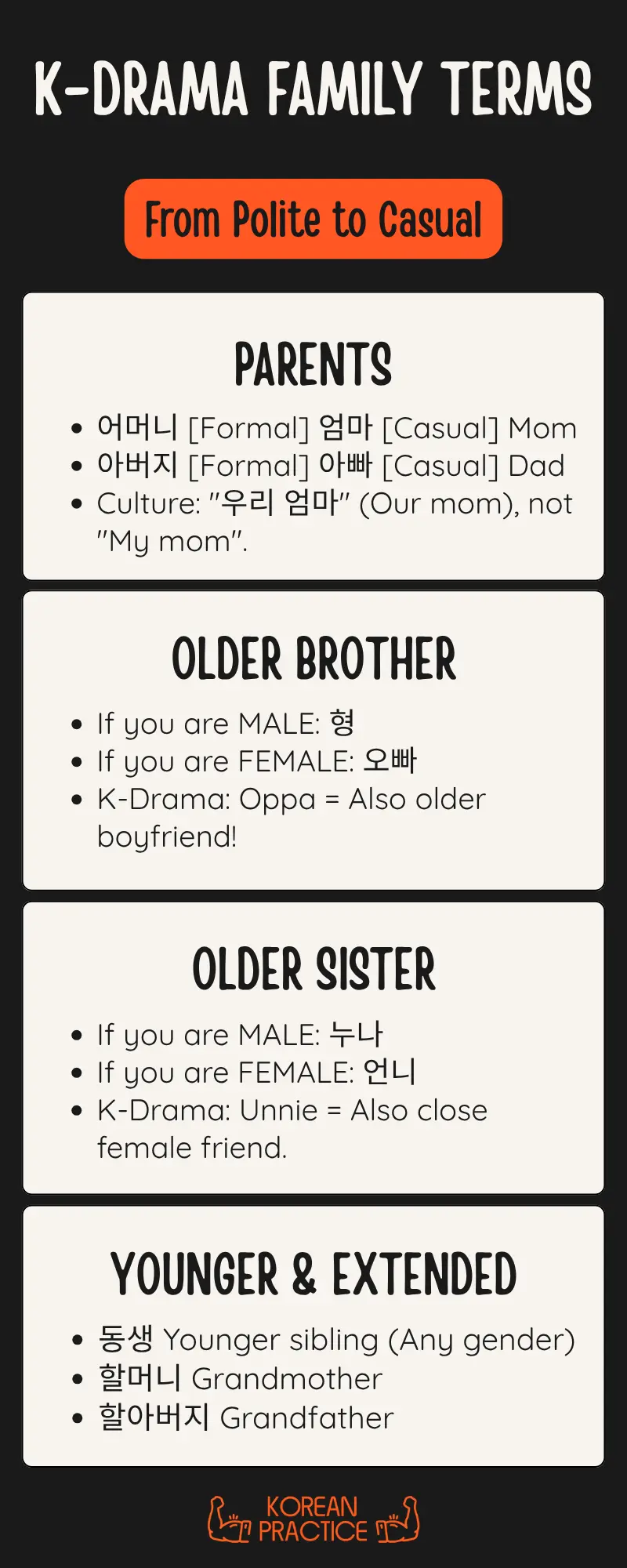
Table of Contents
1. Immediate Family – Korean Terms for Parents
어머니 (Eomeoni) & 엄마 (Eomma) – Korean Terms for Mom
When learning Korean terms for family, the words for mom are essential. The formal term is 어머니 (eomeoni), often used in respectful situations, while 엄마 (eomma) is the casual, affectionate term commonly used in daily life.
Original Korean Sentence
제 어머니는 지금 집에 없어요.
Pronunciation Guide
제 (je) 어머니는 (eo-meo-ni-neun) 지금 (ji-geum) 지베 (ji-be) 업써요 (eop-sseo-yo).
Meaning and Context
제 (my; in a humble way) 어머니 (mother) 는 (my topic is my mother) 지금 (now) 집 (home) 에 (at) 없 (to be not) 어요 (is; I’m telling you polite and friendly).
English Translation
My mother is not home right now.
Literal Translation
My mother is not at home now.
아버지 (Abeoji) & 아빠 (Appa) – Korean Terms for Dad
Just like the terms for mother, the words for dad are split by formality. 아버지 (abeoji) is the formal, respectful title used in serious settings, whereas 아빠 (appa) is the warm, informal term used with family members every day.
Original Korean Sentence
아빠하고 같이 공원에서 놀았어요.
Pronunciation Guide
아빠하고 (a-bba-ha-go) 가치 (ga-chi) 공워네서 (gong-wo-ne-seo) 노랏써요 (no-rat-sseo-yo).
Meaning and Context
아빠 (dad) 하고 (with) 같이 (together) 공원 (park) 에서 (at) 놀 (to play) 았 (past tense) 어요 (I’m telling you polite and friendly).
English Translation
I played at the park with my dad.
Literal Translation
(I) played at park together with dad.
2. Sibling Titles – How to Say Older Brother & Sister in Korean
형 (Hyeong) & 오빠 (Oppa) – Calling Your Older Brother
Just like the terms for parents, the words for an older brother are split by who is speaking. 형 (hyeong) is the respectful yet warm title used exclusively by males, whereas 오빠 (oppa) is the affectionate term used by females—which you will also frequently hear as a nickname for older boyfriends in K-dramas.
Original Korean Sentence
형이 나에게 장난감을 줬어.
Pronunciation Guide
형이 (hyeong-i) 나에게 (na-e-ge) 장난까믈 (jang-nan-gga-meul) 줫써 (jweot-sseo).
Meaning and Context
형 (older brother for a male) 이 (I am going to talk about my older brother) 나 (me) 에게 (to) 장난감 (toy) 을 (my object is a toy) 주 (to give) 었 (past tense) 어 (I’m telling you casually).
Pronunciation Patterns for Conjugations
⊳ 주 + 었 = 줬
When rapidly pronounced, ‘주’ and ‘었’ naturally combine to form ‘줬’.
English Translation
My older brother gave me a toy.
Literal Translation
(My) older brother gave toy to me.
Original Korean Sentence
우리 오빠는 멋있어.
Pronunciation Guide
우리 (u-ri) 오빠는 (o-bba-neun) 머싯써 (meo-sit-sseo).
Meaning and Context
우리 (we, our; but ‘my’; in an intimate way for human relationship) 오빠 (older brother for a female) 는 (my topic is my older brother) 멋있 (to be cool) 어 (is; I’m telling you casually).
English Translation
My older brother is cool.
누나 (Noona) & 언니 (Unnie) – Calling Your Older Sister
The exact same gender rule applies when you are calling an older sister. If you are a male, the correct and polite term to use is 누나 (noona), while a female speaking must use 언니 (unnie)—a versatile word that is also widely used between close female friends outside the family.
Original Korean Sentence
누나가 화장을 하고 있어요.
Pronunciation Guide
누나가 (noo-na-ga) 화장을 (hwa-jang-eul) 하고 (ha-go) 잇써요 (it-sseo-yo).
Meaning and Context
누나 (older sister for a male) 가 (my subject is my older sister) 화장 (makeup) 을 (my object is makeup) 하 (to do) 고 있 (~ing) 어요 (is; I’m telling you polite and friendly).
English Translation
My older sister is doing her makeup.
Literal Translation
(My) older sister is doing makeup.
Original Korean Sentence
어제 언니랑 싸웠어.
Pronunciation Guide
어제 (eo-je) 언니랑 (eon-ni-rang) 싸웟써 (ssa-wot-sseo).
Meaning and Context
어제 (yesterday) 언니 (older sister for a female) 랑 (with) 싸우 (to fight) 었 (past tense) 어 (I’m telling you casually).
Pronunciation Patterns for Conjugations
⊳ 우 + 었 = 웠
When rapidly pronounced, ‘우’ and ‘었’ naturally combine to form ‘웠’.
English Translation
I fought with my older sister yesterday.
Literal Translation
(I) fought with older sister yesterday.
동생 (Dongsaeng) – Korean Family Terms for Younger Siblings
Unlike older siblings, the word 동생 (dongsaeng) is a gender-neutral term used for anyone younger than you. To specify their gender, you simply attach a quick prefix: use 남동생 (nam-dongsaeng) for a younger brother, and 여동생 (yeo-dongsaeng) for a younger sister.
Original Korean Sentence
내 동생은 말썽꾸러기예요.
Pronunciation Guide
내 (nae) 동생은 (dong-saeng-eun) 말썽꾸러기예요 (mal-sseong-ggu-reo-gi-ye-yo).
Meaning and Context
내 (my) 동생 (younger sibling) 은 (my topic is my sibling) 말썽꾸러기 (troublemaker; is often used to describe children who misbehave) 예요 (is; I’m telling you polite and friendly).
English Translation
My sibling is a troublemaker.
Literal Translation
My younger sibling is troublemaker.
3. Children – Korean Words for Son and Daughter
아들 (Adeul) & 딸 (Ddal) – Expressing Parental Love
When parents talk about their children, they use 아들 (adeul) for a son and 딸 (ddal) for a daughter. To express deep affection and warmth, Korean parents almost always place the word 우리 (uri – our) right before these titles, saying “our son” or “our daughter.”
Original Korean Sentence
우리 아들은 초등학교, 삼학년이에요.
Pronunciation Guide
우리 (u-ri) 아드른 (a-deu-reun) 초등학꾜 (cho-deung-hak-ggyo), 삼학녀니에요 (sam-hak-nyeo-ni-e-yo).
Meaning and Context
우리 (we, our; but ‘my’; in an intimate way for human relationship) 아들 (son) 은 (my topic is my son) 초등학교 (elementary school), 삼학년 (third grade) 이에요 (is; I’m telling you polite and friendly).
English Translation
My son is in the third grade.
Literal Translation
My son is in third grade (of) elementary school.
Original Korean Sentence
내 남편은 딸을 정말 사랑해요.
Pronunciation Guide
내 (nae) 남펴는 (nam-pyeo-neun) 따를 (dda-reul) 정말 (jeong-mal) 사랑해요 (sa-rang-hae-yo).
Meaning and Context
내 (my) 남편 (husband) 은 (my topic is my husband) 딸 (daughter) 을 (my object is our daughter) 정말 (very much) 사랑하 (to love) 해요 (I’m telling you polite and friendly).
Pronunciation Patterns for Conjugations
⊳ 하 is changed to 해
English Translation
My husband loves our daughter very much.
Literal Translation
My husband love daughter very much.
Extended Korean Family Terms
✅ Maternal Grandmother: 외할머니 (oehalmeoni)
✅ Paternal Grandmother: 할머니 (halmeoni)
✅ Maternal Grandfather: 외할아버지 (oeharabeoji)
✅ Paternal Grandfather: 할아버지 (harabeoji)
✅ Maternal Aunt: 이모 (imo)
✅ Paternal Aunt: 고모 (gomo)
✅ Maternal Uncle: 외삼촌 (oesamchon)
✅ Paternal Uncle: 삼촌 (samchon)
And more Korean words for Family Members In-Laws and Spouses
✅ Mother-in-Law: 시어머니 (syeomeoni) for husband’s mother, 장모님 (jangmonim) for wife’s mother.
✅ Father-in-Law: 시아버지 (siabeoji) for husband’s father, 장인어른 (jangineoreun) for wife’s father.
✅ Spouse: 남편 (nampyeon) for husband, 아내 (anae) for wife.
Special Korean terms for family in Korean Culture
형 (Hyeong), 오빠 (Oppa), 누나 (Noona), 언니 (Unnie) – Speaking with Friends
In Korean culture, you don’t just use Korean terms for family with biological relatives. These four major sibling titles are widely used outside the family circle to show respect and build close camaraderie with older friends, seniors at school, or coworkers.
✅ 형 (Hyeong) / 누나 (Noona): Used by males to address older male and female friends.
✅ 오빠 (Oppa) / 언니 (Unnie): Used by Core females to address older male and female friends.
Honorifics and Politeness in Korean Family Terms
Hierarchy and respect for elders are foundational to Korean family vocabulary. To elevate a family title to a highly respectful honorific level, Koreans attach the suffix -님 (nim) to the end of the word. This is especially vital when addressing in-laws or elder family members in formal settings.
✅ 어머니 (Mother) ➔ 어머니님 / 어머님 (Eomovnim): Highly respectful form for mother (commonly used for mothers-in-law).
✅ 아버지 (Father) ➔ 아버지님 / 아버님 (Abeovnim): Highly respectful form for father (commonly used for fathers-in-law).
✅ 형 (Older Brother) ➔ 형님 (Hyeongnim): Adds formal respect, often used between brothers-in-law or senior male colleagues.
FAQs (What You Might Still Wonder About)
1. What is the difference between formal and casual Korean terms for family?
Korean hierarchy requires you to switch your language based on who you are speaking to. In formal settings, family gatherings, or when talking to elders, respectful terms like 어머니 (eomeoni) and 아버지 (abeoji) are essential. Among close friends or younger family members, casual terms like 엄마 (eomma) and 아빠 (appa) are perfectly acceptable.
2. Why do Koreans say “Uri” (Our) instead of “My” when talking about family?
In everyday life, you will rarely hear a Korean say “my dad” (내 아빠). Instead, they naturally use 우리 아빠 (uri appa – “our dad”) or 우리 엄마 (uri eomma – “our mom”). This collective cultural expression emphasizes community, closeness, and shared family bonds rather than individual ownership.
3. Can I use sibling titles like Hyeong, Oppa, Noona, and Unnie with non-family members?
Absolutely! These famous K-drama titles are widely adopted in modern Korean society to show respect and camaraderie among close friends, school seniors, and coworkers. For example, 형님 (hyeongnim) adds extra honor when a male addresses an older male friend or senior colleague.
4. How does family hierarchy affect how you address elders in Korea?
Respect for elders is deeply embedded in Korean family vocabulary. Elders must always be addressed using formal, polite titles that carry inherent respect, such as 할아버지 (harabeoji – grandfather) or 삼촌 (samchon – uncle). Younger members are culturally expected to show deference through these titles and polite verb endings ($아요/어요$).
5. What is the best way to master Korean family terms for beginners?
The ultimate trick is context. Start by hardwiring the immediate family vocabulary (parents and siblings) into your brain first. After that, watch K-dramas consistently to see how these titles live and breathe in real conversations. Pairing your watchlist with a structured language training system will turn these complex rules into a natural reflex.
Final words
Understanding Korean terms for family opens up a window to the heart of Korean culture, reflecting values of respect, hierarchy, and closeness.
These Korean family words are a foundation not only for language learners but for anyone wanting to appreciate the strong family bonds that shape Korean society.