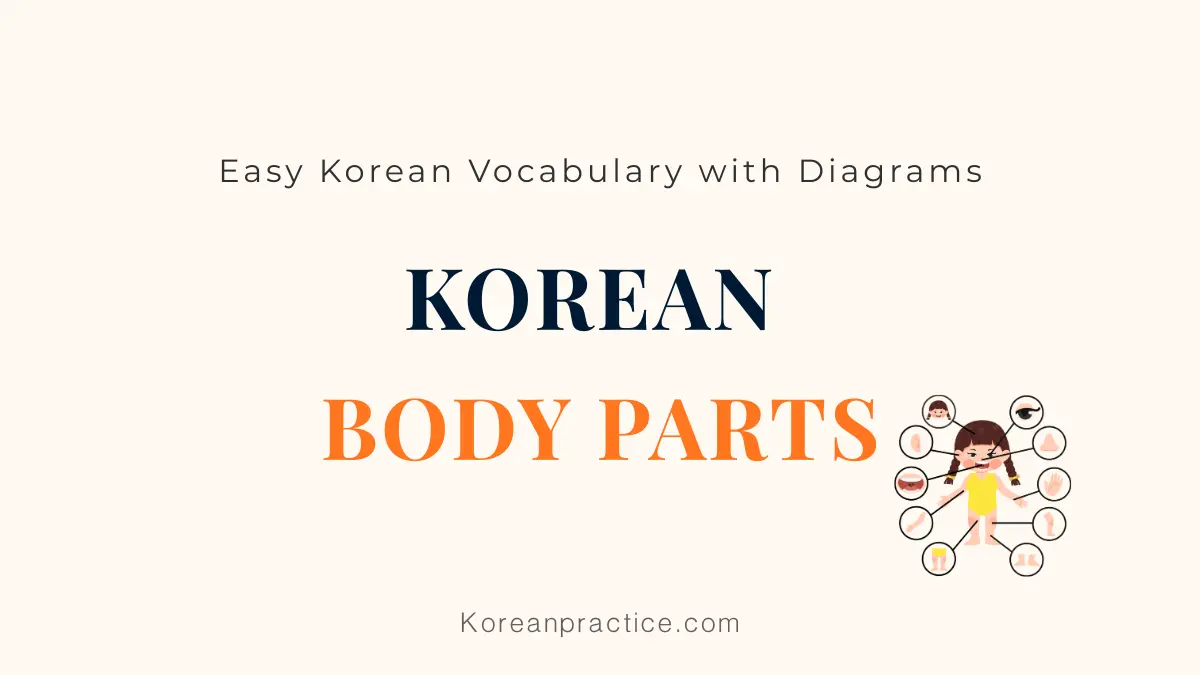
If you’re looking to learn body parts in Korean, here’s the quick answer — words like 머리 (meori) for head, 눈 (nun) for eye, 코 (ko) for nose, 입 (ip) for mouth, and 손 (son) for hand are among the most essential.
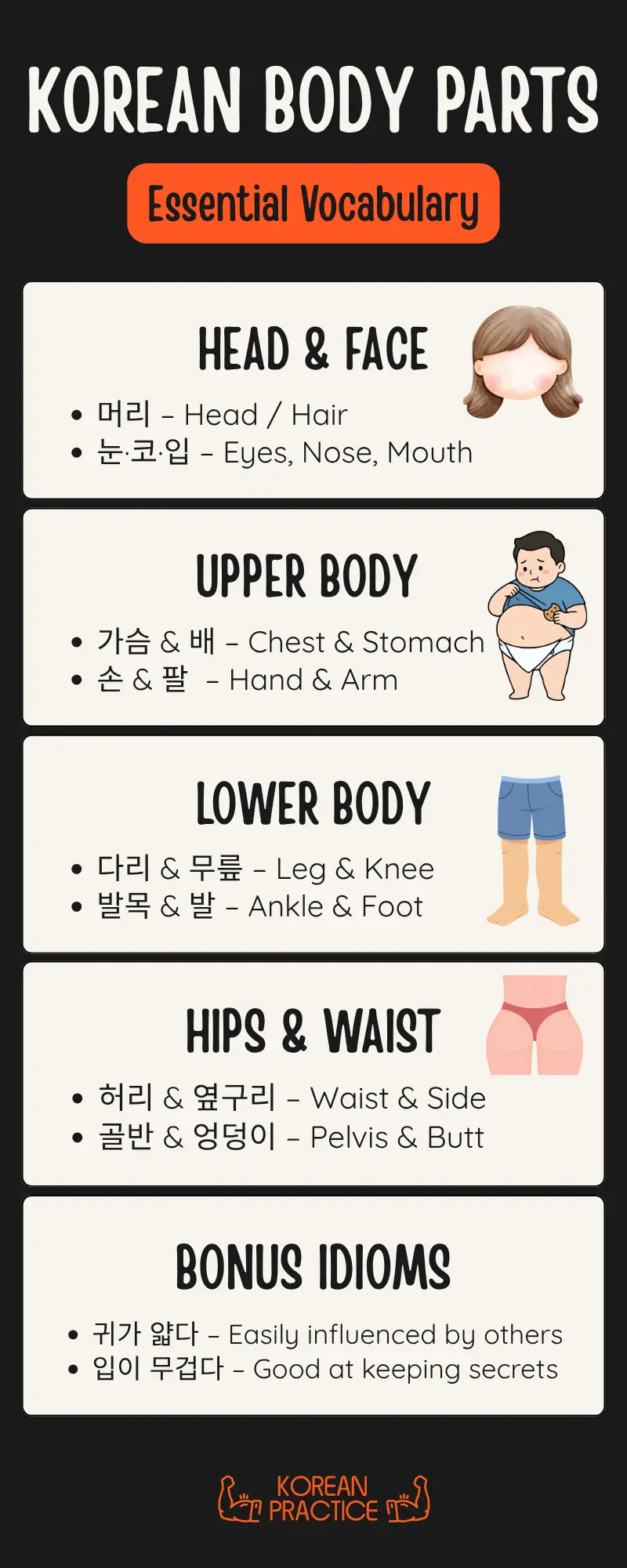
Understanding body parts in Korean helps you communicate naturally in daily life — whether you’re describing how you feel, visiting a doctor, or just chatting about appearances.
👉 Keep scrolling to explore a complete list of Korean body parts, with pronunciation, meanings, and useful examples to help you remember them easily!
Table of Contents
Parts of the Body in Korean Language
Learning the vocabulary related to body parts in Korean is an essential aspect of mastering the language.
Understanding these parts of the body in Korean language not only facilitates effective communication but also enhances comprehension in various everyday contexts.
Body parts vocabulary is crucial in daily conversations where individuals often reference physical attributes or health-related topics.
For instance, if someone expresses discomfort, knowing the word for “head” (머리, meori) or “stomach” (배, bae) allows listeners to respond appropriately.
In this guide, I will delve into the topic of list of body parts in Korean language and provide you with a comprehensive understanding of how to refer to different parts of the human anatomy.
Head
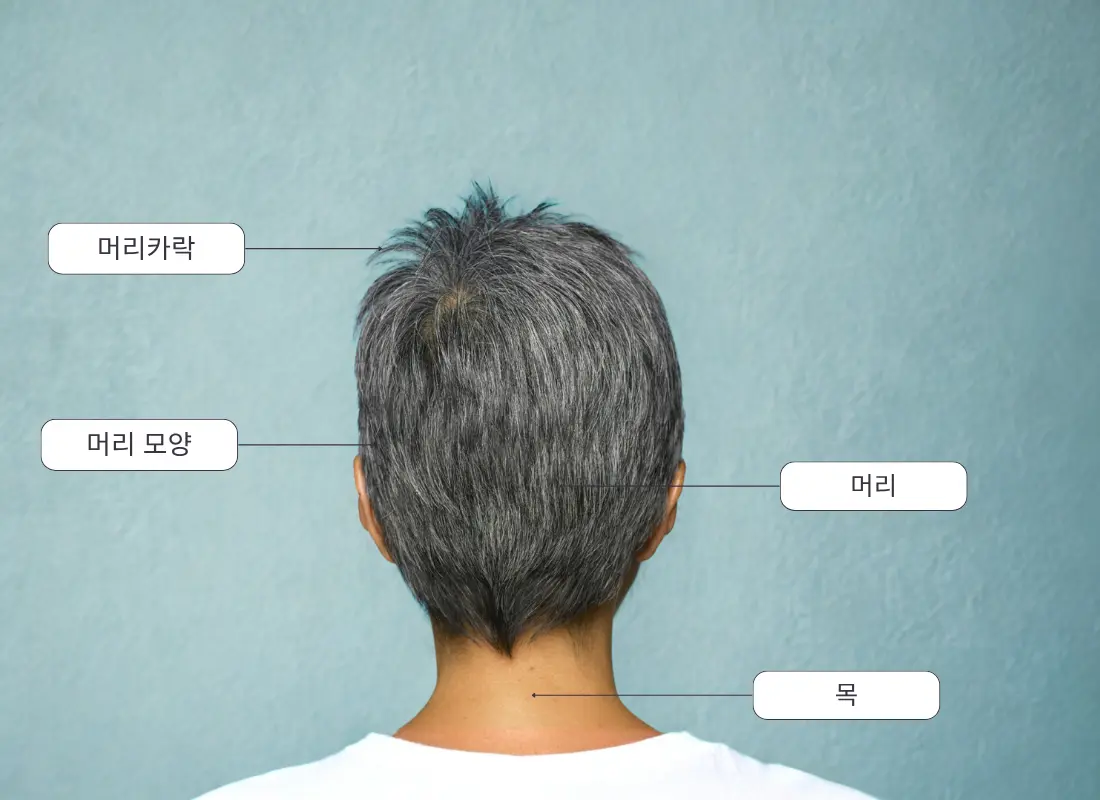
Take a look at some of the essential vocabulary you need to know to refer to various body parts in Korean.
Let’s start with the head, which are some of the most important body parts to learn. Here are some common Korean words for different parts of the head:
✅ 머리 (meo-ri) – head, hair
✅ 머리카락 (meo-ri-ka-rak) – hair (strands)
✅ 머리 모양 (meo-ri mo-yang) – hairstyle
✅ 목 (mok) – neck
Original Korean Sentence
저는 샴푸와 린스로 머리를 감아요.
Pronunciation Guide
저는 (jeo-neun) 샴푸와 (syam-pu-wa) 린스로 (rin-seu-ro) 머리를 (meo-ri-reul) 감아요 (ga-ma-yo).
Meaning and Context
저 (I; in a humble way) 는 (I’m going to talk about me) 샴푸 (shampoo) 와 (and) 린스 (conditioner) 로 (with) 머리 (hair) 를 (my object is hair) 감 (to wash (hair; stem of 감다)) 아요 (I’m telling you polite and friendly).
English Translation
I wash my hair with shampoo and conditioner.
Literal Translation
I wash hair with shampoo and conditioner.
✍️ Related: Younger Sister in Korean: 4 Real Examples (+ 1 Mistake Everyone Makes!)
Face
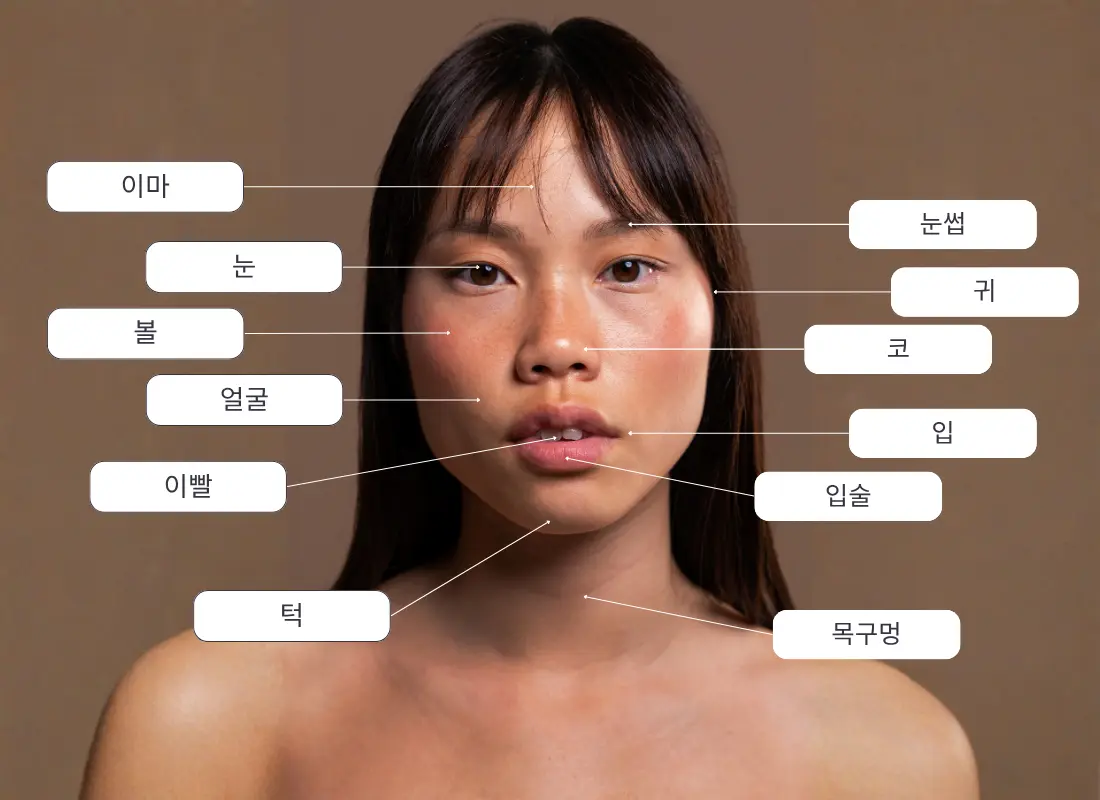
The human face is a canvas of expression, and in Korean culture, understanding its features is essential. Words like “눈” (eye), “코” (nose), and “입” (mouth) are fundamental when discussing the parts of the body in Korean language.
✅ 얼굴 (eol-gul) – face
✅ 눈 (nun) – eye
✅ 코 (ko) – nose
✅ 입 (ip) – mouth
✅ 귀 (gwi) – ear
✅ 이마 (i-ma) – forehead
✅ 볼 (bol) – cheek
✅ 턱 (teok) – chin
✅ 눈썹 (nun-sseop) – eyebrow
✅ 눈꺼풀 (nun-kkeo-pul) – eyelid
✅ 입술 (ip-sul) – lips
✅ 이빨 (i-bbal) – teeth
Original Korean Sentence
내 친구는 얼굴이 예쁘고 키가 커요.
Pronunciation Guide
내 (nae) 친구는 (chin-gu-neun) 얼굴이 (eol-gu-ri) 예쁘고 (ye-bbeu-go) 키가 (ki-ga) 커요 (keo-yo).
Meaning and Context
내 (my) 친구 (friend) 는 (as for) 얼굴 (face) 이 (my subject is face) 예쁘 (to be pretty) 고 (and) 키 (height) 가 (my subject is height) 크 (to be big) 어요 (is; I’m telling you polite and friendly).
English Translation
My friend has a pretty face and is tall.
Literal Translation
As for my friend, face is pretty and height is big.
✍️ Related: 먹다 Meaning in English with 10 Examples
Upper Body
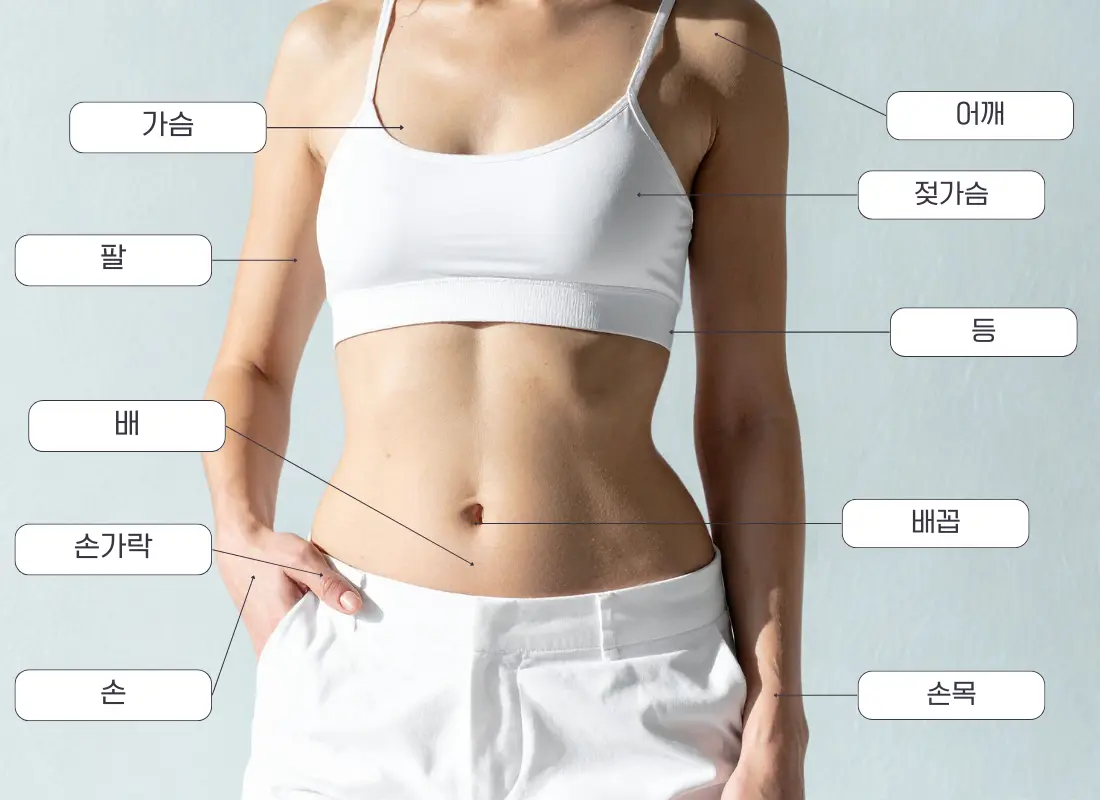
Moving down to the upper body, here are some Korean words for body parts in Korean:
✅ 가슴 (ga-seum) – chest
✅ 젖가슴 (jeot-ga-seum) – breast
✅ 팔 (pal) – arm
✅ 어깨 (eo-kkae) – shoulder
✅ 손목 (son-mok) – wrist
✅ 손 (son) – hand
✅ 손가락 (son-ga-rak) – finger
✅ 배 (bae) – stomach
✅ 등 (deung) – back
✅ 배꼽 (bae-ggop) – belly button
Original Korean Sentence
배가 너무 나와서 고민이에요.
Pronunciation Guide
배가 (bae-ga) 너무 (neo-mu) 나와서 (na-wa-seo) 고미니에요 (go-mi-ni-e-yo).
Meaning and Context
배 (stomach) 가 (my subject is my stomach) 너무 (too much) 나오 (to stick out) 아서 (because) 고민 (worry) 이에요 (am; I’m telling you polite and friendly).
English Translation
I’m worried because my stomach sticks out too much.
Literal Translation
(I)’m worried because my stomach sticks out too much.
✍️ Related: Korean Terms for Family You Already Know from K-Dramas (But Don’t Fully Understand
Lower Body
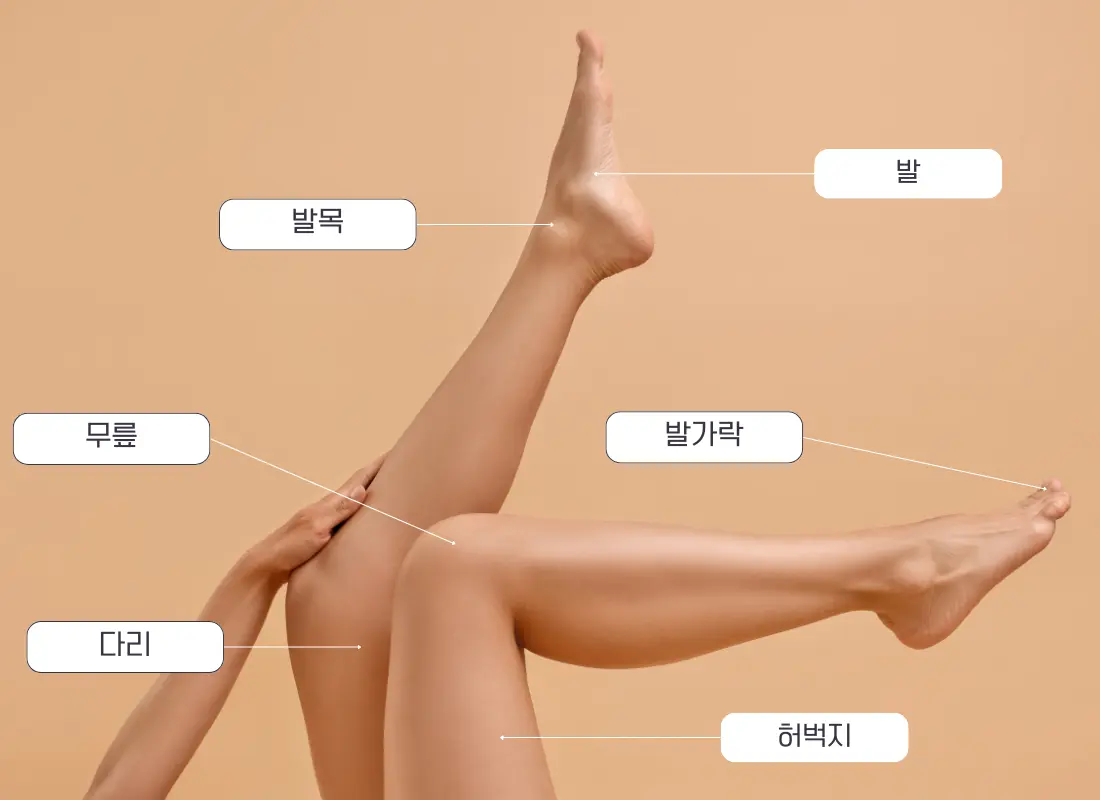
Finally, let’s take a look at some different Korean vocabulary parts of the body:
✅ 다리 (da-ri) – leg
✅ 무릎 (mu-reup) – knee
✅ 발목 (bal-mok) – ankle
✅ 발 (bal) – foot
✅ 발가락 (bal-ga-rak) – toe
✅ 허벅지 (heo-beok-ji) – thighs
Original Korean Sentence
저는 매일 아침에 조깅을 하고 다리 운동을 해요.
Pronunciation Guide
저는 (jeo-neun) 매일 (mae-il) 아침에 (a-chi-me) 조깅을 (jo-ging-eul) 하고 (ha-go) 다리 (da-ri) 운동을 (un-dong-eul) 해요 (hae-yo).
Meaning and Context
저 (I; in a humble way) 는 (I’m going to talk about me) 매일 (everyday) 아침 (morning) 에 (in) 조깅 (jogging) 을 (my object is jogging) 하 (to do) 고 (and) 다리 (leg) 운동 (exercises) 을 (my object is exercises) 하 (to do) 해요 (I’m telling you polite and friendly).
English Translation
I jog every morning and do leg exercises.
Literal Translation
I do jogging in everyday morning and do leg exercises.
✍️ Related: 15 Cute Korean Words K-pop Fans Use All the Time (And You Should Too!)
Hips and Buttocks
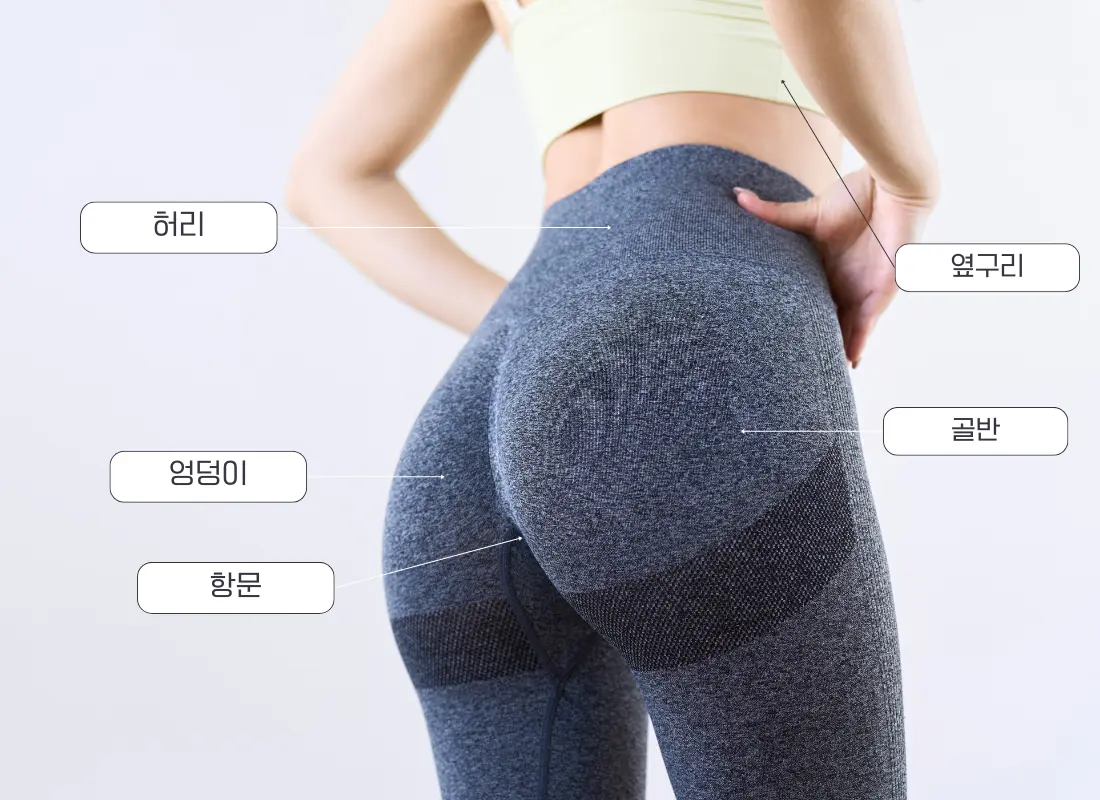
When studying body parts in Korean, the hip and buttock area often gets overlooked, yet these terms are important for comprehensive vocabulary learning.
✅ 엉덩이 (eong-deongi) – buttocks/bottom
✅ 궁둥이 (gung-dungi) – buttocks (informal/dialect)
✅ 항문 (hangmun) – anus
✅ 골반 (golban) – pelvis
✅ 허리 (heori) – waist/lower back/hip area
✅ 옆구리 (yeopguri) – side of waist
Wrap-up Pop Quiz!
Let’s see if you mastered today’s lesson! Can you solve this quick puzzle? 🧩

FAQs (What You Might Still Wonder About)
1. Which body parts in Korean are most confusing for learners?
Many learners confuse 머리 (meori), which means head or hair, and 머리카락 (meorikarak), which specifically means hair strands. Similarly, 발 (bal) means foot, while 다리 (dari) means leg. Remembering that “다리” covers the whole leg and “발” is only the foot helps you avoid mix-ups.
2. What are some common Korean idioms that use body parts?
Korean expressions often include body parts, like 귀가 얇다 (to have thin ears) meaning “to be easily influenced,” or 입이 무겁다 (to have a heavy mouth) meaning “to keep secrets well.” Learning these idioms makes your Korean sound much more natural.
3. Do certain body parts have special cultural meanings in Korean?
Yes. For example, 얼굴 (face) is often linked to social reputation and beauty, while 손 (hand) symbolizes skill or generosity. Complimenting someone’s 눈 (eyes) or 피부 (skin) is also a polite and common way to express admiration in Korean culture.
4. How can I describe body movements in Korean using body parts?
To describe actions, combine body part nouns with verbs: 머리를 흔들어요 (I shake my head), 손을 들어요 (I raise my hand), or 다리를 꼬아요 (I cross my legs). This pattern — [body part + object marker + verb] — is one of the most useful structures to practice.
5. Are there gender differences in body parts vocabulary in Korean?
Most body parts in Korean are gender-neutral, but a few have gender-specific forms. For instance, 가슴 (gaseum) means chest for both men and women, yet 젖가슴 (jeotgaseum) refers only to a woman’s breasts, while 남자가슴 (namjagaseum) can clarify it’s a man’s chest.
6. How can I talk about private or sensitive body parts politely in Korean?
Koreans often use neutral or indirect terms to stay polite. For example, instead of directly saying butt, people might say 엉덩이 (eongdeongi) in a casual context or 하체 (hache) — meaning lower body — in a formal or medical setting. Choosing softer expressions shows cultural awareness and respect.
Final words
Knowing the names for body parts in Korean can be extremely helpful for communication, especially in a medical or fitness setting. It’s important to learn the correct terms so that you can accurately describe any injuries or physical concerns.
In addition, understanding the proper vocabulary for body parts in Korean can also help you better understand and appreciate the culture and language.
Whether you’re a native speaker or a language learner, taking the time to learn these terms is a valuable investment in your understanding of the Korean language.