When you are talking to a native speaker, you want to ask things smoothly. But for many beginners, trying to figure out how to ask questions in Korean in real-time feels like a trap. You know the words, but your brain freezes.
The secret to breaking this freeze is simple: stop thinking about grammar rules and focus on basic Korean sentence endings. In fact, about 90% of daily Korean questions can be answered using just four essential patterns.
Table of Contents
4 Magic Question Skeletons You Need
Here are the 4 fundamental structures to master, along with 40 practical Korean question sentences examples you can start using today:
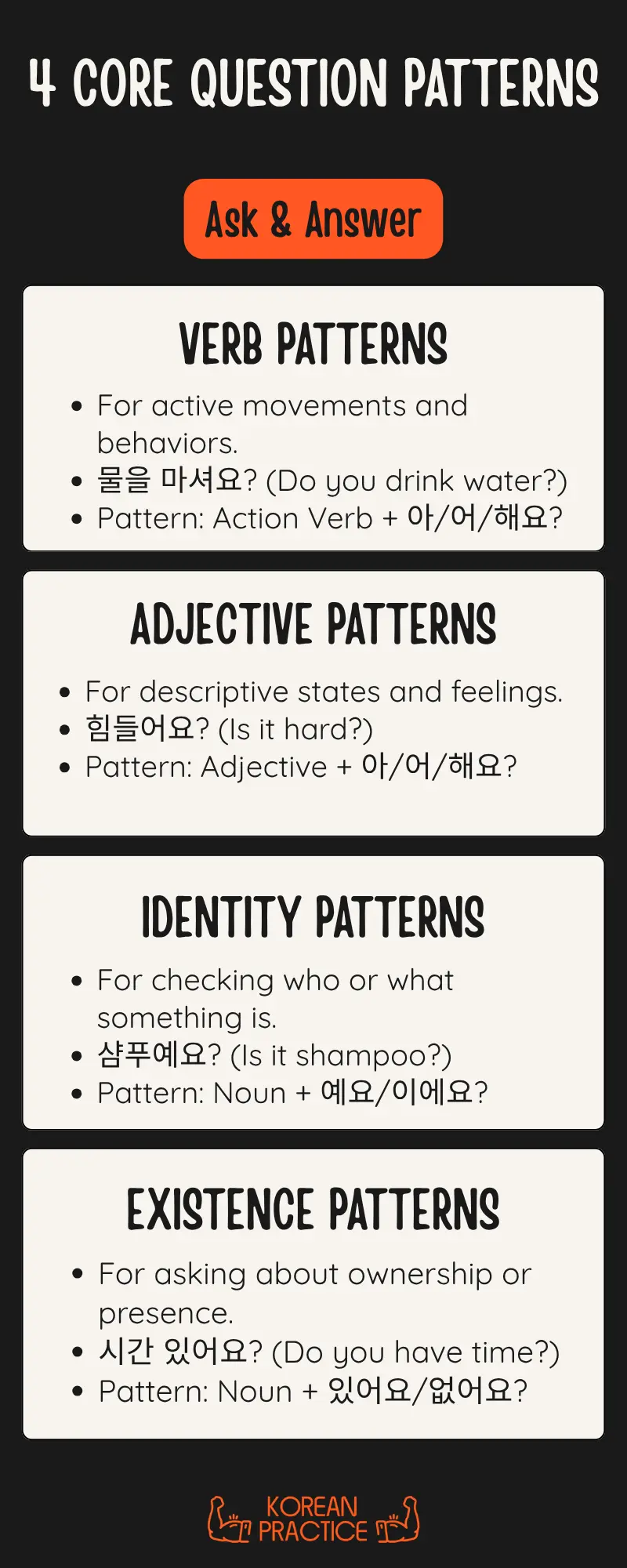
Verb Patterns (Actions & Behaviors)
Used to ask about what someone does, focusing on active movements and habits.
Note: The English translations below focus on the literal present tense to help you master the core pattern, though they can also mean “Are you doing…” in real conversations.
✅ 물을 마셔요? (Do you drink water?)
✅ 숙제를 해요? (Do you do your homework?)
✅ 김밥을 사요? (Do you buy Gimbap?)
✅ 책을 읽어요? (Do you read a book?)
✅ 자전거를 타요? (Do you ride a bicycle?)
✅ 운동을 해요? (Do you exercise?)
✅ 그림을 그려요? (Do you draw a picture?)
✅ 청소를 해요? (Do you clean?)
✅ 한국어를 배워요? (Do you learn Korean?)
✅ 옷을 입어요? (Do you wear clothes?)
Adjective Patterns (States & Feelings)
Used to ask about how something is, how it tastes, or how someone feels.
✅ 힘들어요? (Is it hard?)
✅ 뜨거워요? (Is it hot?)
✅ 아파요? (Does it hurt? / Are you sick?)
✅ 바빠요? (Are you busy?)
✅ 귀여워요? (Is it cute?)
✅ 나빠요? (Is it bad?)
✅ 어두워요? (Is it dark?)
✅ 맛있어요? (Is it delicious?)
✅ 좋아요? (Is it good?)
✅ 재미있어요? (Is it fun?)
Noun + Identity Patterns (Who & What)
Used to ask about the identity of an object, location, or person using 예요/이에요.
✅ 힘들어요? (Is it hard?)
✅ 샴푸예요? (Is it shampoo?)
✅ 공항이에요? (Is it the airport?)
✅ 노트북이에요? (Is it a laptop?)
✅ 장갑이에요? (Are they gloves?)
✅ 학생증이에요? (Is it a student ID?)
✅ 커피예요? (Is it coffee?)
✅ 한국 사람이에요? (Are you Korean?)
✅ 제 가방이에요? (Is it my bag?)
✅ 비밀이에요? (Is it a secret?)
✅ 선물이에요? (Is it a gift?)
Existence & Possession Patterns (Is there & Have)
Used to ask if something or someone exists nearby, or if someone owns a specific item using 있어요/없어요.
Note: Korean uses the exact same pattern 있어요/없어요 for both having something (Have) and checking if something exists (Is there).
✅ 시간 있어요? (Do you have time?)
✅ 통장 없어요? (Don’t you have a bankbook?)
✅ 현금 있어요? (Do you have cash?)
✅ 학생증 있어요? (Do you have a student ID?)
✅ 친구 있어요? (Do you have friends?)
✅ 계획 있어요? (Do you have a plan?)
✅ 민수 씨 있어요? (Is Minsu here?)
✅ 이유 있어요? (Is there a reason?)
✅ 걱정 없어요? (Don’t you have any worries?)
✅ 가방 있어요? (Do you have a bag?)
Instead of memorizing dozens of textbook rules, you just need to see these clear structures and drill them until they become automatic.
Build Your Korean Speaking Muscle Memory
If you are tired of pausing to translate English structure into Korean structure, you need to build Korean speaking muscle memory. You need to learn Korean without translating.
Are you ready to move your mouth faster than your internal translator? In our Pattern Shadowing Course, we take these 4 core structures and mix them up in our ultimate drilling simulator. No long lectures. Just pure muscle rewiring.
Train your brain to react instantly. 🔥 [Enroll in the Pattern Shadowing Course Now]
FAQs (What You Might Still Wonder About)
1. How do I know whether to choose between 어요 and 해요 when asking a question?
It all depends on the dictionary form of the verb or adjective. If the word ends in 하다, it naturally changes to 해요? in conversation. For other words, you drop 다 and attach 아요 or 어요 based on the last vowel. Instead of memorizing this as a dry rule, practicing with real Korean question sentences examples is the fastest way to get used to the sound.
2. What is the easiest way to learn Korean without translating every sentence in my head?
The key is to move away from text-based grammar studies and focus on raw vocal repetition. When you repeat a specific structure dozens of times out loud, your mouth takes over before your English brain can intervene. This training shifts the language from your analytical memory to your physical memory.
3. Is the intonation different when I use basic Korean sentence endings as a question?
Yes, and it is actually much easier than English! In Korean, the word order for a statement and a question can be exactly the same. To turn a statement into a question, you simply raise the pitch of your voice at the very end of the sentence, just like you do in English when you are surprised.
4. Why does my brain freeze even though I know how to ask questions in Korean?
Brain freeze happens because you are trying to build sentences using English logic (Subject-Verb-Object) and then rearranging them into Korean logic (Subject-Object-Verb). Your brain gets overloaded by the mental math. To fix this, you need to turn the Korean word order into an instant reflex rather than a puzzle to solve.
5. How can I build Korean speaking muscle memory effectively at home?
You can achieve this through targeted shadowing drills. Listen to a short, native audio clip of a sentence pattern and mimic the sound immediately—almost like an echo. By doing this for 10 to 15 minutes every day, your vocal muscles adapt to the rhythm and flow of Korean naturally.
6. Can I use these four magic question skeletons with anyone I meet?
Yes! The 요 ending used in these four patterns represents the polite, standard spoken form (해요체). It is perfectly safe and respectful to use with strangers, colleagues, or people older than you. Mastering this single level of politeness is the most practical shortcut to holding real-world daily conversations.
Final words
Mastering how to ask questions in Korean is not about memorizing thick grammar textbooks. It is about converting those structures into an instant vocal reflex.
If you are ready to build genuine Korean speaking muscle memory and finally learn Korean without translating every single sentence in your head, you need a different approach. You need targeted drilling.
Our Pattern Shadowing Course skips the long, boring lectures and gets straight to the point. We take the essential core skeletons and drill them into your mouth until they become natural neural pathways.
Stop fighting the word order loop. Start drilling today and watch your speech flow seamlessly.
🔥 [Enroll in the Pattern Shadowing Course Now]