Learning Korean is an exciting journey, but irregular Korean verbs can feel overwhelming at first. Unlike regular verbs, these change their stems in certain situations, creating exceptions to the rules you’ve memorized.
The good news? These irregularities follow predictable patterns. Once you understand them, Korean verb conjugation becomes much more intuitive.
Many students ask, “how many irregular verbs in Korean do I need to learn?” While there are many, mastering the most common ones is the secret to sounding like a native.
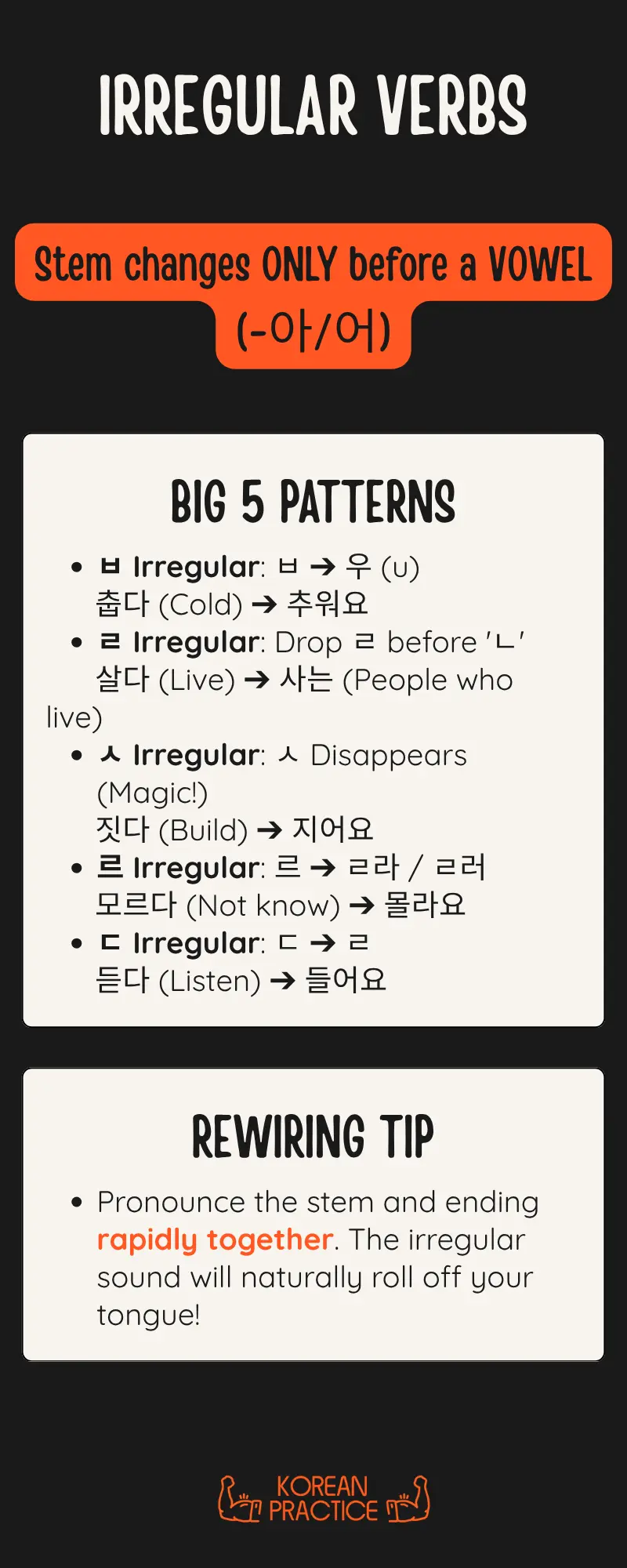
Table of Contents
Why Irregular Verbs Matter
You must learn the irregular Korean verbs list because it includes the most common words we use every day, such as:
듣다 (to listen)
춥다 (to be cold)
아름답다 (to be beautiful)
Without knowing these, you might make grammatical errors that make it hard for others to understand you. Let’s break down the 5 most common types.
1. ㅂ (Bieup) Irregular Verbs
This is a very common pattern. When a verb ending in ㅂ meets a vowel, the ㅂ usually changes to 우 (u).
춥다 (to be cold) → 추워요
덥다 (to be hot) → 더워요

Original Korean Sentence
날씨가 너무 추워요.
Pronunciation Guide
날씨가 (nal-ssi-ga) 너무 (neo-mu) 추워요 (chu-wo-yo).
Meaning and Context
날씨 (weather) 가 (subject marker) 너무 (too much) 춥 (to be cold) * 어요 (is; I’m telling you polite and friendly).”
Pronunciation Patterns for Conjugations
⊳ 춥 + 어요 = 추워요. The ㅂ changes to 우 when followed by a vowel.
⊳ But I teach it this way: 춥 + 어요 = 추워요. Rapidly pronouncing ‘춥’ and ‘어’ results in ‘추워’.
English Translation
The weather is very cold.
Literal Translation
Weather is too cold.
7 Ways to Say “And in Korean”: Complete Guide for Beginners

2. ㄹ (Rieul) Irregular Verbs
In Korean verb conjugation, verbs ending with ㄹ often drop this final consonant when they meet certain endings like -는.
알다 (to know) → 아는
살다 (to live) → 사는
Original Korean Sentence
서울에 사는 사람들은 바빠요.
Pronunciation Guide
서우레 (seo-u-re) 사는 (sa-neun) 사람드른 (sa-ram-deu-reun) 바빠요 (ba-ppa-yo).
Meaning and Context
서울 (Seoul) 에 (in) 살 (to live) * 는 (present participle) 사람 (person) 들 (plural) 은 (topic marker) 바쁘 (to be busy) * 어요 (are; I’m telling you polite and friendly).”
Pronunciation Patterns for Conjugations
⊳ 살 + 는 = 사는. The ㄹ is dropped when followed by 는.
⊳ But I teach it this way: 살 + 는 = 사는. Rapidly pronouncing ‘살’ and ‘는’ results in ‘사는’ to make it easier.
Grammar
* 는: people (who) live
English Translation
People who live in Seoul are busy.
Where in Korean: 9 Essential Expressions Every Beginner Must Know
3. ㅅ (Siot) Irregular Verbs
For these verbs, the ㅅ disappears when followed by a vowel. It’s like magic!
낫다 (to recover) → 나아요
짓다 (to build) → 지어요
Original Korean Sentence
그 사람이 집을 지어요.
Pronunciation Guide
그 (geu) 사라미 (sa-ra-mi) 지블 (ji-beul) 지어요 (ji-eo-yo).
Meaning and Context
그 (that) 사람 (person) 이 (I’m going to talk about hime) 집 (house) 을 (my object is a house) 짓 (to build) * 어요 (I’m telling you polite and friendly).
Pronunciation Patterns for Conjugations
⊳ 짓 + 어요 = 지어요. The ㅅ disappears when followed by a vowel.
⊳ But I teach it this way: 짓 + 어요 = 지어요. Rapidly pronouncing ‘짓’ and ‘어’ results in ‘지어’ to make it easier.
Grammar
* 이/가: Subject marker used with a noun. “이” is used after words ending in a consonant, and “가” is used after words ending in a vowel.
English Translation
He is building a house.
Literal Translation
That person build house.
7 Must-Know Ways to Say “Because in Korean” + Easy Examples
4. 르 (Reu) Irregular Verbs
These verbs are unique. The 르 changes into ㄹ라 or ㄹ러 depending on the vowel.
모르다 (to not know) → 몰라요
부르다 (to sing/call) → 불러요
Original Korean Sentence
제가 노래를 불러요.
Pronunciation Guide
제가 (je-ga) 노래를 (no-rae-reul) 불러요 (bul-leo-yo).
Meaning and Context
제 (I) 가 (I am going to talk about what I should do) 노래 (song) 를 (object marker) 부르 (to sing) * 어요 (am; I’m telling you polite and friendly).
Pronunciation Patterns for Conjugations
⊳ 부르 + 어요 = 불러요. The 르 changes to ㄹ러 when followed by a vowel.
⊳ But I teach it this way: 부르 + 어요 = 불러요. Rapidly pronouncing ‘부르’ and ‘어’ results in ‘불러’ to make it easier.
English Translation
I am singing a song.
Literal Translation
I sing song.
Korean Honorifics Made Simple: Why ‘시’ Is the Key to Respectful Korean
5. ㄷ (Digeut) Irregular Verbs
In this pattern, the final ㄷ changes to ㄹ when it meets a vowel. This is very common in listening and walking!
듣다 (to listen) → 들어요
걷다 (to walk) → 걸어요
Original Korean Sentence
저는 라디오를 들어요.
Pronunciation Guide
저는 (jeo-neun) 라디오를 (ra-di-o-reul) 드러요 (deu-reo-yo).
Meaning and Context
저 (I) 는 (as for me) 라디오 (radio) 를 (object marker) 듣 (to listen) * 어요 (I’m telling you polite and friendly).
Pronunciation Patterns for Conjugations
⊳ 듣 + 어요 = 들어요. The ㄷ changes to ㄹ when followed by a vowel.
⊳ But I teach it this way: 듣 + 어요 = 들어요. Rapidly pronouncing ‘듣어’ and ‘어’ results in ‘들어’ to make it easier.
English Translation
I listen to the radio.
Literal Translation
I listen radio.
Why You’re Still Struggling With Korean Grammar (And How to Fix It)
Common Mistakes to Avoid
When practicing Korean irregular verbs conjugation, be careful:
Don’t overgeneralize: Not every verb ending in ㅂ or ㄷ is irregular (e.g., 닫다 – to close is regular).
Practice slowly: Try my method—pronounce the stem and the ending quickly together, and the irregular sound will often come out naturally!

FAQs (What You Might Still Wonder About)
1. Are there any verbs that look irregular but are actually regular?
Yes! This is one of the trickiest parts of Korean verb conjugation. For example, in the ㄷ irregular group, 듣다 (to listen) is irregular (들어요), but 닫다 (to close) is regular (닫아요). You should learn these “look-alike” regular verbs along with your irregular Korean verbs list to avoid confusion.
2. Why do some ㅂ verbs stay regular?
Most ㅂ verbs like 춥다 (cold) are irregular, but a few common ones like 입다 (to wear), 잡다 (to catch), and 뽑다 (to pick) are regular. They stay as 입어요, 잡아요, 뽑아요. Understanding these exceptions is key to mastering how many irregular verbs in Korean you truly need to use daily.
3. Is there a “gold rule” to memorize all these patterns?
The best way is to focus on vowel harmony. Most irregular Korean verbs change their shape when they meet an ending that starts with a vowel (like -아/어/여요). If the ending starts with a consonant (like -고, -지만), the verb usually stays in its original form!
4. What is the hardest irregular pattern for beginners?
Many students find the 르 (reu) irregular and 으 (eu) irregular most challenging because they involve changing or dropping vowels. For example, 쓰다 (to write) becomes 써요 because the ‘으’ is dropped. Practicing these through Korean irregular verbs conjugation charts can really help visual learners.
5. Do irregular patterns change in the past tense?
Yes, but the rule stays the same! Once you know the present tense conjugation (e.g., 춥다 → 추워요), the past tense follows that same irregular stem: 추웠어요. Irregularity usually happens at the “neck” of the verb where the stem and the first vowel ending meet.
6. How many irregular verbs in Korean do I actually need for basic conversation?
There are hundreds, but don’t panic! You only need to master about 20 to 30 highly common verbs (like to walk, to listen, to be hot/cold, to not know) to handle 90% of daily conversations. Focus on the most used words first.
7. Can I predict if a new verb is irregular just by looking at it?
Unfortunately, no. You can’t tell just by the “look” of the dictionary form. However, as you get used to Korean verb conjugation, you will develop an “ear” for it. If a conjugation sounds “clunky” or hard to pronounce, there’s a good chance it’s an irregular form meant to make the language flow more smoothly!
Final words
Mastering irregular Korean verbs takes time and exposure. Even native speakers learned these through habit, not just charts.
By using an irregular Korean verbs list in your daily practice, you will soon conjugate them without even thinking.
Which irregular pattern do you find the hardest? Let me know, and keep practicing!