Searching for the right Korean reading material for beginners can feel like an endless cycle of opening and closing dictionaries. You want to practice, but most resources are either too simple (like alphabet drills) or discouragingly complex (like news articles).
You may have already explored bilingual stories or simple children’s books to improve your skills. These are good starts, but to truly master the language, you need graded reading materials designed specifically to help you understand the natural flow of Korean.
In this guide, we’ll explore why stories are the ultimate tool for fluency and how to choose the right materials for your level.
At KoPra (Korean Practice), we believe that reading should be a bridge to communication, not a barrier.
Table of Contents
Common Types of Korean Reading Material for Beginners
When you first start looking for practice texts, you might encounter these popular options:
Korean Children’s Books (e.g., Pororo, Pinkfong): These are great for basic vocabulary and simple sentence structures.
Traditional Folktales (전래 동화): Excellent for cultural context, though some vocabulary can be a bit dated for daily use.
Bilingual Graded Readers: Designed for learners, these books often provide a side-by-side translation.
While these are fantastic resources, many self-learners still feel “stuck.” Why? Because there is still a massive gap between recognizing words and truly understanding the flow of the language.
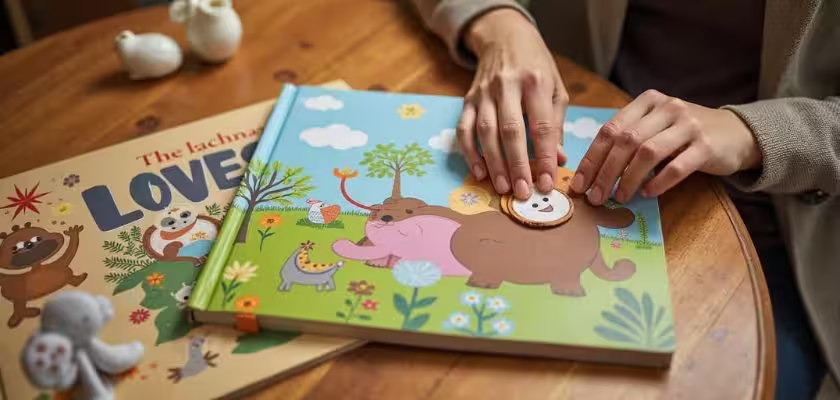
Why Most Korean Reading Materials Fail Beginners
Many learners assume that any Korean story book in Hangul will help them learn. However, standard books often lack the pedagogical structure needed for a non-native speaker.
Common frustrations include:
The Vocabulary Gap: Too many unknown words in a single paragraph.
Grammar Confusion: Seeing complex sentence endings without any explanation.
Natural Sound: Not knowing how the words should actually sound in conversation.
Introducing Enchanting Korean Short Stories in English: Flower Friends
This is why interactive Korean stories for reading practice are becoming the preferred choice for self-learners. They don’t just give you text; they give you a system.
The Power of Graded Reading for Fluency
If you’ve wondered how to improve Korean reading fluency with stories, the secret lies in “Comprehensible Input.” This means reading material that is just one small step above your current level.
Instead of struggling with a full novel, successful learners use interactive Korean courses that break down stories into bite-sized, manageable pieces. This approach allows you to:
Recognize sentence patterns instantly.
Build “reading stamina” without getting burned out.
Connect sounds to letters through integrated audio.
Korean Shopping Phrases through Korean Story
Experience a Smarter Way to Read (Full Story Breakdown)
To show you how an effective Korean graded reader works, let’s look at a snippet from my ‘Jungle Wildlife’ series.
While I’ve shared a brief look at this story in my course overview, today I’m providing the full 7-sentence breakdown. This is designed to show you exactly how my Story Style Breakdown™ turns a simple story into a deep learning experience.

🚀 Quick Learning
Original Korean Sentence
사자가 코끼리를 잡아요.
Pronunciation Guide
사자가 (sa-ja-ga) 코끼리를 (ko-ggi-ri-reul) 자바요 (ja-ba-yo).
English Translation
The lion catches the elephant.
Literal Translation
Lion catch elephant.
Quick Reference
사자가 (lion) 코끼리를 (elephant) 잡아요 (catch).
🔍 Deep Learning
Meaning and Context
사자 (lion)
→ The lion — the one taking action now in the story.
가 (subject marker)
→ Points out that the lion is doing the action.
코끼리 (elephant)
→ The one the action is done to.
를 (object marker)
→ Shows that the elephant is the object being caught.
잡 (to catch, grab, take)
→ The action — the lion catches or grabs the elephant.
아요 (polite ending)
→ I’m telling you this in a polite and friendly way.
Real-Life Usage
잡아요 is common when talking about catching or holding something.
Pattern Practice
1. 사자가 토끼를 잡아요.
2. 고양이가 쥐를 잡아요.
3. 아이가 공을 잡아요.
4. 강아지가 공을 잡았어요.
🚀 Quick Learning
Original Korean Sentence
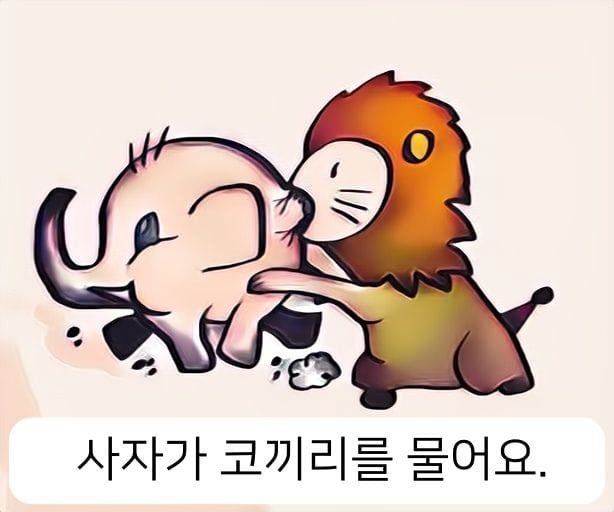
사자가 코끼리를 물어요.
Pronunciation Guide
사자가 (sa-ja-ga) 코끼리를 (ko-ggi-ri-reul) 무러요 (mu-reo-yo).
English Translation
The lion bites the elephant.
Literal Translation
Lion bite elephant.
Quick Reference
사자가 (lion) 코끼리를 (elephant) 물어요 (bite).
🔍 Deep Learning
Meaning and Context
사자 (lion)
→ The lion — now it takes a stronger action in the story.
가 (subject marker)
→ Points out that the lion is doing this action.
코끼리 (elephant)
→ The one being acted on — our elephant friend.
를 (object marker)
→ Shows that the elephant is the object of the action.
물 (to bite)
→ The action — the lion is biting the elephant.
어요 (polite ending)
→ I’m telling you politely and gently.
Pattern Practice
1. 아기가 사과를 물어요.
2. 강아지가 내 손을 물어요.
3. 고양이가 장난감을 물어요.
4. 새가 열매를 물어요.
🚀 Quick Learning
Original Korean Sentence
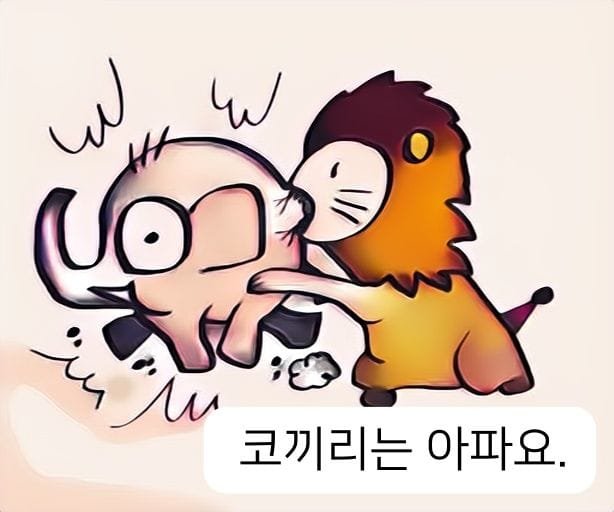
코끼리는 아파요.
Pronunciation Guide
코끼리는 (ko-ggi-ri-neun) 아파요 (a-pa-yo).
English Translation
The elephant is in pain.
Literal Translation
Elephant is painful.
Quick Reference
코끼리는 (elephant) 아파요 (is painful).
🔍 Deep Learning
Meaning and Context
코끼리 (elephant)
→ Our elephant — now feeling the result of the lion’s action.
는 (topic marker)
→ Highlights the elephant as the topic of this sentence.
아프 (to be painful / hurt)
→ Describes how the elephant feels now.
아요 (polite ending; is)
→ I’m telling you polite and friendly.
Pronunciation Flow Tip
⊳ 아프 + 아요 = 아파요: When rapidly pronounced, ‘프’ and ‘아’ naturally combine to form ‘파’, not 아프아요.
Real-Life Usage
아파요 can describe both physical pain and emotional hurt. You might hear it often if someone is unwell
Grammar
The ending 아요 doesn’t mean “is” on its own — it isn’t the same as is in English. But because it works together with the verb like a be verb (helping express a state in the present), I wrote it as is to make it easier to understand.
Pattern Practice
1. 아이가 아파요.
2. 할아버지가 아파요.
3. 마음이 아파요.
4. 다리가 아파요.
🚀 Quick Learning
Original Korean Sentence
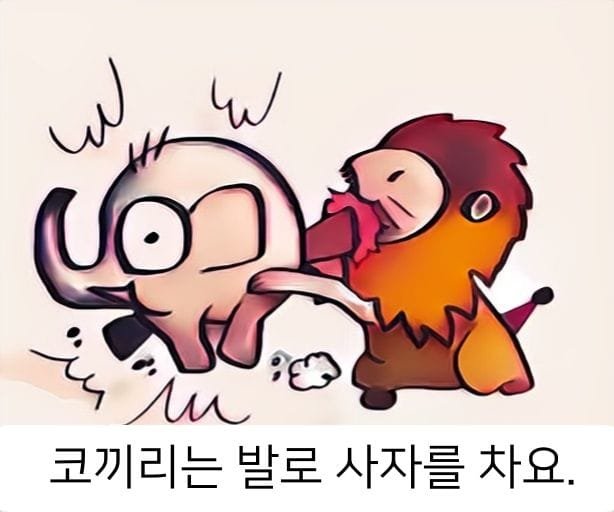
코끼리는 발로 사자를 차요.
Pronunciation Guide
코끼리는 (ko-ggi-ri-neun) 발로 (bal-ro) 사자를 (sa-ja-reul) 차요 (cha-yo).
English Translation
The elephant kicks the lion with its foot.
Literal Translation
Elephant kick lion with foot.
Quick Reference
코끼리는 (elephant) 발로 (wit its foot) 사자를 (lion) 차요 (kick).
🔍 Deep Learning
Meaning and Context
코끼리 (elephant)
→ The elephant, now fighting back.
는 (topic marker)
→ I’m focusing on the elephant’s action.
발 (foot)
로 (with)
→ Shows the means — the foot is what’s doing the kicking.
사자 (lion)
→ The lion is the target of the kick.
를 (object marker)
→ Marks the lion as the object of the action.
차 (to kick)
→ The action the elephant is doing.
아요 (polite ending)
→ I’m telling you this polite and friendly.
Pronunciation Flow Tip
⊳ 차 + 아요 = 차요: When rapidly pronounced, ‘차’ and ‘아’ naturally combine to form ‘차’, not 차아요.
Pattern Practice
1. 아이는 공을 발로 차요.
2. 강아지가 문을 발로 차요.
3. 오빠는 쓰레기통을 발로 차요.
4. 내 친구가 돌을 발로 차요.
How My Story Course is Different
Whether you’re tired of searching for the perfect textbook or struggling with stories that feel too advanced, my approach offers a unique advantage.
Unlike a static book, this is an immersive learning experience designed to keep you engaged from start to finish. Each lesson includes:
Vibrant Visuals for Every Sentence: Every part of the story is paired with an illustration, helping you visualize the action and anchor the new vocabulary in your memory instantly.
Full Audio Support: High-quality recordings accompany every sentence, allowing you to shadow a native speaker and perfect your pronunciation.
Deep Grammar Insights: We go beyond simple translation. We explain the “why” behind the sentence structure, giving you the tools to build your own Korean sentences.
Unbeatable Engagement: No more dry grammar drills. These are stories that keep you curious, making you want to keep reading to find out what happens next.
If you want to see exactly how this curriculum is structured and how it can transform your learning journey, [check out my full Story Course overview here].
You’ll see how I’ve combined these interactive stories into a complete system for beginners.
FAQs (What You Might Still Wonder About)
1. How much Hangul do I need to know before using these materials?
While our interactive Korean stories include pronunciation guides, knowing the basics of the Korean alphabet will help you progress much faster. If you can recognize the letters, these stories will serve as the perfect reading practice to improve your speed and accuracy.
2. Can I really improve my speaking just by reading stories?
Yes, if you use the “Shadowing” method. By listening to the native audio recordings and repeating each sentence aloud, you develop muscle memory. This turns a simple reading exercise into a powerful speaking drill that improves your intonation and rhythm.
3. Why do you emphasize “Story Style Breakdown™” instead of just giving translations?
A simple translation only tells you what a sentence means, but it doesn’t teach you how to build one. Our breakdown explains the Korean word order and particle usage, which is the “missing link” for most beginners moving from single words to full sentences.
4. I’m an adult learner. Won’t children’s stories feel too childish?
It’s a common concern! That’s why we focus on graded reading for adults. While the sentences are simple enough for beginners, the themes and the way we analyze the language are designed for mature learners who want to understand the logic behind the language.
5. How many times should I review one story?
Repetition is key to fluency. We recommend going through a story at least three times: first for general meaning, second for detailed grammar analysis, and third for shadowing the audio until you can say the sentences without looking at the text.
6. Do I need any expensive software to access these interactive stories?
Not at all. You can access all the learning materials and audio through your web browser on any device. Whether you are on your phone during a commute or on a laptop at home, you can continue your Korean reading journey anytime, anywhere.
7. Is this material suitable for Korean proficiency tests like the TOPIK?
Absolutely. While these stories are engaging and fun, they are built on essential Korean grammar and high-frequency vocabulary found in the TOPIK I (Beginner) level. Reading in context helps you remember word usage and sentence patterns much better than memorizing dry vocabulary lists for an exam.
Final words
Reading should be a bridge to communication, not a barrier. By choosing the right Korean reading material for beginners, you can transform your study time from a chore into an enjoyable habit.
Are you ready to move beyond the dictionary and start reading real Korean stories?