Quick Answer: What is the Secret of Korean Adjectives?
The easiest way to spot a Korean adjective is its dictionary form, which almost all end with -다 (-da) (e.g., 예쁘다, 크다, 작다).
⚠️ The Golden Rule: You don’t use this “-다” form when describing a noun or speaking politely. You must drop “-다” and conjugate it! (Exception: Native speakers only use “-다” when muttering to themselves like “날씨 좋다!”).
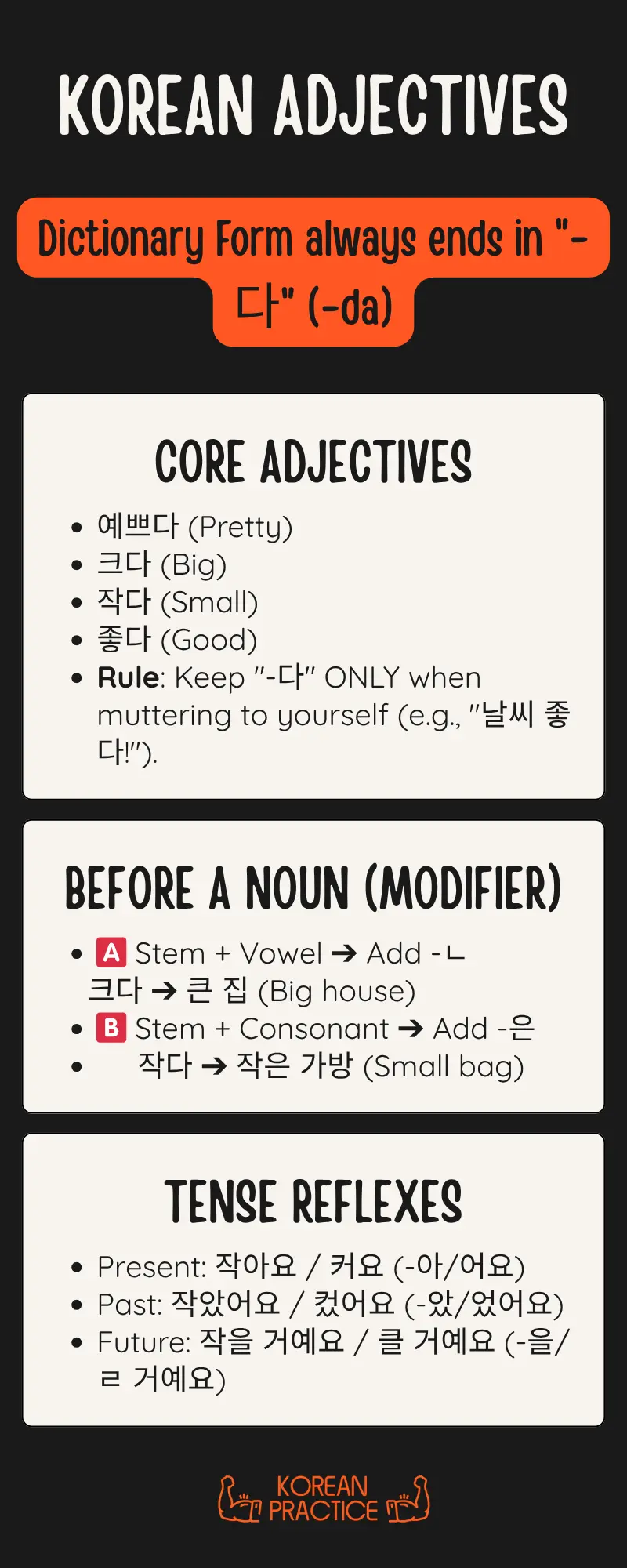
Table of Contents
Understanding the Basics of Korean Adjectives
If you’re starting to learn Korean, describing things is a fundamental part of mastering the language. While Korean grammar can seem daunting at first, the basic structure of Korean adjectives is actually quite straightforward.
Let’s look at some essential Korean adjectives:
✅ 예쁘다 (ye-ppeu-da): pretty, beautiful
✅ 크다 (keu-da): big, large
✅ 작다 (jak-da): small
✅ 좋다 (jo-ta): good
✅ 나쁘다 (na-ppeu-da): bad
✅ 맛있다 (ma-sit-ta): delicious
✅ 비싸다 (bi-ssa-da): expensive
See the pattern? Every single one ends in -다!
Why Do They End in ‘-다’ (-da)?
The ‘-다’ ending indicates the declarative form. It’s how adjectives are listed in the dictionary and how you’ll see them when a sentence simply states a raw fact. It signifies that the word possesses that specific quality.
From Dictionary to Real Speech
Important Note: You usually don’t use this ‘-다’ ending when you’re actively using the adjective within a sentence. In real conversation, the -다 will be dropped and the stem will be modified based on the level of politeness and the tense.
Types of Korean Adjectives
Korean adjectives can be classified into two primary categories: descriptive adjectives and an adjective form of verbs called stative verbs.
✅ Descriptive Adjectives: Directly express a quality (e.g., 예쁘다 – to be pretty).
✅ Stative Verbs: Function like adjectives to describe a state of being (e.g., 좋다 – to be good).
Let’s look at how these work in simple sentences through our Original Story Style Breakdown™:
Original Korean Sentence
꽃이 예쁘다.
Pronunciation Guide
꼬치 (ggo-chi) 예쁘다 (ye-bbeu-da).
Meaning and Context
꽃 (flower) 이 (I’m going to talk about the flowers) 예쁘 (to be pretty/beautiful) 다 (are; I’m expressing my opinion).
Grammar
* 이/가: Subject marker used with a noun. “이” is used after words ending in a consonant, and “가” is used after words ending in a vowel.
English Translation
The flowers are pretty.
Literal Translation
Flowers are pretty.
In contrast, stative verbs, such as “좋다” (jota), meaning “to be good,” can function similarly to Korean adjectives when used in a context that describes a state of being.
Original Korean Sentence
날씨가 좋다.
Pronunciation Guide
날씨가 (nal-ssi-ga) 조타 (jo-ta).
Meaning and Context
날씨 (weather) 가 (subject particle; used with words ending in vowels) 좋 (to be good) 다 (is; I’m expressing my opinion).
English Translation
The weather is good.
Literal Translation
Weather is good.
Korean Adjectives Before Nouns
In English, adjectives stay the same (e.g., “big” stays “big” in “big house”). However, in Korean, when you want to use an adjective directly before a noun, you must drop the -다 and attach a modifier ending based on the adjective stem:
Stem ends in a Vowel: Add -ㄴ to the bottom.
✅ 크다 (to be big) ➔ 큰 집 (big house)
✅ 예쁘다 (to be pretty) ➔ 예쁜 꽃 (pretty flower)
Stem ends in a Consonant: Add -은.
✅ 작다 (to be small) ➔ 작은 가방 (small bag)
Conjugating Common Korean Adjectives
Korean adjectives function like verbs—they must be conjugated based on tense and politeness level. Instead of scrolling through long explanations, use this Quick Comparison Table to master the three core tenses:
| Base Form | Meaning | Present Tense (-아/어요) | Past Tense (-았/었어요) | Future Tense (-을/ㄹ 거예요) |
| 작다 (Consonant) | To be small | 작아요 | 작았어요 | 작을 거예요 |
| 크다 (Vowel) | To be big | 커요 (크+어) | 컸어요 (크+었) | 클 거예요 (크+ㄹ) |
1. Present Tense (현재형)
In present tense, Korean adjectives don’t need an extra verb like “to be.” Instead, you drop -다 and add -아/어/여요 depending on the vowel in the stem.
Original Korean Sentence
가방이 작아요.
Pronunciation Guide
가방이 (ga-bang-i) 자가요 (ja-ga-yo).
Meaning and Context
가방 (bag) 이 (I’m going to talk about the bag) 작 (to be small) 아요 (is; I’m telling you polite and friendly).
Grammar
* 이/가: Subject marker used with a noun. “이” is used after words ending in a consonant, and “가” is used after words ending in a vowel.
English Translation
The bag is small.
Literal Translation
Bag is small.
Original Korean Sentence
이 집은 커요.
Pronunciation Guide
이 (i) 지븐 (ji-beun) 커요 (keo-yo).
Meaning and Context
이 (this) 집 (house) 은 (my new topic is this house) 크 (to be big) 어요 (is; I’m telling you polite and friendly).
Pronunciation Patterns for Conjugations
⊳ 크 + 어 = 커
When rapidly pronounced, ‘크’ and ‘어’ naturally combine to form ‘커’.
Grammar
* 은/는: topic marker used with a noun. ‘은’ is used after words ending in a consonant, and ‘는’ is used after words ending in a vowel.
English Translation
This house is big.
2. Past Tense (과거형)
To form the past tense, take the present tense stem and add -ㅆ어요/-ㅆ아요, or 었어요/았어요.
Original Korean Sentence
가방이 작았어요.
Pronunciation Guide
가방이 (ga-bang-i) 자갓써요 (ja-gat-sseo-yo).
Meaning and Context
가방 (bag) 이 (subject marker) 작 (to be small) 았 (past tense) 어요 (is; I’m telling you polite and friendly).
English Translation
The bag was small.
Literal Translation
Bag was small.
Original Korean Sentence
그 집이 컸어요.
Pronunciation Guide
그 (geu) 지비 (ji-bi) 컷써요 (keot-sseo-yo).
Meaning and Context
그 (that) 집 (house) 이 (subject marker) 크 (to be big) 었 (past tense) 어요 (is; I’m telling you polite and friendly).
Pronunciation Patterns for Conjugations
⊳ 크 + 었 = 컸
When rapidly pronounced, ‘크’ and ‘었’ naturally combine to form ‘컸’.
English Translation
That house was big.
3. Future Tense (미래형)
To form the future tense, take the stem and add -ㄹ/을 거예요. If the stem ends in a vowel, add -ㄹ 거예요. If the stem ends in a consonant, add -을 거예요.
Original Korean Sentence
가방이 작을 거예요.
Pronunciation Guide
가방이 (ga-bang-i) 자글 (ja-geul) 꺼예요 (ggeo-ye-yo).
Meaning and Context
가방 (bag) 이 (subject marker) 작 (to be small) 을 거예요 (will; I’m telling you polite and friendly).
English Translation
The bag will be small.
Literal Translation
Bag will be small.
Original Korean Sentence
이 집은 클 거예요.
Pronunciation Guide
이 (i) 지븐 (ji-beun) 클 (keul) 꺼예요 (ggeo-ye-yo).
Meaning and Context
이 (this) 집 (house) 은 (topic marker) 크 (to be big) ㄹ 거예요 (will; I’m telling you polite and friendly).
Pronunciation Patterns for Conjugations
⊳ 크 + ㄹ = 클
When rapidly pronounced, ‘크’ and ‘ㄹ’ naturally combine to form ‘클’.
English Translation
This house will be big.

FAQs (What You Might Still Wonder About)
1. What are the most common Korean adjectives beginners should learn first?
If you’re just starting out, focus on common Korean adjectives like 예쁘다 (pretty), 크다 (big), 작다 (small), and 맛있다 (delicious). These words appear constantly in daily conversation and help you describe almost anything.
2. How many basic Korean adjectives do I need to know to sound natural?
You don’t need hundreds! Even 20–30 basic Korean adjectives will help you sound much more natural. They’re super versatile and easy to conjugate once you understand the pattern.
3. Is there a simple Korean adjectives list I can memorize quickly?
Yes! A short Korean adjectives list like 좋다 (good), 나쁘다 (bad), 비싸다 (expensive), 싸다 (cheap), and 재미있다 (fun) is a great starting point. Once you master these, you can expand your vocabulary step by step.
4. Why do Korean adjectives act like verbs instead of staying the same like in English?
In Korean, adjectives are more like “descriptive verbs.” That’s why they conjugate for tense and politeness. This might feel strange at first, but it actually makes Korean adjectives vocabulary easier to learn because the rules are consistent.
5. How do I use Korean adjectives before nouns correctly?
You need to slightly change their form. For example, 크다 (to be big) becomes 큰 when placed before a noun, like 큰 집 (big house). This happens with almost all common Korean adjectives.
6. What’s the fastest way to learn and remember basic Korean adjectives?
Use them in simple sentences every day. For example, point to something and say “이 가방은 작아요” (This bag is small). Repetition with real-life examples helps the adjectives stick in your memory.
7. Are there different politeness levels for Korean adjectives?
Yes! Just like verbs, Korean adjectives change based on politeness. For example, 좋다 (good) becomes 좋아요 in polite speech, and 좋습니다 in formal situations. Learning this will make your Korean adjectives vocabulary more flexible.
Final words
Korean adjectives are essential for expressing descriptions, emotions, and opinions. Unlike English, they function like verbs and must be conjugated based on tense and usage. By understanding how to modify nouns, form different tenses, and use key patterns, you can describe Korean adjectives vocabulary naturally in Korean.
Remember these key points:
To modify a noun: Add -ㄴ or -은 (e.g., 큰 집 – big house)
To conjugate in tenses: -아요 / -어요 / -ㄹ 거예요
With practice, Korean adjectives will become second nature. Want to learn them in a simple, structured way? My courses break down grammar step by step, helping you master Korean easily. Try free sample lessons today!