Just like the English word “pin” ends with the final consonant “n”, Korean syllables can also have a final consonant. In Korean, this is called 받침 (Batchim).
You don’t need to learn any new letters—it uses the basic consonants you already know, just placed at the bottom of the syllable block to complete the word!
For example, look at how a simple word transforms when you add a final consonant:
바 (ba) → No final consonant (Means “Bar”)
밤 (bam) → With final consonant ㅁ (m) (Means “Night” or “Chestnut”)
👉 Check out this quick visual guide to see exactly how Korean Final Consonants work instantly!
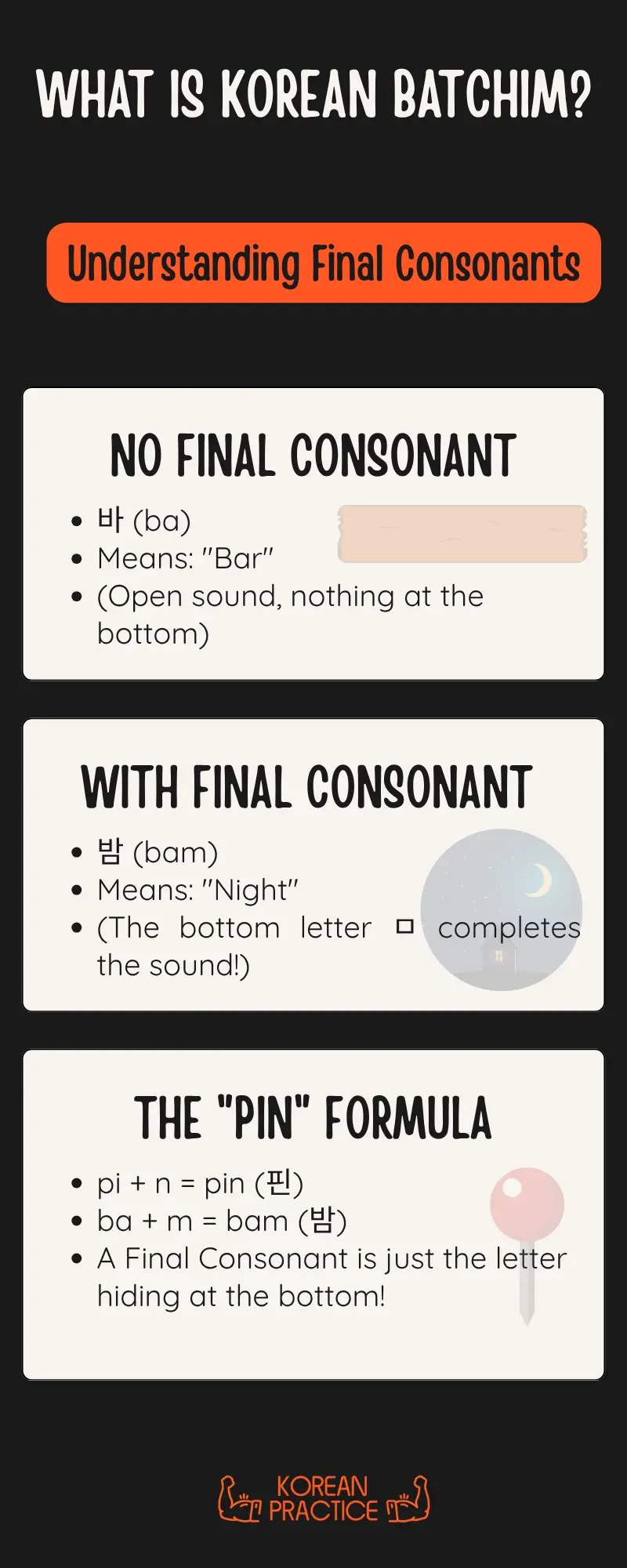
Table of Contents
Meet Korean final consonants
Good news: You don’t need to learn any new letters!
Korean final consonants are made from the same 14 basic consonants you’ve already studied.
But here’s the catch:
When Korean final consonants appear at the bottom of a syllable, their pronunciation changes slightly.
Let’s take a look:
Compare the Difference: No 받침 vs With 받침
I’ll show you two similar words:
One without a final consonant
One with a final consonant (받침)
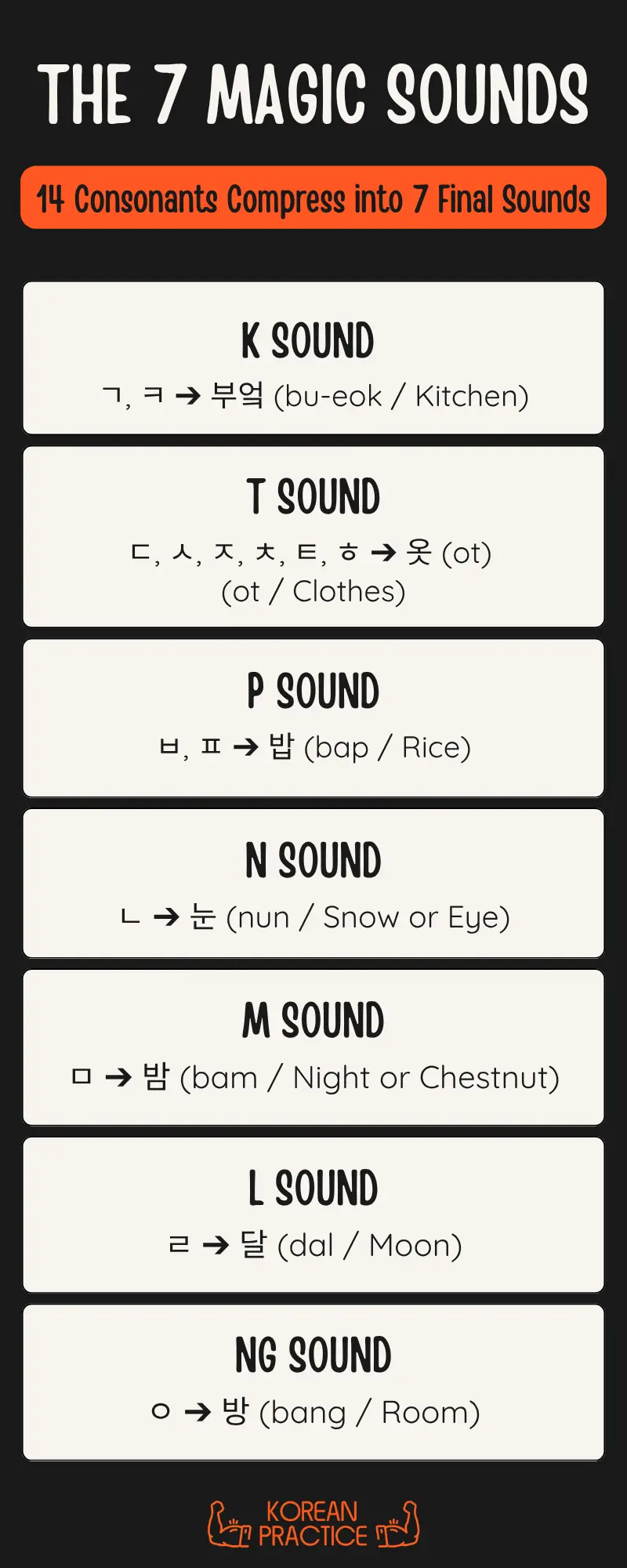
1. Final K Sound (ㄱ, ㅋ)
주 (ju) — no final consonant (“Week”)
죽 (juk) — with final consonant ㄱ (“Porridge”)
소 (so) — no final consonant (“Cow”)
속 (sok) — with final consonant ㄱ (“Inside”)
2. Final T Sound (ㄷ, ㅅ, ㅈ, ㅊ, ㅌ, ㅎ)
나 (na) — no final consonant (“I / Me”)
낮 (nat) — with final consonant ㅈ (“Daytime”)
비 (bi) — no final consonant (“Rain”)
빚 (bit) — with final consonant ㅈ (“Debt”)
3. Final P Sound (ㅂ, ㅍ)
수 (su) — no final consonant (“Number”)
숲 (sup) — with final consonant ㅍ (“Forest”)
바 (ba) — no final consonant (“Bar”)
밥 (bap) — with final consonant ㅂ (“Rice”)
4. Final M Sound (ㅁ)
고 (go) — no final consonant (“High”)
곰 (gom) — with final consonant ㅁ (“Bear”)
자 (ja) — no final consonant (“Ruler”)
잠 (jam) — with final consonant ㅁ (“Sleep”)
5. Final N Sound (ㄴ)
바 (ba) — no final consonant (“Bar”)
반 (ban) — with final consonant ㄴ (“Half / Class”)
구 (gu) — no final consonant (“Sphere / District”)
군 (gun) — with final consonant ㄴ (“County / Military”)
6. Final L Sound (ㄹ)
다 (da) — no final consonant (“All”)
달 (dal) — with final consonant ㄹ (“Moon”)
마 (ma) — no final consonant (“Yam”)
말 (mal) — with final consonant ㄹ (“Horse”)
7. Final NG Sound (ㅇ)
바 (ba) — no final consonant (“Bar”)
방 (bang) — with final consonant ㅇ (“Room”)
가 (ga) — no final consonant (“Edge”)
강 (gang) — with final consonant ㅇ (“River”)

Korean Final Consonants in Action: Short Story Practice
Let’s feel how Korean final consonants actually sound in real sentences — not just syllables.
A: 바람이 불어.
B: 오늘 날씨가 춥네.
A: 집에 일찍 가자.
Original Korean Sentence
바람이 불어.
Pronunciation Guide
바라미 (ba-ra-mi) 부러 (bu-reo).
Meaning and Context
바람 (wind) 이 (subject marker; I’m going to talk about the wind) 불 (to blow) 어 (I’m telling you casually).
Grammar
* -어: Casual speech ending for present tense.
English Translation
The wind is blowing.
Literal Translation
Wind blow.
Original Korean Sentence
오늘 날씨가 춥네.
Pronunciation Guide
오늘 (o-neul) 날씨가 (nal-ssi-ga) 춥네 (chup-ne).
Meaning and Context
오늘 (today) 날씨 (weather) 가 (subject marker; my subject is today weather) 춥 (to be cold) 네 (is; exclamation indicating a feeling or realization).
Culture
* -네 is often used when noticing something new or sharing a feeling.
English Translation
The weather is cold today, isn’t it?
Literal Translation
Today, weather is cold (I notice).
Original Korean Sentence
집에 일찍 가자.
Pronunciation Guide
지베 (ji-be) 일찍 (il-jjik) 가자 (ga-ja).
Meaning and Context
집 (house/home) 에 (to/towards) 일찍 (early) 가 (to go) 자 (let’s; in a casual way).
English Translation
Let’s go home early.
Literal Translation
Let’s go to home early.
Teacher’s Insight: Don’t Overthink 받침
As a Korean teacher with 14+ years of experience, here’s what I want to say:
받침 isn’t a Korean-only invention.
Korean final consonants are just a natural result of how the human vocal system works.
We can:
close the throat (like ㅇ or ㄱ),
stop the air in the mouth (like ㅂ or ㄷ),
or let the tongue rest (like ㄴ or ㄹ).
It’s the same in every language — we just call them different things.
So don’t treat 받침 like some alien sound system.
And definitely don’t study them like robots.
Let your body do the work.
When your throat feels tight, you’ll automatically find easier, more natural ways to pronounce.
Trust that instinct.
Korean final consonants are not a science experiment.
They’re just human sounds.
Wrap-up Pop Quiz!
Let’s see if you mastered today’s lesson! Can you solve this quick puzzle? 🧩

FAQs (What You Might Still Wonder About)
1. Why do different letters (like ㄷ, ㅅ, ㅈ) end up making the exact same [T] sound?
It comes down to the physical limits of our mouths! When you try to cut off a sound at the end of a word with ㄷ, ㅅ, ㅈ, ㅊ, ㅌ, or ㅎ, your tongue naturally hits the exact same spot—flat against the back of your upper teeth. Because your vocal system naturally chooses the easiest way to close the sound, all these different-looking letters melt into one clean [T] sound (like in 옷 – ot).
2. Why is “ㅇ” silent at the beginning of a word but sounds like [NG] at the bottom?
Think of ㅇ as a shape-shifter. When it sits at the very beginning of a syllable block (like in 아), it has no sound value at all—it simply acts as a placeholder for the vowel. However, when it drops down to the bottom as a final consonant (like in 방), it transforms into a solid, vibrating nasal sound. It is exactly like the “ng” sound in the English words sing or bang.
3. Why does the pronunciation change so much in a sentence instead of staying true to the spelling?
Because Koreans don’t speak like robots block by block; they prefer a smooth, fluid flow. When a syllable with a final consonant is followed by a blank vowel placeholder (ㅇ), the bottom letter thinks, “Oh, there’s an empty room next door!” and naturally slides up to take that spot. That’s why 바람이 is pronounced as 바라미 (ba-ra-mi). It’s just much easier on your throat and tongue!
4. If my final consonant pronunciation isn’t perfect, will Koreans understand me?
Absolutely! Don’t stress about being flawless. If you try to force every single bottom letter to ring out perfectly, your speech will actually sound stiff and unnatural. Koreans easily understand 90% of what you say through context. The real secret to sounding natural isn’t surgical precision—it’s letting the sounds glide smoothly from one word to the next.
5. What is the physical difference between pronouncing “밥” [P] and “방” [NG]?
It’s all about how you trap the air using your mouth:
밥 [P Sound]: You completely close the sound by snapping both lips shut tightly at the very end.
방 [NG Sound]: You keep your lips slightly open and close off the back of your throat, letting the sound resonate through your nose. Just remember: Lips closed for ㅂ, throat closed for ㅇ!
Final words
Korean final consonants like ㄱ, ㄴ, ㅂ, ㅁ, and ㅇ are not exotic, alien sounds unique to the Korean peninsula. They are universal human sounds. You already have them wired into your body—you just need to unlock them.
The secret to mastering Batchim? Stop trying to be precise. Start trying to be comfortable.
Language is movement, and your vocal system naturally loves efficiency.
When you force yourself to be mathematically precise, your throat tightens, your tongue freezes, and you sound like a textbook robot.
But when you relax, focus on the rhythm, and let the sounds glide, your body will automatically find the easiest, most natural way to close those syllables.
Remember: Pronunciation isn’t about showing off how perfectly you can mimic a chart. It’s about being understood while sounding like yourself—just in Korean.
You don’t need a science experiment to speak Korean. You already have the tools. Loosen your jaw, trust your instincts, and let it flow.