
When starting Korean, unlocking the true sajangnim meaning is essential for understanding K-dramas, business meetings, and daily life. While it usually translates to “boss” or “owner,” this respectful title carries deep cultural layers that go far beyond a simple English translation.
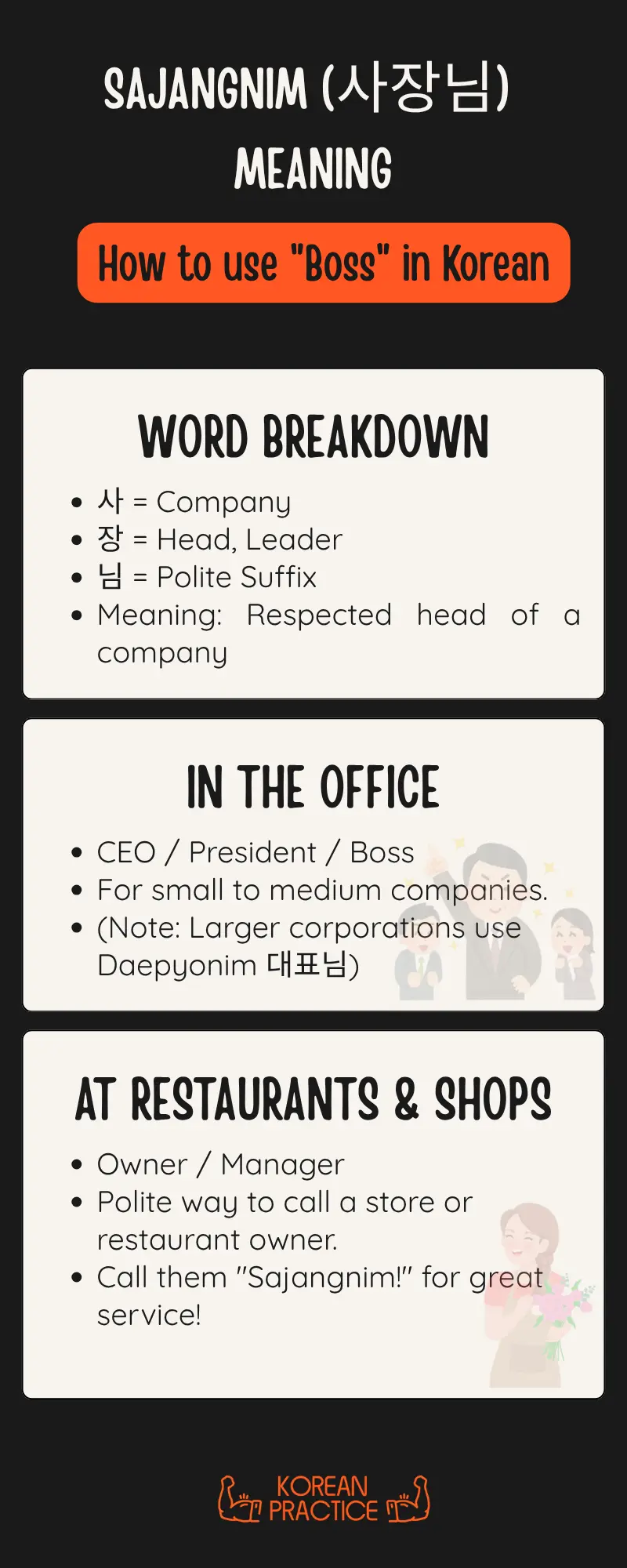
Check out this quick visual guide to master how and when to use sajangnim like a true native speaker right away!
Quick Warm-up Quiz!
Test your skills before diving into the blog post! 🧩 See if your Korean intuition is right on track.
Table of Contents
Sajangnim Meaning in Korean
The Korean word sajangnim (사장님) is a respectful title. It usually means “boss” or “company president.”
Sa (사, 社) = company
Jang (장, 長) = head, leader
Nim (님) = polite suffix that shows respect
So literally, sajangnim means “the respected head of the company.”
In daily life, people use it to call the owner of a company, the boss of a shop, or the manager of a place. If you go to a small restaurant in Korea, you might call the owner “sajangnim” even if he is cooking food in the kitchen.
Original Korean Sentence
사장님은 회사에 있어요.
Pronunciation Guide
사장님은 (sa-jang-ni-meun) 회사에 (hwei-sa-e) 있어요 (it-sseo-yo).
Meaning and Context
사장님 (boss) 은 (topic marker; marks the boss as the topic) 회사 (company) 에 (at) 있 (is) 어요 (polite ending; I’m telling you polite and friendly).
English Translation
The boss is at the company.
Literal Translation
Boss is at company.
Did You Eat in Korean? → Discover why this “greeting” is really about care, not food.
Sajangnim in English
If we try to find the sajangnim in English, the closest words are:
Boss – in casual settings
President / CEO – in a formal business setting
Owner – when talking about a store or restaurant
But none of these are perfect translations. In English, if you say “boss,” it sounds casual. But in Korean, sajangnim is polite and respectful. That is why many English learners of Korean get confused.
For example, in an American restaurant, you don’t usually call the owner “boss.” But in Korea, calling the restaurant owner sajangnim is very natural and polite.
Korean Honorifics Made Simple → Add ‘시’ and instantly sound respectful—see how!
Sajangnim in Korean Culture
The meaning of sajangnim is not only about position. It is also about culture and respect. Korean culture values hierarchy and titles. People don’t often call each other by first names in professional settings. Instead, they use job titles with the polite ending -nim.
So, even if you don’t know the real name of someone, you can respectfully say “sajangnim” to show that you see them as the leader or owner. This is very different from Western culture.
In the U.S., people might just say, “Mr. Smith” or even use first names in the office. In Korea, using titles like sajangnim is a way to show politeness and to build good relationships.
🚀 Quick Learning
Original Korean Sentence
우리 사장님은 직원들을 좋아해요.
Pronunciation Guide
우리 (u-ri) 사장니믄 (sa-jang-ni-meun) 지권드를 (ji-gwon-deu-reul) 조아해요 (jo-a-hae-yo).
English Translation
Our boss likes the employees.
Literal Translation
Our boss like employees.
Quick Reference
우리 사장님은 (our boss) 직원들을 (employees) 좋아해요 (likes).
🔍 Deep Learning
Meaning and Context
우리 (our, we)
→ Possessive pronoun indicating belonging to “us.”
사장님 (boss, company president)
→ 사장 (company president) + 님 (honorific suffix showing respect)
은 (topic marker)
→ Sets “our boss” as the topic of the sentence.
직원 (employee, staff member)
→ 직 (job, work) + 원 (person, member)
들 (plural marker)
→ Makes “employee” plural: “employees.”
을 (object marker)
→ Marks employees as the object being liked.
좋아해요 (like; stem of 좋아하다)
→ I’m telling you polite and friendly.
Real-Life Usage
– “사장님” is the respectful way to refer to a company president or boss. The “님” suffix adds respect.
– “직원들” means “employees” – the “들” makes it plural.
– “좋아하다” expresses liking or being fond of someone/something: “저는 커피를 좋아해요” (I like coffee), “친구들을 좋아해요” (I like my friends). This sentence expresses a positive workplace relationship!
Pattern Practice
우리 선생님은 학생들을 좋아해요.
저는 우리 팀원들을 좋아해요.
사장님은 회사를 좋아해요.
직원들은 사장님을 좋아해요.

Annyeonghaseyo Sajangnim
One very common greeting is annyeonghaseyo sajangnim (안녕하세요 사장님).
This phrase simply means, “Hello, boss.”
But it carries more meaning. By adding sajangnim, you are not only greeting but also showing respect. Imagine walking into your company and smiling at your boss, saying politely, “Annyeonghaseyo sajangnim!” It makes the boss feel recognized and respected.
In dramas, you often hear employees greet their company head this way. In small businesses, customers also say it to shop owners.
Blind Date in Korean (Sogaeting) → Learn the word, the rules, and what to expect.
Original Korean Sentence
안녕하세요 사장님!
Pronunciation Guide
안녕하세요 (an-nyeong-ha-se-yo) 사장님 (sa-jang-nim)!
Meaning and Context
안녕하세요 (hello in a polite way) 사장님 (boss)!
English Translation
Hello, boss!
White Day in Korean Culture 🍬 → Who gives candy—and why it matters.
Sajangnim vs. Daepyonim Meaning
Another similar word is daepyonim (대표님).
Dae-pyo (대표) = representative
Nim (님) = polite ending
So daepyonim means “the respected representative” of a company.
The difference between sajangnim and daepyonim meaning is small but important:
Sajangnim: owner or president, often used in small or medium companies.
Daepyonim: CEO or official representative of a company, used more in larger or formal companies.
In many cases, people use them interchangeably. But if the company has a more modern structure, daepyonim feels a bit more professional than sajangnim.
Original Korean Sentence
대표님은 회의실에 있어요.
Pronunciation Guide
대표님은 (dae-pyo-ni-meun) 회의실에 (hwei-ui-si-le) 있어요 (it-sseo-yo).
Meaning and Context
대표님 (CEO) 은 (topic marker; marks the CEO as a topic) 회의 (meeting) 실 (room) 에 (in) 있 (is) 어요 (polite ending; I’m telling you polite and friendly).
English Translation
The CEO is in the meeting room.
Literal Translation
CEO is in meeting room.
6 Korean Table Etiquette Mistakes → Avoid these slips and eat like a local.
Sajangnim vs. “Sir” in Korean
Sometimes learners ask: Is sajangnim the same as saying “sir” in Korean?
The answer is not really.
In English, “sir” is a polite way to address a man, especially a stranger. But in Korean, you don’t use sajangnim like that. If you say sajangnim to a stranger, it means you see them as a boss or owner.
For “sir” in Korean, people often use:
Seonsaengnim (선생님) – teacher, but also a polite way to call men respectfully.
Agassi / Ajusshi / Ajumeoni – polite words for young lady, middle-aged man, and middle-aged woman.
So while sajangnim shows respect, it is not the same as just “sir.” It has a business or ownership nuance.
Original Korean Sentence
사장님, 여기 물 좀 주세요.
Pronunciation Guide
사장님 (sa-jang-nim), 여기 (yeo-gi) 물 (mul) 좀 (jom) 주세요 (ju-se-yo).
Meaning and Context
사장님 (boss), 여기 (here) 물 (water) 좀 (some) 주 (to give) 세요 (please).
English Translation
Boss, please give me some water here.
Literal Translation
Boss, please give some water here.
Korean Age System → Understand “Korean age” in 2 minutes with clear examples.
Everyday Use of Sajangnim
Now let’s look at how people use sajangnim every day.
At Work: Employees call their boss “sajangnim.”
직원: 사장님, 오늘 회의는 몇 시예요?
(Employee: Boss, what time is the meeting today?)
At Restaurants or Shops: Customers call the owner “sajangnim.”
손님: 사장님, 계산이요!
(Customer: Boss, check please!)
In Conversation: Sometimes people use “sajangnim” even as a nickname, especially if the person is successful or runs a business.
친구: 와, 이제 너는 진짜 사장님이네!
(Friend: Wow, now you’re really a sajangnim!)
Korean Hurry Culture → Why everything is fast—and how to keep up without stress.

FAQs (What You Might Still Wonder About)
1. Can I call my foreign boss “sajangnim” in Korean?
Yes, if you are working in Korea, it is natural to call any company owner or boss sajangnim in Korean, even if they are not Korean. It shows respect in the workplace. In English, you might still call them “boss” or “Mr./Ms. [Name].”
2. Is sajangnim only for men?
No. The word sajangnim is gender-neutral. A woman who owns a shop, restaurant, or company can also be called sajangnim. Unlike English titles like “Mr.” or “Ms.,” sajangnim is the same for everyone.
3. What is the difference between sajangnim and seonsaengnim?
Both end with -nim, which shows respect. But the meanings are different:
Sajangnim = boss, company owner, or business leader.
Seonsaengnim = teacher or respectful way to say “sir” or “ma’am” in Korean.
4. Can customers really say “annyeonghaseyo sajangnim” in a restaurant?
Yes! In fact, it is very common. If you greet the owner by saying annyeonghaseyo sajangnim, they will probably smile and feel respected. It is a polite cultural habit in Korea.
5. Which is more polite: sajangnim or daepyonim?
Both are polite, but daepyonim meaning is a bit more formal, often used in larger companies or in official meetings. Sajangnim feels warmer and is common in smaller businesses and shops.
6. Do K-dramas use sajangnim often?
Yes. In many dramas, you will hear employees say “sajangnim” when talking to their company president, or even customers using it in shops. Listening to K-dramas is a fun way to learn how sajangnim in Korean is used in daily life.
Final words
Understanding the sajangnim meaning is about more than vocabulary—it’s about grasping the subtle layers of Korean respect and hierarchy. Now, whether you say annyeonghaseyo sajangnim at a local market or distinguish the daepyonim meaning in a boardroom, you’re speaking with cultural depth.
Don’t just translate; start feeling the language. Next time you’re watching a K-drama, listen for that word. You’ll hear the respect, the authority, and the “Korean soul” behind it.