Learning a new language can feel like a big challenge. But the Korean writing system, called Hangul, is one of the easiest alphabets to learn in the world.
In this blog, we will take a close look at the Korean alphabet, how to write Hangul in Korean, and even practice with some examples. By the end, you will feel much more confident reading Korean!
And here’s something extra: I also made a free video course called How to Read Korean. You can watch it here: How to Read Korean – Free Course.
We will also use a Hangul chart (Korean alphabet chart) in this lesson. You can save the chart as a PDF or image to practice later.
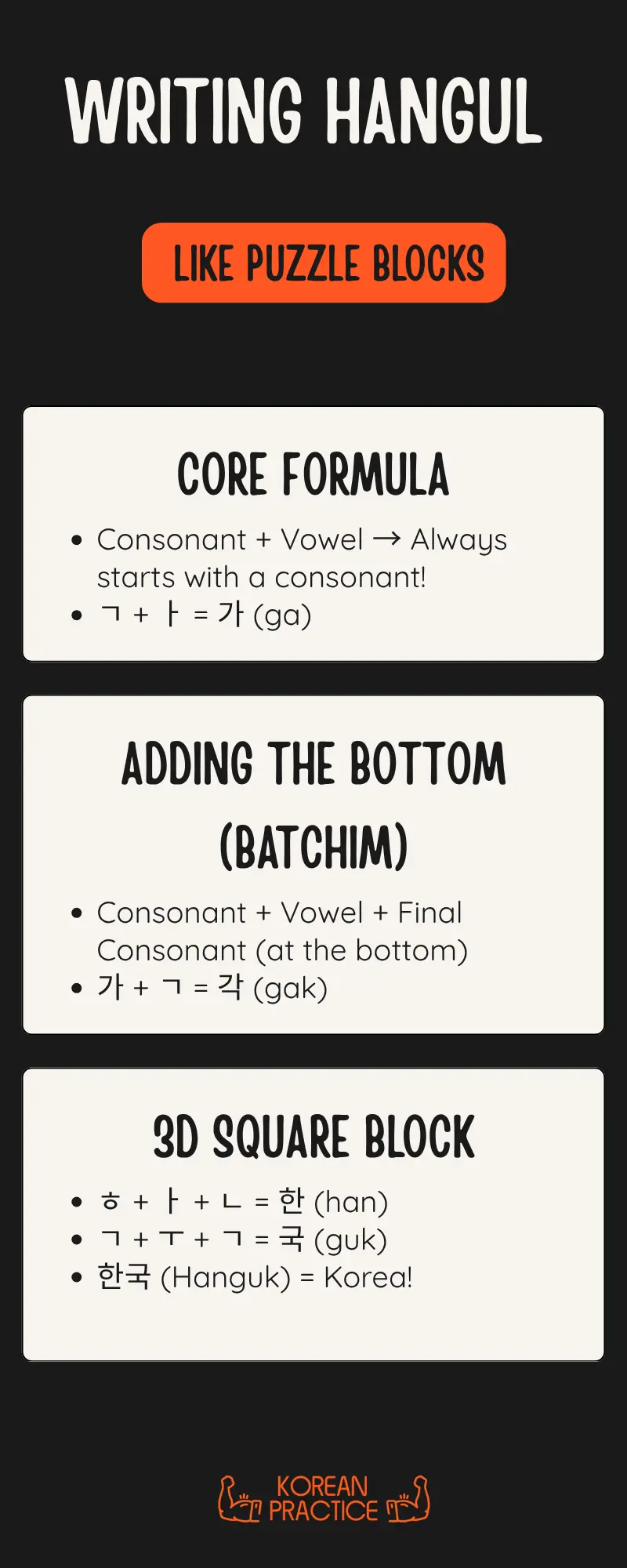
Table of Contents
What Is Hangul?
Hangul is the Korean alphabet. It was created in the 15th century by King Sejong the Great and his scholars.
Before Hangul, Korean people used complicated Chinese characters. Only rich or highly educated people could read and write. King Sejong wanted everyone, even farmers, to read and write easily. So he created Hangul.
Hangul has 24 basic letters:
14 consonants
10 vowels
These letters can be combined into blocks, and each block makes one syllable. For example:
한 (han)
글 (geul)
Together, 한글 (Hangul) means “Korean writing system.”
The Korean Writing System: Consonants and Vowels
When we study the Korean Writing System (Hangul), we see that it is made of two groups of letters: consonants and vowels. This is similar to the English alphabet, but with a special design that makes Hangul very logical and easy to learn.
King Sejong, who created Hangul in the 15th century, designed each letter to match the shape of the mouth and tongue when making the sound. That is why the Korean writing system feels so scientific and simple once you start using it.
Basic Consonants (14 letters)
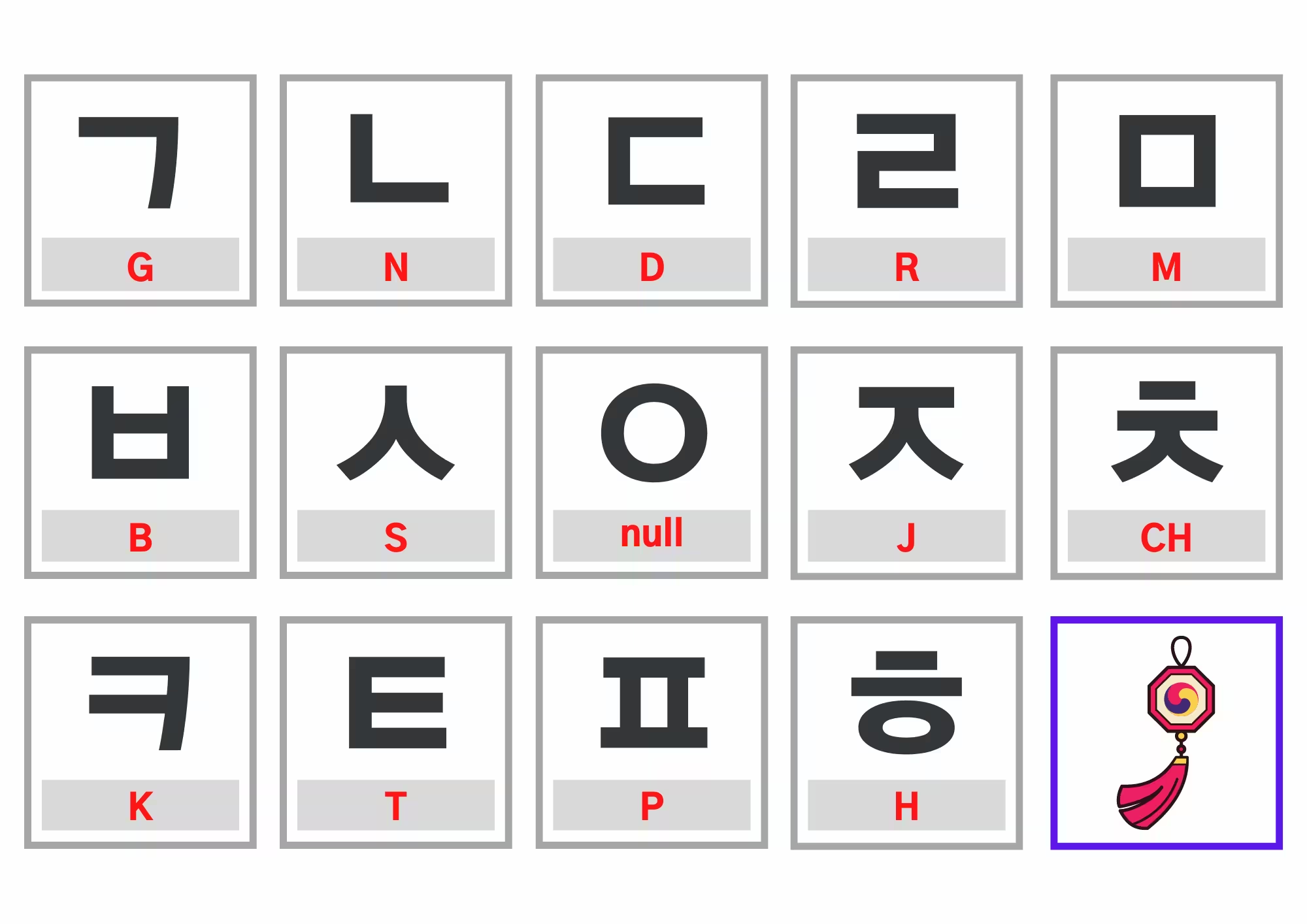
Here are the 14 basic consonants in the Korean writing system:
ㄱ (g/k), ㄴ (n), ㄷ (d/t), ㄹ (r/l), ㅁ (m), ㅂ (b/p), ㅅ (s), ㅇ (ng or silent), ㅈ (j), ㅊ (ch), ㅋ (k), ㅌ (t), ㅍ (p), ㅎ (h)
Each consonant has a shape that reflects how your tongue or lips move.
For example:
ㄴ (n) looks like your tongue touching the top of your mouth.
ㅁ (m) looks like closed lips.
ㄱ (g/k) looks like the back of your tongue blocking air.
Learn more about 14 Korean Basic Consonants in 10 Mins: The Ultimate Beginner’s Guide
Basic Vowels (10 letters)
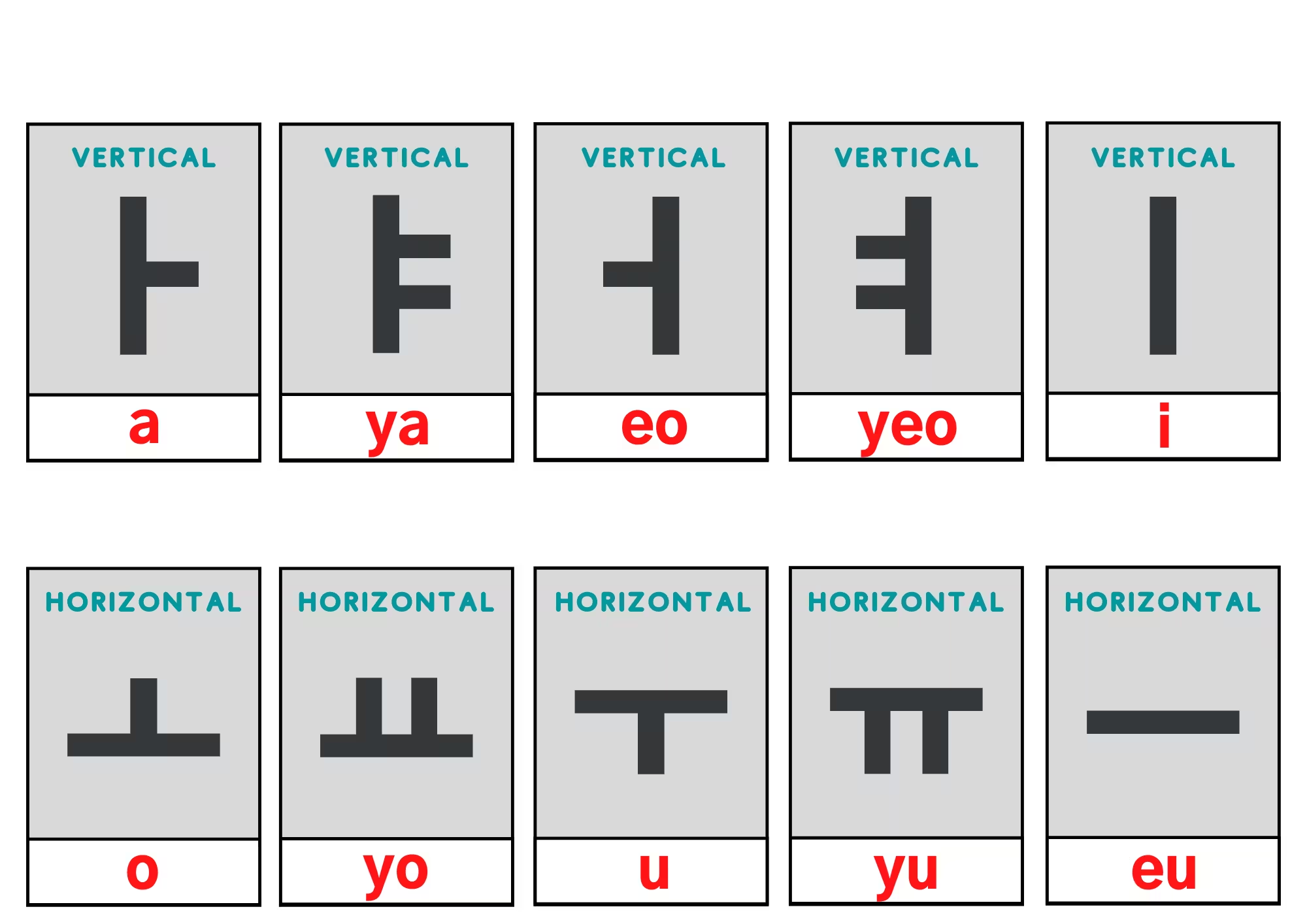
Vowels in the Korean writing system are divided into vertical type and horizontal type. This helps you see how they fit with consonants when building syllables.
Vertical Vowels|
ㅏ (a), ㅑ (ya), ㅓ (eo), ㅕ (yeo), ㅣ (i)
These vowels are written up-and-down. For example:
ㅏ (a) → pronounced like “ah” in father.
ㅣ (i) → pronounced like “ee” in see.
Horizontal Vowels
ㅗ (o), ㅛ (yo), ㅜ (u), ㅠ (yu), ㅡ (eu)
These vowels are written side-to-side. For example:
ㅜ (u) → pronounced like “oo” in moon.
ㅡ (eu) → a unique Korean sound, produced with your lips flat.
✨ Tip: The Korean writing system is not random. The basic consonants and vowels combine like building blocks. Once you master these shapes, you can read any Korean word!
Learn more about 10 Korean Basic Vowels – Why Pronouncing Them Right Matters More Than You Think
How to Write Hangul in Korean
Writing in Hangul is like building with blocks. You put consonants and vowels together to make syllables.
Rule 1: Always start with a consonant + vowel.
For example:
ㄱ + ㅏ = 가 (ga)
ㄴ + ㅏ = 나 (na)
Rule 2: Add a final consonant if needed.
For example:
가 (ga)
각 (gak) → adds ㄱ at the bottom.
Rule 3: Arrange letters in a square block.
한 (han) = ㅎ + ㅏ + ㄴ
국 (guk) = ㄱ + ㅜ + ㄱ
Together, 한국 (Hanguk) means “Korea.”
Learn about Korean Final Consonants Explained Simply — No Phonetics, Just Real Talk
Double Consonants (쌍자음)
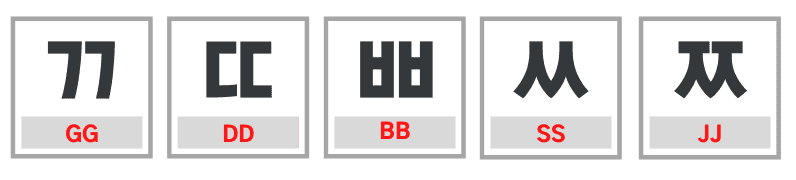
In the Korean Writing System (Hangul), some consonants can be “doubled” to make a stronger sound. These are called 쌍자음 (ssangja-eum), or double consonants.
The five double consonants are:
ㄲ (kk), ㄸ (tt), ㅃ (pp), ㅆ (ss), ㅉ (jj)
How they sound:
ㄲ (kk) → stronger than ㄱ (g/k)
ㄸ (tt) → stronger than ㄷ (d/t)
ㅃ (pp) → stronger than ㅂ (b/p)
ㅆ (ss) → sharper than ㅅ (s)
ㅉ (jj) → stronger than ㅈ (j)
👉 Think of double consonants like “tense” sounds. You say them with more force and energy.
Example word:
빨리 (ppal-li) → “quickly”
Here ㅃ is pronounced like a strong “pp” sound.
Double consonants are important because they change the meaning of words. For example:
발 (bal) → foot
빨강 (ppal-gang) → red color
So, the Korean alphabet in English doesn’t show these small differences, but the Hangul alphabet does!
Double Vowels (쌍모음)
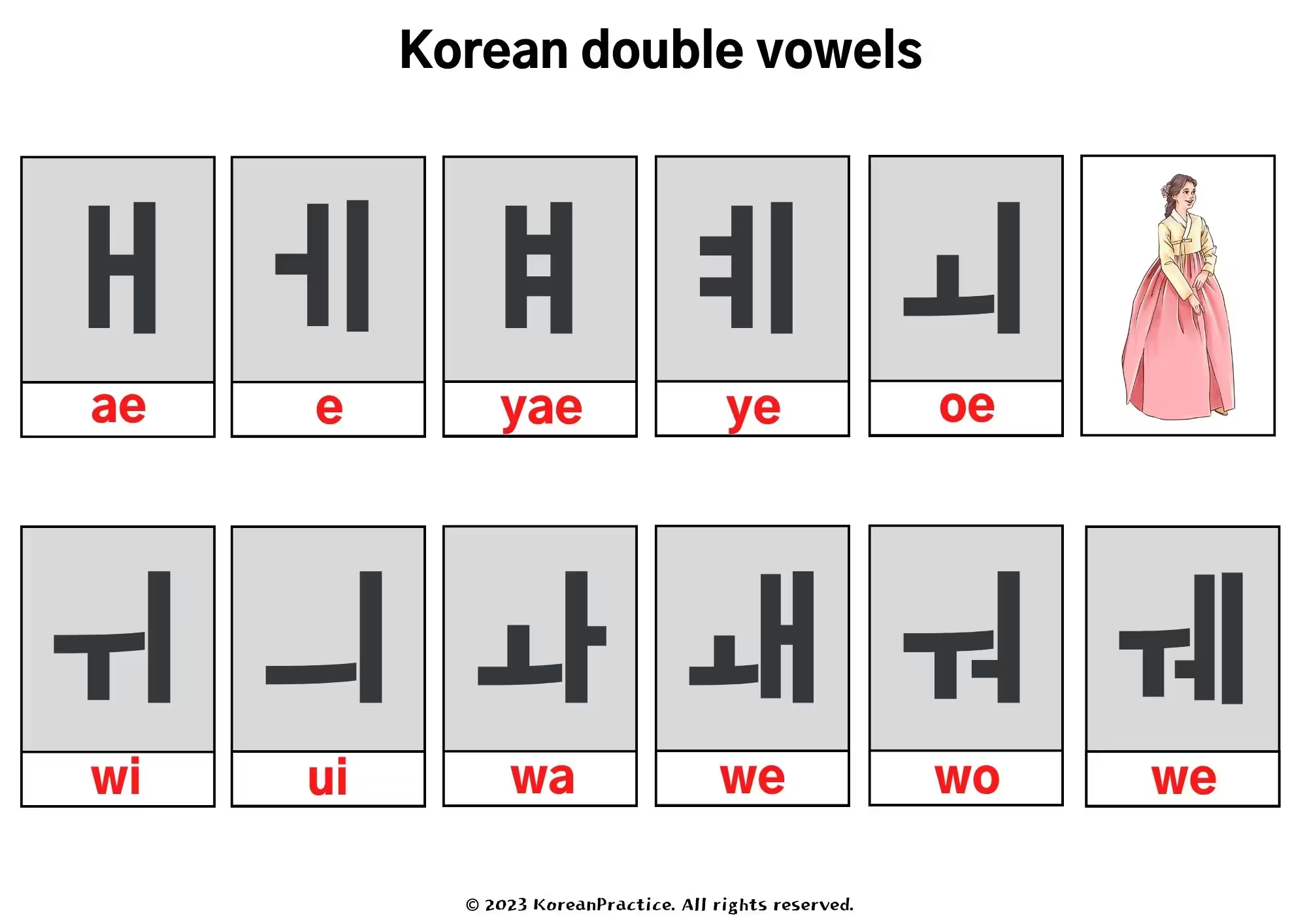
The Korean Writing System also has double vowels, called 쌍모음 or more commonly “diphthongs” (complex vowels). These are made by combining two basic vowels to create a new sound.
Examples:
ㅐ (ae), ㅔ (e), ㅒ (yae), ㅖ (ye), ㅘ (wa), ㅙ (wae), ㅚ (oe), ㅝ (wo), ㅞ (we), ㅟ (wi), ㅢ (ui)
How they work:
ㅐ (ae) → from ㅏ (a) + ㅣ (i)
ㅘ (wa) → from ㅗ (o) + ㅏ (a)
ㅢ (ui) → from ㅡ (eu) + ㅣ (i)
Example words:
개 (gae) → dog
왜 (wae) → why
귀 (gwi) → ear
These double vowels might look complicated at first, but they follow a very clear pattern. If you already know the basic vowels, you can learn how to write Hangul in Korean by simply combining them.
✨ Tip for learners:
When you look at a Hangul chart, you’ll usually see double consonants and double vowels listed separately from the basic ones. That’s because they’re built from the same simple shapes, showing again how logical the Korean Writing System really is.
Real-Life Words
Hangul is used everywhere in Korea:
Street signs: 서울 (Seo-ul)
Menus: 김치 (kim-chi), 불고기 (bul-go-gi)
Names: 민지 (Min-ji), 지훈 (Ji-hoon)
When you travel to Korea, being able to read Hangul helps you understand directions, food, and names.
Example Sentences (Step-by-Step)
Let’s practice some simple sentences in Korean. We will break them down for you.
Original Korean Sentence
나는 학생이에요.
Pronunciation Guide
나는 (na-neun) 학생이에요 (hak-saeng-i-e-yo).
Meaning and Context
나 (I) 는 (topic marker; as for me..) 학생 (student) 이에요 (polite ending; am).
English Translation
I am a student.
Literal Translation
I am student.
Original Korean Sentence
코끼리가 있어요.
Pronunciation Guide
코끼리가 (ko-ggi-ri-ga) 있어요 (it-sseo-yo).
Meaning and Context
코끼리 (elephant) 가 (subject marker; I’m going to talk about an elephant) 있 (there is) 어요 (polite ending; I’m telling you polite and friendly).
English Translation
There is an elephant.
Literal Translation
There is elephant.
See how each Korean word can be broken into syllables, and each syllable comes from consonant + vowel combinations? This is the power of Hangul!
Why Hangul Is Easy to Learn
Compared to other Asian writing systems like Chinese or Japanese, Hangul is very simple:
1. Only 24 letters to learn.
2. Letters combine like puzzle pieces.
3. The shapes are scientific — based on mouth movements.
Many learners can read Hangul in just one day of practice. Writing takes more time, but the first step is recognizing the letters.
Korean Sentence Structure Is More Important Than Grammar—Here’s Why

FAQs (What You Might Still Wonder About)
1. Who invented the Korean Writing System (Hangul)?
The Korean Writing System, known as Hangul, was created in the 15th century by King Sejong the Great and his scholars. They wanted a writing system that was simple and logical, so even common people could learn to read and write easily.
2. How is the Korean alphabet in English different from Hangul?
When we write the Korean alphabet in English, we only show the sounds using Roman letters. But Hangul itself is much more precise. For example, in English “g” and “k” might look the same, but in the Hangul alphabet ㄱ can sound like both depending on the word.
3. Is Hangul really one of the easiest alphabets in the world?
Yes! Many linguists say that the Hangul alphabet is one of the most scientific and easy-to-learn writing systems. Because the letters are designed to match the shape of the mouth and tongue, beginners can often learn how to write Hangul in Korean in just a few hours.
4. Do I need to memorize the Hangul chart before learning Korean words?
It helps! A Hangul chart shows you all the consonants and vowels at once. If you study the chart first, you will recognize patterns quickly when reading Korean. However, you don’t have to memorize everything before starting. Learning through words and examples makes it more fun.
5. How are Hangul letters written inside a block?
In the Korean Writing System, letters are grouped into blocks that represent syllables. For example, 한 (han) is made of ㅎ + ㅏ + ㄴ. This is different from English, where letters are written in a straight line. That’s why learning how to write Hangul in Korean is about arranging letters into these neat blocks.
6. Are there sounds in Hangul that don’t exist in English?
Yes! Some sounds in the Hangul alphabet don’t match perfectly with English sounds. For example, the vowel ㅡ (eu) doesn’t really exist in English. This is why looking at both the Hangul chart and pronunciation guides is very helpful for learners.
Final words
The Korean writing system is not scary at all. The Hangul alphabet is logical, simple, and fun to learn. With the Hangul chart, practice sentences, and your own writing, you can start reading Korean very quickly.
Remember:
Learn the 24 letters.
Practice combining them.
Read real Korean words.
Soon, you’ll be able to read menus, signs, and even text your Korean friends in Hangul. Don’t forget to grab the Hangul chart PDF and watch the free course for extra help. Happy learning!