Ever wondered why Koreans talk about “eating age” when they celebrate a birthday? If you want to learn Korean vocabulary that makes you sound like a real native, understanding Korean idioms is the ultimate shortcut.
Instead of getting lost in direct translations, check out our quick infographic below to master this unique expression in just 3 seconds!
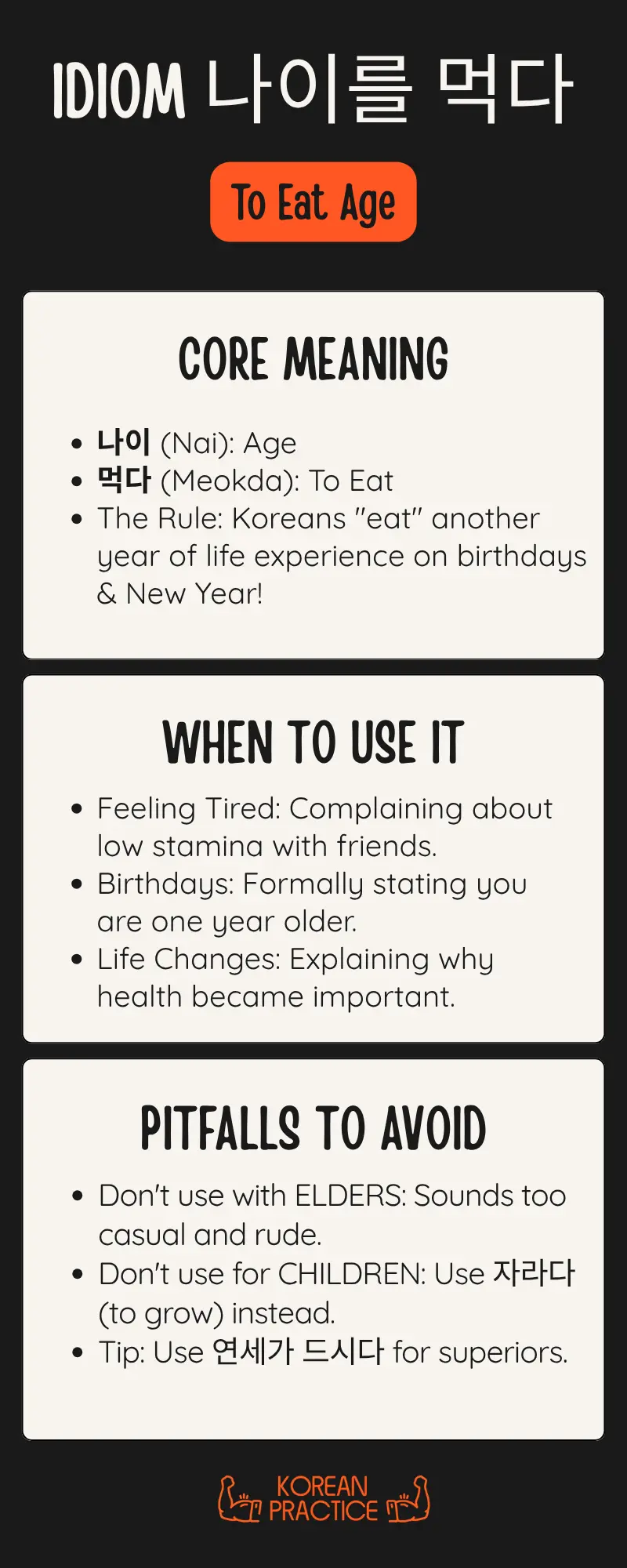
Table of Contents
What Does “나이를 먹다” Actually Mean?
The Literal Breakdown vs. Real Meaning
If you translate 나이를 먹다 word by word, it sounds quite strange. 나이 (nai) means “age,” and 먹다 (meokda) means “to eat.” So it literally translates to “to eat age.”
However, the real 나이를 먹다 meaning in English is simply “to get older” or “to age.” It is a highly common, casual way to express that time is passing and you are growing older.
✅ 나이 (Age) + 먹다 (To Eat) ➔ To get older / To age
3 Practical Ways to Say “Get Older in Korean”
To help you use this phrase naturally, let’s look at three everyday situations where Koreans use this expression.
Situation 1: Talking About Getting Tired (Casual)
Koreans frequently use this phrase lightheartedly when they feel a bit more exhausted than usual. It’s a fun, relatable way to complain about stamina with friends.
Original Korean Sentence
친구: 요즘 너무 피곤해.
나: 우리도 나이를 먹었나 봐.
Pronunciation Guide
친구 (chin-gu): 요즘 (yo-jeum) 너무 (neo-mu) 피고네 (pi-go-ne).
나 (na) 우리도 (u-ri-do) 나이를 (na-i-reul) 머건나 (meo-geon-na) 봐 (bwa).
Meaning and Context
친구 (friend): 요즘 (these days) 너무 (too) 피곤해 (tired; I’m telling you casually).
나 (me): 우리 (we) 도 (also) 나이 (age) 를 (my object particle is age) 먹다 (to eat; “to get older”) 었 (past tense) 나 봐 (I guess; in a casual way)
Grammar
나 봐: Used when making a guess based on observation.
Culture
In Korean conversations, aging is often talked about lightheartedly, especially when discussing tiredness or physical changes.
English Translation
Friend: I’m so tired these days.
Me: I guess we’re getting older too.
Literal Translation
Friend: These days very tired.
Me: We also eat age, I guess.
Situation 2: Marking a New Year or Birthday (Formal)
When celebrating a birthday or the New Year, this phrase is used to formally state that you have successfully marked another year in your life.
Original Korean Sentence
나이를 한 살 더 먹었습니다.
Pronunciation Guide
나이를 (na-i-reul) 한 (han) 살 (sal) 더 (deo) 머것슴니다 (meo-geot-seum-ni-da).
Meaning and Context
나이 (age) 를 (my object particle is age) 한 (one) 살 (year of age) 더 (more) 먹다 (to eat; “to get older”) 었 (past tense) 습니다 (I’m telling you in a formal way)
Grammar
더: Means “more” and emphasizes an additional amount.
Culture
In Korea, adding one year to your age is often associated with celebrations like birthdays and the Lunar New Year.
English Translation
I’ve gotten one year older.
Literal Translation
I ate one more year of age.
Situation 3: Discussing Health and Priorities (Polite)
As time goes on, priorities shift. This expression is perfect for explaining the cause or reason behind changes in your lifestyle as you mature.
Original Korean Sentence
나이를 먹으니까 건강이 중요해졌어요.
Pronunciation Guide
나이를 (na-i-reul) 머그니까 (meo-geu-ni-gga) 건강이 (geon-gang-i) 중요해졋써요 (jung-yo-hae-jyeot-sseo-yo).
Meaning and Context
나이 (age) 를 (my object particle is age) 먹다 (to eat; idiomatically “to get older”) 으니까 (because) 건강 (health) 이 (my subject particle is health) 중요해지다 (to become important) 었 (past tense) 어요 (I’m telling you polite and friendly)
Pronunciation Patterns for Conjugations
⊳ 지 + 었 = 졌. Rapidly pronouncing ‘지’ and ‘었’ results in ‘졌’.
Grammar
니까: Expresses reason or cause (“because”)
Culture
In Korean, people often talk about health and well-being more as they age, emphasizing the importance of maintaining a balanced lifestyle.
English Translation
As I’m getting older, health has become more important.
Literal Translation
Because (I) eat age, health became important.
FAQs (What You Might Still Wonder About)
1. Can I use “나이를 먹다” to describe someone else getting older?
Yes, but only if they are your peers or younger than you. If you are talking about an elder, a boss, or someone who requires Korean honorifics, using this phrase sounds disrespectful. Instead, you should use the elegant honorific verb 연세가 드시다 (yeonse-ga deushida), which is the polite way to say “aging” for superiors.
2. Is there a past tense variation of this phrase I should know?
Absolutely. In daily conversations, you will hear the past tense 나이를 먹었다 (geot-da) much more often than the base form. For example, when you want to sigh about aging right now, you say “나이 많이 먹었네” (I’ve gotten so old). Understanding this Korean conjugation helps you catch the phrase instantly in K-dramas.
3. Does “먹다” (to eat) mean “to gain” or “to accumulate” in other Korean idioms?
Yes! The verb 먹다 is incredibly versatile in Korean idioms. Beyond eating food and aging, it is used in phrases like 마음을 먹다 (maeum-eul meokda – literally “to eat one’s mind”), which means “to make up one’s mind” or “to decide.” Mastering these hidden meanings is the fastest way to speak Korean naturally.
4. Is “나이를 먹다” considered a negative or depressing expression?
Not necessarily. While it can be used to complain about getting tired, Koreans also use it in a deeply positive, reflective way. It often implies that someone is becoming more mature, gaining wisdom, and collecting valuable life experiences—not just getting physically wrinkly or old.
5. What is the difference between “나이를 먹다” and “늙다”?
Both mean getting older, but their nuances are completely different. 늙다 (neukda) focuses strictly on the physical, biological process of aging or looking old (e.g., getting wrinkles). On the other hand, 나이를 먹다 is a much softer, idiomatic expression that focuses on the passage of time and the accumulation of years.
6. How do I change “나이를 먹다” into a polite sentence for daily use?
If you want to say “I am getting older” to someone you need to be polite to (like a language partner or acquaintance), you simply change the ending of the Korean verbs. You can say “저도 이제 나이를 먹었나 봐요” (I guess I am getting older too, polite) or “나이를 먹으니까 그렇네요” (It’s because I’m aging, polite).
7. Is there a specific age when people start using this phrase?
Interestingly, you will hear everyone from 20-somethings to elders use it! In Korea, even university students jokingly say “나이 먹어서 힘들다” (It’s hard because I’m getting old) when they feel tired after a long week of exams. It functions more as a universal, relatable social icebreaker rather than a strict chronological statement.
Final words
나이를 먹다 meaning in English is a useful and frequently used phrase that you’ll hear often in Korean conversations.
It’s a great example of how Korean expressions can be different from their literal translations, but once you understand them, they become easy and fun to use. Try using this phrase in your own sentences and see how natural it sounds!