
Surviving in South Korea requires knowing how to navigate. However, many learners get confused because directions in Korean change forms depending on whether you are describing a static location or actively giving commands.
This ultimate guide delivers the exact answers you need. We break down 17 essential directional expressions into a clean, highly visual format: basic spatial locations, cardinal directions, and real-life navigation phrases. No fluff, no rigid grammar traps—just instant speaking reflexes.
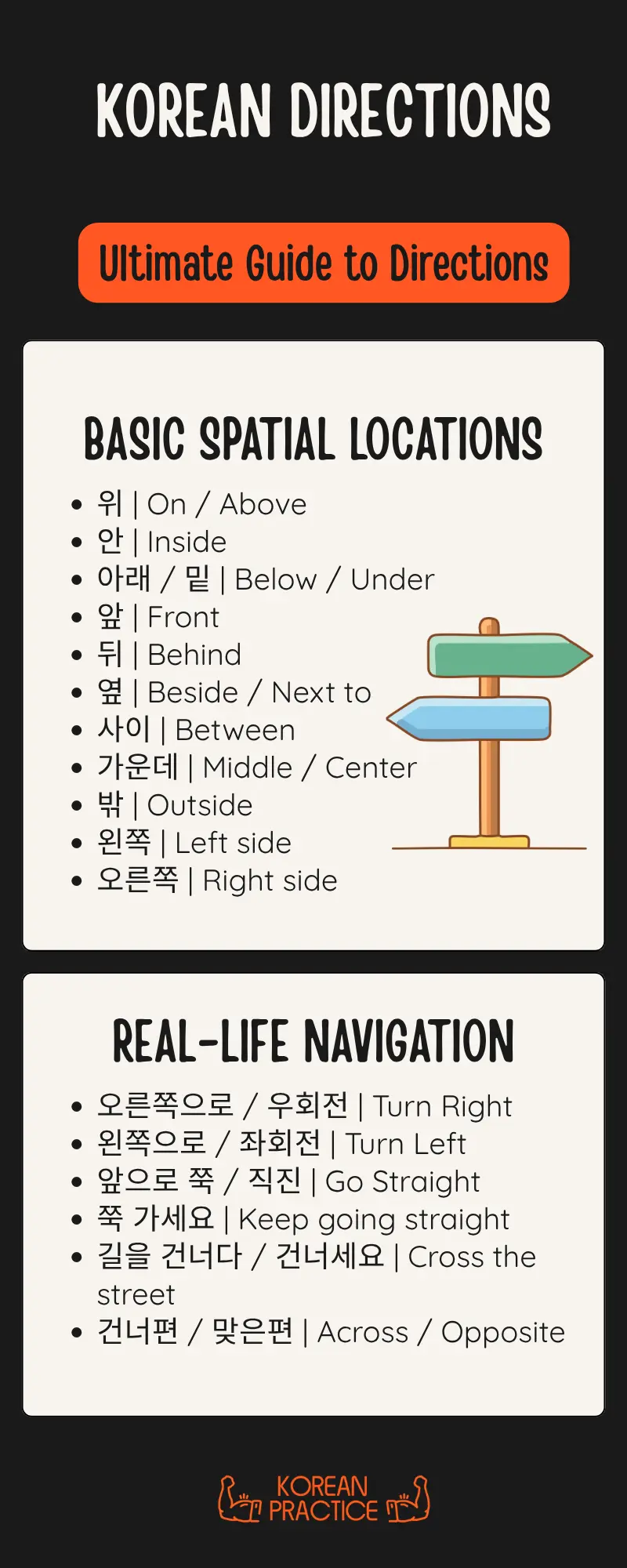
Table of Contents
Part 1: Basic Spatial Locations (11 Everyday Expressions)
When describing where an object or a place is located, Korean uses a simple blueprint:
✅ {Noun} + {Location Word} + {에 있어요 (is located at)}
Instead of scrolling through repetitive grammar explanations, use this master table to memorize the 11 most common spatial Korean direction words used in daily conversations.
| 한국어 (Korean Word) | 영어 (English) | Spatial Grammar Pattern |
| 위 (wi) | On / Above | Noun + 위에 있어요 |
| 안 (an) | Inside | Noun + 안에 있어요 |
| 아래 (a-rae) / 밑 (mit) | Below / Under | Noun + 아래에 있어요 |
| 앞 (ap) | Front | Noun + 앞에 있어요 |
| 뒤 (dwi) | Behind | Noun + 뒤에 있어요 |
| 옆 (yeop) | Beside / Next to | Noun + 옆에 있어요 |
| 사이 (sa-i) | Between | Noun A + 과/와 Noun B + 사이에 있어요 |
| 가운데 (ga-un-de) | Middle / Center | Noun + 가운데에 있어요 |
| 밖 (bak) | Outside | Noun + 밖에 있어요 |
| 건너편 (geon-neo-pyeon) / 맞은편 (ma-jeun-pyeon) | Across / Opposite | Noun + 건너편에 있어요 |
Key Examples in Action
Original Korean Sentence
책이 책상 위에 있어요.
Pronunciation Guide
채기 (chae-gi) 책쌍 (chaek-ssang) 위에 (wi-e) 잇써요 (it-sseo-yo).
Meaning and Context
책 (book) * 이 (book is the subject) 책상 (desk) * 위에 (on top of) 있 (to be) 어요 (I’m telling you polite and friendly).
Grammar
* Subject Marker 이/가: Used to indicate the subject of the sentence.
* Location Particle 에: Indicates location (on, in, at).
* 있다 (it-da): To exist, to be (conjugated to 있어요 for polite form).
* Politeness Level: ‘-요’ at the end makes the sentence polite but not too formal.
Culture
Use of “있다” (to exist) is common when describing the location of objects.
English Translation
The book is on the desk.
Literal Translation
book is on desk.
Original Korean Sentence
고양이가 상자 안에 있어요.
Pronunciation Guide
고양이가 (go-yang-i-ga) 상자 (sang-ja) 아네 (a-ne) 잇써요 (it-sseo-yo).
Meaning and Context
고양이 (cat) * 가 (cat is the subject) 상자 (box) * 안에 (inside) 있 (is) 어요 (is; I’m telling you polite and friendly).
Grammar
* Subject Marker 이/가: Used to indicate the subject of the sentence.
* Location Particle 에: Indicates location (in).
* 안 (an): inside
English Translation
The cat is in the box.
Literal Translation
Cat is in box.
Original Korean Sentence
학교가 은행 오른쪽에 있어요.
Pronunciation Guide
학꾜가 (hak-ggyo-ga) 은행 (eun-haeng) 오른쪼게 (o-reun-jjo-ge) 잇써요 (it-sseo-yo).
Meaning and Context
학교 (school) 가 (school is the subject) 은행 (bank) 오른쪽 (right side) 에 (on the right side) 있 (to exist) 어요 (I’m telling you polite and friendly).
English Translation
The school is on the right side of the bank.
Literal Translation
School exist on right side (of) bank.
Original Korean Sentence
강아지가 문 밖에 있어요.
Pronunciation Guide
강아지가 (gang-a-ji-ga) 문 (mun) 바께 (ba-gge) 잇써요 (it-sseo-yo).
Meaning and Context
강아지 (puppy) 가 (puppy is the subject) 문 (door) 밖에 (outside) 있 (is) 어요 (I’m telling you polite and friendly).
English Translation
The puppy is outside the door.
Literal Translation
Puppy is outside door.
Part 2: Cardinal Directions in Korean (4 Main Points)
Mastering the four cardinal directions in Korean is incredibly beneficial for reading maps, understanding highway signs, or traveling between regions like Seoul (North) and Busan (South).
In Korean culture, these directions carry deep geographical and historical significance. When used to point toward a direction, you simply add the direction particle -쪽 (side).
| Cardinal Direction | Korean Base | Directional Form (Toward) | Cultural Context |
| East | 동 (dong) | 동쪽 (dong-jjok) | Symbolizes the sunrise and new beginnings. |
| West | 서 (seo) | 서쪽 (seo-jjok) | Represents the setting sun and completion. |
| South | 남 (nam) | 남쪽 (nam-jjok) | Associated with warmth, summer, and growth. |
| North | 북 (buk) | 북쪽 (buk-jjok) | Associated with the cold winter winds. |
Original Korean Sentence
해는 동쪽에서 뜬다.
Pronunciation Guide
해는 (hae-neun) 동쪼게서 (dong-jjo-ge-seo) 뜬다 (tteun-da)
Meaning and Context
해 (Sun) * 는 (topic marker) 동쪽 (East) * 에서 (from; at) 뜨 (to rise) * ㄴ다 (declarative ending).
Pronunciation Patterns for Conjugations
뜨다 + -ㄴ다 = 뜬다
Grammar
* Topic Marker (는/은): ‘는’ indicates the sun as the main topic of the sentence.
* Location Particle (에서): ‘에서’ indicates the place where the action occurs (rising).
* Declarative Ending (-ㄴ다/는다): Used to state a fact.
English Translation
The sun rises in the east.
Literal Translation
Sun rise from east.
Original Korean Sentence
해는 서쪽으로 진다.
Pronunciation Guide
해는 (hae-neun) 서쪼그로 (seo-jjo-geu-ro) 진다 (jin-da)
Meaning and Context
해 (Sun) 는 (topic marker) 서쪽 (West) 으로 (towards; to) 지다 (to set) ㄴ다 (declarative ending).
English Translation
The sun sets in the west.
Literal Translation
Sun set towards west.
Part 3: Real-Life Navigation (Giving Directions in Korean)
When it comes to giving directions in Korean or asking a passerby for help, you need action verbs rather than just static location nouns. This is where most students get stuck because native speakers use polite imperative endings like -세요 (please do) or change particles to indicate movement.
Let’s look at the 6 core action phrases you will hear constantly on Korean GPS apps or from friendly locals, broken down through our Original Story Style Breakdown™:
| 한국어 표현 (Korean Phrase) | 영어 (English) | 핵심 문법 및 특징 (Key Pattern & Feature) |
| 오른쪽으로 가세요 | Please go to the right. | Noun + 으로/로 (toward) Creates active movement toward a direction. |
| 왼쪽으로 도세요 | Please turn to the left. | 돌다 (to turn) ➔ 도세요 The ‘ㄹ’ is dropped for easier pronunciation. |
| 앞으로 쭉 가세요 | Go straight ahead. | 쭉 (straight / continuously) A native adverb emphasizing continuous movement. |
| 우회전하세요 | Please make a right turn. | 우회전 (Sino-Korean) Used frequently in driving, GPS, or signs. |
| 좌회전하세요 | Please make a left turn. | 좌회전 (Sino-Korean) Used frequently in driving, GPS, or signs. |
| 직진하세요 | Please go straight. | 직진 (Sino-Korean) Formal noun for moving forward without turning. |
| 길을 건너세요 | Please cross the street. | 건너다 (to cross) + -세요 (please) Essential when changing blocks or sides. |
Original Korean Sentence
오른쪽으로 가세요.
Pronunciation Guide
오-른-쪼그로 (o-reun-jjo-geu-ro) 가세요 (ga-se-yo).
Meaning and Context
오른쪽 (right side) 으로 (to/toward) 가 (to go) * 세요 (please; honorific ending).
Grammar
* Polite Imperative: ‘-세요’ is a common ending used to politely command or request someone to do something.
Culture
Directions in Korea are often given with respect, even to strangers. The ‘-세요’ ending adds a layer of politeness.
English Translation
Please go to the right.
Literal Translation
Please go to right.
Original Korean Sentence
이 길로 직진하면 오른쪽에 공원이 있어요.
Pronunciation Guide
이 (i) 길로 (gil-ro) 직찐하면 (jik-jjin-ha-myeon) 오른쪼게 (o-reun-jjo-ge) 공워니 (gong-wo-ni) 잇써요 (it-sseo-yo).
Meaning and Context
이 (this) 길 (road/street) 로 (along/by way of) 직진하 (to go straight) 면 (if/when) 오른쪽에 (on the right side) 공원 (park) 이 (subject marker) 있 (there is) 어요 (polite ending).
English Translation
If you go straight on this road, there is a park on the right.
Literal Translation
If (you) go straight along this road, there is park on right side.
FAQs (What You Might Still Wonder About)
1. What is the most common mistake when using directions in Korean?
The most frequent mistake is mixing up static locations with active movement. When pointing out a fixed spot, use Korean direction words with the location particle -에 (e.g., 우측에 있어요 – It is on the right). However, when you are actively giving directions in Korean, you must use the movement particle -으로/로 (e.g., 오른쪽으로 가세요 – Please go toward the right).
2. Are cardinal directions in Korean used often in daily street navigation?
In daily life, locals rarely use cardinal directions in Korean (North, South, East, West) to guide someone on the street. Instead of saying “Go North,” people prefer landmark-based or relative instructions like “Go straight” or “Turn right at the convenience store.” Save cardinal terms for reading maps, riding subways, or highway driving.
3. What is the difference between 오른쪽으로 and 우회전하세요?
Both mean turning right, but the context is different. 오른쪽으로 가세요 uses native Korean words and is perfect for casual, everyday street walk guidance. On the other hand, 우회전하세요 relies on Sino-Korean roots and is the standard phrase you will hear from GPS navigation apps or when driving a car.
4. How do I politely ask for directions in Korean if I am lost?
Before asking for directions in Korean, it is polite to open with an icebreaker to grab attention. You can say “저기요…” (jeo-gi-yo – Excuse me) or more formally, “실례지만 길 좀 물어볼게요” (sil-rye-ji-man gil jom mool-eo-bol-ge-yo – Excuse me, but may I ask for directions?). This sets a respectful tone before you use your specific Korean direction words.
5. Why do navigation apps say 직진하세요 instead of 앞으로 쭉 가세요?
It comes down to formality. 직진하세요 is a Sino-Korean term meaning “to execute a straight movement,” making it ideal for the clear, formal tone required by digital maps and traffic signs. 앞으로 쭉 가세요 is a native Korean expression that sounds much warmer and more natural when friendly locals are guiding you in person.
6. Is the particle -으로 always required when giving directions in Korean?
Not always, but it makes your speech highly natural. The particle -으로/로 literally means “in the direction of.” While saying 오른쪽 가세요 might be understood in a rush, adding the particle to make it 오른쪽으로 가세요 provides the correct grammatical engine that native speakers naturally expect to hear.
7. How can I practice these Korean direction words to build a speaking reflex?
The best way is to narrate your own movements while using a map app in Korea. Instead of just silently following the blue dot, practice saying the steps out loud: “다음 골목에서 좌회전… 그리고 앞으로 쭉” (Turn left at the next alley… then straight ahead). This contextual practice installs the language engine far better than rote memorization.
Final words
In conclusion, mastering directions in Korean is an essential step toward effective communication and deeper engagement with the language.
As we’ve explored, understanding directions not only helps you navigate your environment with confidence but also enriches your interactions with native speakers, allowing for more meaningful conversations and connections.
Whether you’re asking for directions or assisting someone in finding their way, these phrases are invaluable tools in your language-learning journey. We encourage you to practice these phrases regularly and make them a part of your daily conversations. With resources like KoreanPractice, you can enhance your vocabulary and gain the confidence to communicate effectively in a variety of scenarios.
So why wait? Start using these essential directions in Koreans today and experience the difference they can make in your Korean language skills!