Expressing your feelings to someone special is beautiful, but doing it in another language adds a whole new layer of romance. If you’ve been searching for the perfect I love you in Korean words, you’ve come to the right place!
In this ultimate guide, we’ll move beyond the basic textbook definitions and explore how to say I love you in Korean naturally, depending on who you are talking to. Let’s unlock your romantic reflexes! 👇
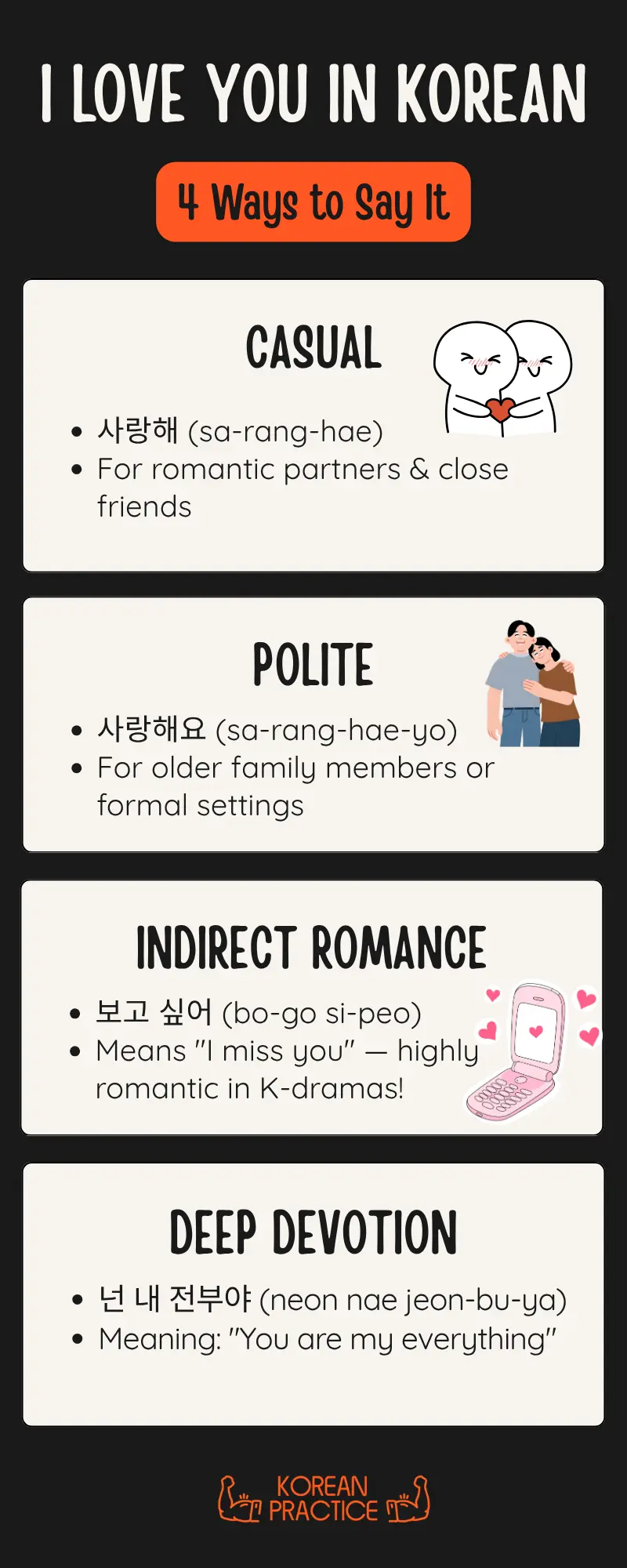
Table of Contents
1. Saranghae Meaning & Casual Forms
When it comes to Korean romance, the most famous word you’ll ever hear in K-dramas is 사랑해.
But what is the exact Saranghae meaning? It is the most direct, casual way to express deep affection, usually reserved for romantic partners or someone you are incredibly close to.
If you are speaking to a boyfriend, girlfriend, or someone younger, this is your starting point.
Original Korean Sentence
사랑해.
Pronunciation Guide
사랑해 (sa-rang-hae).
Meaning and Context
사랑하 (to love; stem of 사랑하다) 해 (I’m telling you casually).
English Translation
I love you.
Literal Translation
(I) love (you).
Original Korean Sentence
너 나 사랑해?
Pronunciation Guide
너 (neo) 나 (na) 사랑해 (sa-rang-hae)?
Meaning and Context
너 (you) 나 (me) 사랑하 (to love) 해 (I’m asking you casually)?
English Translation
Do you love me?
Literal Translation
(Do) you love me?
Original Korean Sentence
나는 너를 사랑해.
Pronunciation Guide
나는 (na-neun) 너를 (neo-reul) 사랑해 (sa-rang-hae).
Meaning and Context
나 (I) 는 (I’m going to talk about me) 너 (you) 를 (my object is you) 사랑하 (to love) 해 (I’m telling you casually).
English Translation
I love you.
Original Korean Sentence
나는 당신을 좋아해.
Pronunciation Guide
나는 (na-neun) 당신을 (dang-si-neul) 좋아해 (jo-a-hae).
Meaning and Context
나 (I) 는 (I’m going to talk about me) 당신 (you; in a polite form) 을 (my object is you) 좋아하 (to like; stem of 좋아하다) 해 (I’m telling you casually).
English Translation
I like you.
Korean Love Story, Library Love Tale
✅ “내 사람” (nae saram): This phrase translates to “my person” or “my love” and is a more casual way of expressing love.
✅ “보고 싶어” (bogo shipeo): While this phrase doesn’t directly translate to “I love you,” it means “I miss you” and can be used to express your feelings towards someone you love.
✅ “누나/오빠/언니/형 사랑해” (nuna/oppa/unni/hyung saranghae): These phrases are used by younger people to express love towards their older siblings or friends.
2. Adding Respect: Polite & Deep Korean Romantic Phrases
Korean language structures change based on who you are talking to.
If you want to say I love you in Korean words to someone older, or if you prefer a softer, more polite and friendly tone, you need to add the magic suffix “~요” or use dedicated Korean romantic phrases.
These variations allow you to intensify your feelings safely and respectfully.
✅ “사랑해요” (saranghaeyo): This is a more polite version of “사랑해” and is often used when speaking to someone older or in a formal setting.
Original Korean Sentence
너무 사랑해요.
Pronunciation Guide
너무 (neo-mu) 사랑해요 (sa-rang-hae-yo).
Meaning and Context
너무 (very) 사랑하 (to love) 해요 (I’m telling you polite and friendly).
English Translation
I love you so much.
Literal Translation
(I) love (you) very.
Original Korean Sentence
더 사랑해요.
Pronunciation Guide
더 (deo) 사랑해요 (sa-rang-hae-yo).
Meaning and Context
더 (more) 사랑하 (to love) 해요 (I’m telling you polite and friendly).
English Translation
I love you more.
Literal Translation
(I) love (you) more.
Jewelry in Korean: 5 Beautiful Words You’ll Love to Learn
Original Korean Sentence
진짜 사랑해요.
Pronunciation Guide
진짜 (jin-jja) 사랑해요 (sa-rang-hae-yo).
Meaning and Context
진짜 (really) 사랑하 (to love) 해요 (I’m telling you polite and friendly).
English Translation
I really love you.
Literal Translation
(I) really love (you).
3. Forever Promises: Deep Emotional Expressions in Korean
Sometimes, just saying “I love you” isn’t enough. To truly capture someone’s heart, you need poetic phrases that express devotion. These advanced expressions show that the person is the center of your universe.
Original Korean Sentence
보고 싶어.
Pronunciation Guide
보고 (bo-go) 싶어 (si-peo).
Meaning and Context
보 (to see) 고 싶 (want to) 어 (I’m telling you casually).
English Translation
I miss you.
Literal Translation
want to see (you).
White Day in Korean Culture: Candy, Love, and a Surprise Tradition 🍬
Original Korean Sentence
넌 내 전부야.
Pronunciation Guide
넌 (neon) 내 (nae) 전부야 (jeon-bu-ya).
Meaning and Context
너 (you) ㄴ (my topic is myself) 내 (my) 전부 (everything) 야 (are; I’m telling you casually). * 너 + ㄴ = 넌
English Translation
You are my everything.
Original Korean Sentence
항상 사랑할게요.
Pronunciation Guide
항상 (hang-sang) 사랑할게요 (sa-rang-hal-gge-yo).
Meaning and Context
항상 (always) 사랑하 (to love) ㄹ게 (will) 요 (I’m telling you polite and friendly). * 사랑하 + ㄹ게 = 사랑할게
English Translation
I will always love you.
Literal Translation
(I) will always love (you).
Original Korean Sentence
영원히 사랑해요.
Pronunciation Guide
영원히 (yeong-won-hi) 사랑해요 (sa-rang-hae-yo).
Meaning and Context
영원히 (forever) 사랑하 (to love) 해요 (I’m telling you polite and friendly).
English Translation
I love you forever.
Literal Translation
(I) love (you) forever.
5 Best Korean Love Story Drama – Learn Korean with Romance & Real Dialogue
Original Korean Sentence
너는 내 인생의 보물이야.
Pronunciation Guide
너는 (neo-neun) 내 (nae) 인생의 (in-saeng-e) 보물이야 (bo-mu-ri-ya).
Meaning and Context
너 (you) 는 (my topic is you) 내 (my) 인생 (life) 의 (of) 보물 (treasure) 이야 (are; I’m telling you casually).
English Translation
You are the treasure of my life.
Literal Translation
You are treasure of my life.
4. Beyond Words: Understanding Korean Culture Love Gestures
Learning how to say I love you in Korean is only the first step. To truly connect, you must understand Korean culture love gestures.
In Korea, affection isn’t just spoken; it is deeply rooted in the concept of “정” (Jeong)—a deep emotional bond. While massive public displays of affection (PDA) like kissing are less common, Koreans express love through thoughtful actions:
✅ The Power of Small Gifts: Exchanging chocolates, stuffed animals, or writing cute letters.
✅ The “Heart” (하트) Phenomenon: Using physical finger hearts or texting the word 하트 in chat messages.
✅ Food is Love: Cooking a warm, home-cooked meal is often considered the ultimate silent “I love you.”
Wrap-up Pop Quiz!
Let’s see if you mastered today’s lesson! Can you solve this quick puzzle? 🧩

FAQs (What You Might Still Wonder About)
1. Is there a difference between “사랑해” and “좋아해”?
Yes, a big one! While both are essential Korean romantic phrases, they carry different emotional weights. 좋아해 (jo-a-hae) means “I like you” and is perfect for the early stages of dating or crushing on someone. On the other hand, the true saranghae meaning is a deep, committed “I love you,” usually reserved for serious relationships.
2. How do I say “I love you” to my parents or family members?
In Korean culture, directly saying “I love you” to family members can sometimes feel a bit shy or formal. However, if you want to express it beautifully, you should use the polite form: 사랑해요 (sa-rang-hae-yo). It shows the perfect balance of deep love and utmost respect for your elders.
3. What does it mean when someone calls me “내 사람” (nae saram)?
This is one of the most heart-fluttering I love you in Korean words variants! Literally translating to “my person,” it softly implies, “You belong in my world, and I will protect you.” It’s a deeply romantic and intimate way to tell someone they are your everything without using the literal word for love.
4. Can I say “사랑해” to my close friends?
Generally, Koreans rarely say “사랑해” to friends of the opposite sex unless they are confessing their romantic feelings. Doing so might cause a major misunderstanding! If you want to show platonic affection to a close friend, it is much more natural to say 고마워 (go-ma-wo / thank you) or 네가 최고야 (ne-ga choi-go-ya / you’re the best).
5. Why do K-dramas use “보고 싶어” so much in romantic scenes?
Even though how to say I love you in Korean seems straightforward, Koreans often prefer indirect, emotional expressions. 보고 싶어 (bo-go si-peo) literally means “I want to see you” (I miss you). In Korean romance, telling someone you miss them is often considered just as powerful—if not more romantic—than a direct confession.
6. Are there any unique Korean culture love gestures I should know?
Absolutely! Beyond the spoken words, Korean culture love gestures are huge. You will often see couples wearing matching “couple looks” (similar outfits), celebrating romantic milestones every 100 days (instead of just yearly anniversaries), and sending the digital 하트 (heart) emoji after almost every single text sentence!
7. How do I reply when someone tells me “사랑해”?
If you feel the same way, the most natural and sweet response is to add the magic word “도” (do), which means “too” or “also.” You can reply with “나도 사랑해” (na-do sa-rang-hae), which means “I love you too.” If you want to step it up, you can say “내가 더 사랑해” (nae-ga deo sa-rang-hae) — “I love you more!”
Final words
Learning how to say I love you in Korean is so much more than just memorizing a few letters from a textbook. It is about unlocking a whole new culture of deep emotion, affection, and connection.
Whether you whisper a casual “사랑해” to someone special, share a heartwarming “보고 싶어” on a rainy day, or use unique Korean romantic phrases to show your devotion, you are now equipped to express your heart beautifully.
But remember—true fluency doesn’t come from staring at isolated vocabulary lists. Romance in Korean is all about flow, rhythm, and natural reflexes.
If you want to experience how these beautiful phrases naturally come to life through immersive, unforgettable stories, come dive into my Story Courses! Let’s re-engineer your brain to think—and love—natively in Korean.
What is your absolute favorite I love you in Korean words expression from today’s list? Share your heart in the comments below!