Making a great first impression in Korea starts with a single sentence. Whether you are planning a trip or starting your language journey, knowing how to introduce yourself in Korean is the bridge to understanding the culture.
In this guide, we will break down the process step-by-step. Even if you are just starting to learn how to say annyeonghaseyo in Korean, these 9 easy examples will help you speak with confidence.
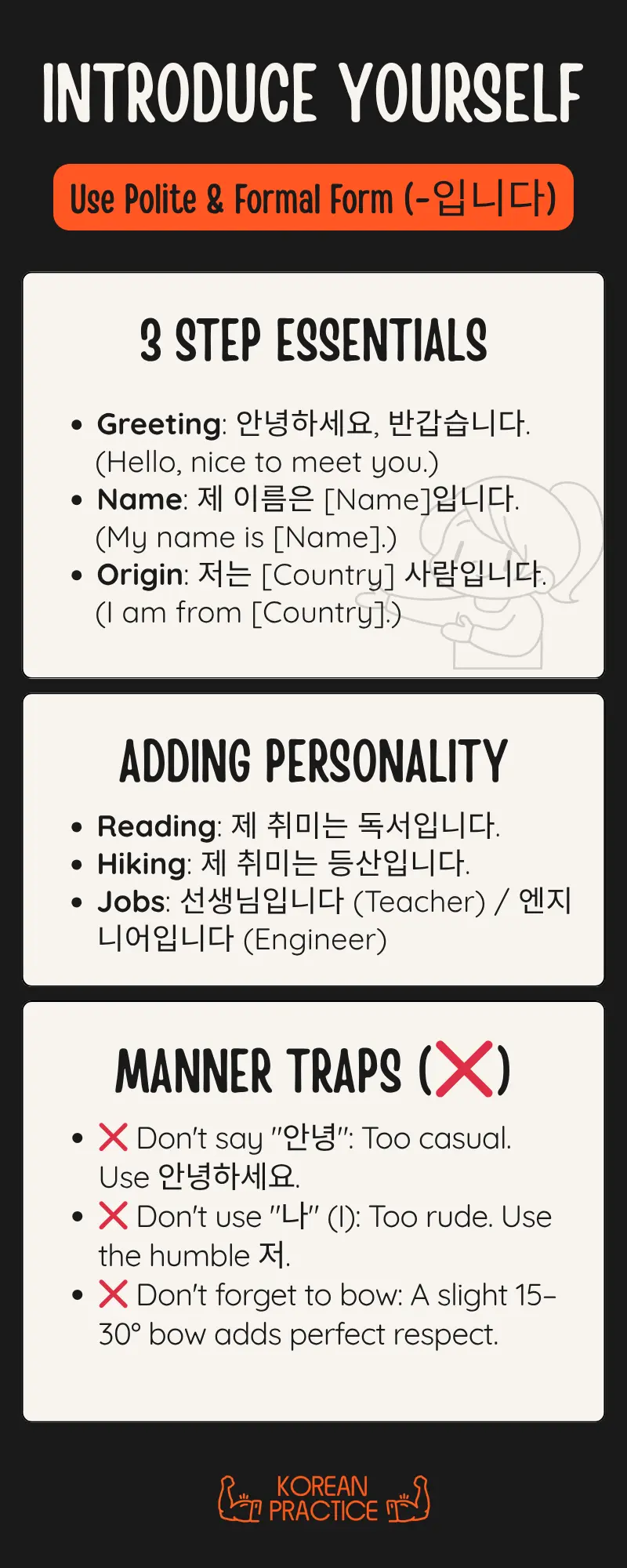
Table of Contents
Understanding the Basics: Formal Structure
Before diving into phrases, it is important to understand the soul of the language. For a self introduction in Korean formal settings, we use the sentence ending “-im-ni-da” (입니다). This ensures you sound respectful to everyone you meet.
The Gold Rule: SOV Order
Unlike English, Korean follows a Subject-Object-Verb (SOV) order. This might feel strange at first, but with a little practice, it becomes a natural speaking reflex.
Original Korean Sentence
제 이름은 제인입니다.
Pronunciation Guide
제 (je) 이르믄 (i-reu-meun) 제이님니다 (je-i-nim-ni-da).
Meaning and Context
제 (my; in a humble way) 이름 (name) 은 (my topic is my name) 제인 (Jane) 입니다 (is; I’m telling you formally).
English Translation
My name is Jane.
Original Korean Sentence
저는 멕시코 사람입니다.
Pronunciation Guide
저는 (jeo-neun) 멕시코 (mek-si-ko) 사람임니다 (sa-ram-im-ni-da).
Meaning and Context
저 (I; in a humble way) 는 (I’m going to talk about me) 멕시코 (Mexico) 사람 (person) 입니다 (am; I’m telling you formally).
English Translation
I am from Mexico.
Literal Translation
I am Mexico person.

Step-by-Step: Creating Your Introduction
Step 1: Start with a Polite Greeting
Every introduction begins with a greeting. Mastering your annyeonghaseyo in Korean pronunciation is crucial because it sets the tone for the entire conversation.
Original Korean Sentence
안녕하세요, 반갑습니다.
Pronunciation Guide
안녕하세요 (an-nyeong-ha-se-yo), 반갑슴니다 (ban-gap-seum-ni-da).
Meaning and Context
안녕하세요 (hello; in a polite way), 반갑 (to be glad) 습니다 (am; I’m telling you formally).
English Translation
Hello, nice to meet you.
Literal Translation
Hello, (I)’m glad.
Step 2: How to Introduce Yourself in Korean with Name
Once you’ve greeted someone, it’s time to share who you are. This is the most common way to let people know your name while remaining humble and polite.
Original Korean Sentence
안녕하세요, 제 이름은 존입니다. 만나서 반갑습니다.
Pronunciation Guide
안녕하세요 (an-nyeong-ha-se-yo), 제 (je) 이르믄 (i-reu-meun) 존임니다 (jon-im-ni-da). 만나서 (man-na-seo) 반갑슴니다 (ban-gap-seum-ni-da).
Meaning and Context
안녕하세요 (hello; in a polite way), 제 (my; in a humble way) 이름 (name) 은 (my topic is my name) 존 (John) 입니다 (is; I’m telling you formally). 만나 (to meet) 아서 (because) 반갑 (to be glad) 습니다 (am; I’m telling you formally). * 만나 + 아서 = 만나서
English Translation
Hello, my name is John. Nice to meet you.
Literal Translation
Hello, my name is John. (I)’m glad because (I) meet (you).
Step 3: Sharing Your Background (Nationality & Job)
Korean people are often curious about where you are from and what you do. This is a fantastic conversation starter.
Original Korean Sentence
안녕하세요, 제 이름은 John이고 저는 미국 사람입니다.
Pronunciation Guide
안녕하세요 (an-nyeong-ha-se-yo), 제 (je) 이름은 (i-reu-meun) 존이고 (jo-ni-go) 저는 (jeo-neun) 미국 (mi-guk) 사람입니다 (sa-ram-im-ni-da).
Meaning and Context
안녕하세요 (hi; in a polite way), 제 (my; in a humbe way) 이름 (name) 은 (my topic is my name) 존 (John) 이고 (and) 저 (I; in a humble way) 는 (my topic is myself) 미국 (the United States) 사람 (person) 입니다 (am; I’m telling you formally).
English Translation
Hi, my name is John and I’m from the United States.
Literal Translation
Hi, my name is John and I’m United States person.
Original Korean Sentence
제 직업은 선생님입니다.
Pronunciation Guide
제 (je) 지거븐 (ji-geo-beun) 선생님임니다 (seon-saeng-nim-im-ni-da).
Meaning and Context
제 (my; in a humble way) 직업 (occupation) 은 (my topic is my occupaton) 선생님 (teacher) 입니다 (is; I’m telling you formally).
English Translation
My occupation is a teacher.
Literal Translation
My occupation is teacher.
Original Korean Sentence
저는 엔지니어로 일합니다.
Pronunciation Guide
저는 (jeo-neun) 엔지니어로 (en-ji-ni-eo-ro) 일함니다 (il-ham-ni-da).
Meaning and Context
저 (I; in a humble way) 는 (my topic is myself) 엔지니어 (engineer) 로 (as) 일하 (to work) ㅂ니다 (I’m telling you formally).
English Translation
I work as an engineer.
Literal Translation
I work as engineer.
Adding Personality: Hobbies and Interests
Sharing your hobbies makes you more relatable. It turns a standard introduction into a real connection.
Original Korean Sentence
제 취미는 독서입니다.
Pronunciation Guide
제 (je) 취미는 (chwi-mi-neun) 독서입니다 (dok-sseo-im-ni-da).
Meaning and Context
제 (my; in a humbe way) 취미 (hobby) 는 (my topic is my hobby) 독서 (reading) 입니다 (is; I’m telling you formally).
English Translation
My hobby is reading.
Original Korean Sentence
제 취미는 등산입니다.
Pronunciation Guide
제 (je) 취미는 (chwi-mi-neun) 등사님니다 (deung-sa-nim-ni-da).
Meaning and Context
제 (my; in a humble way) 취미 (hobby) 는 (my topic is my hobby) 등산 (hiking) 입니다 (is; I’m telling you formally).
English Translation
My hobby is hiking.
Pro Tips for Natural Pronunciation
Many learners worry about their accent. However, how to introduce yourself in Korean pronunciation improves quickly when you focus on the rhythm of the words rather than just individual letters.
Keep it Simple: In a self introduction in Korean formal context, clear and short sentences are better than long, complex ones.
Respect the Status: Always use honorifics (like using ‘Je’ instead of ‘Na’) when speaking to someone older or in a higher position.

FAQs (What You Might Still Wonder About)
1. When should I use ‘Annyeong’ instead of ‘Annyeonghaseyo’?
Save ‘Annyeong’ for your very close friends or people younger than you. In almost all other cases, sticking to the polite annyeonghaseyo in Korean is the safest way to show respect.
2. Is my name pronounced differently in Korean?
Sometimes! Depending on the sounds in your name, it might be adapted to fit the Korean phonetic system. Learning the right how to introduce yourself in Korean pronunciation for your own name is a great first task.
3. Do I need to bow when I introduce myself?
Yes, a slight bow while saying your greeting adds a layer of politeness that Koreans deeply appreciate.
4. Is bowing mandatory during a self-introduction?
In Korea, a greeting is rarely just verbal. A slight bow (about 15 to 30 degrees) while saying annyeonghaseyo in Korean is a non-verbal sign of respect. It shows that you understand and value Korean etiquette, which always leaves a lasting positive impression.
5. What if I forget the formal verb endings mid-sentence?
Don’t panic! Koreans are very patient with language learners. If you accidentally use a casual form, just smile and correct yourself with a polite ending. The effort to speak self introduction in Korean formal style is what matters most to native speakers.
6. How can I sound more like a native speaker quickly?
The secret isn’t in the vocabulary—it’s in the rhythm. Instead of robotic memorization, we recommend “Shadowing” short, natural sentences. At KoPra (Korean Practice), we focus on this “Reflex Training” so that your introduction sounds fluid and rhythmic, rather than practiced and stiff.
Final words
Learning how to introduce yourself in Korean is more than just a language lesson; it is your first handshake with a new culture. From mastering a polite annyeonghaseyo in Korean pronunciation to confidently sharing your story in a self introduction in Korean formal setting, every step counts.
Don’t worry about being perfect from day one. Whether you are practicing how to introduce yourself in Korean with name or nationality, the most important thing is to start. At KoPra (Korean Practice), we are here to help you turn these phrases into a natural speaking reflex. Keep practicing, stay curious, and you will be making great first impressions in no time!