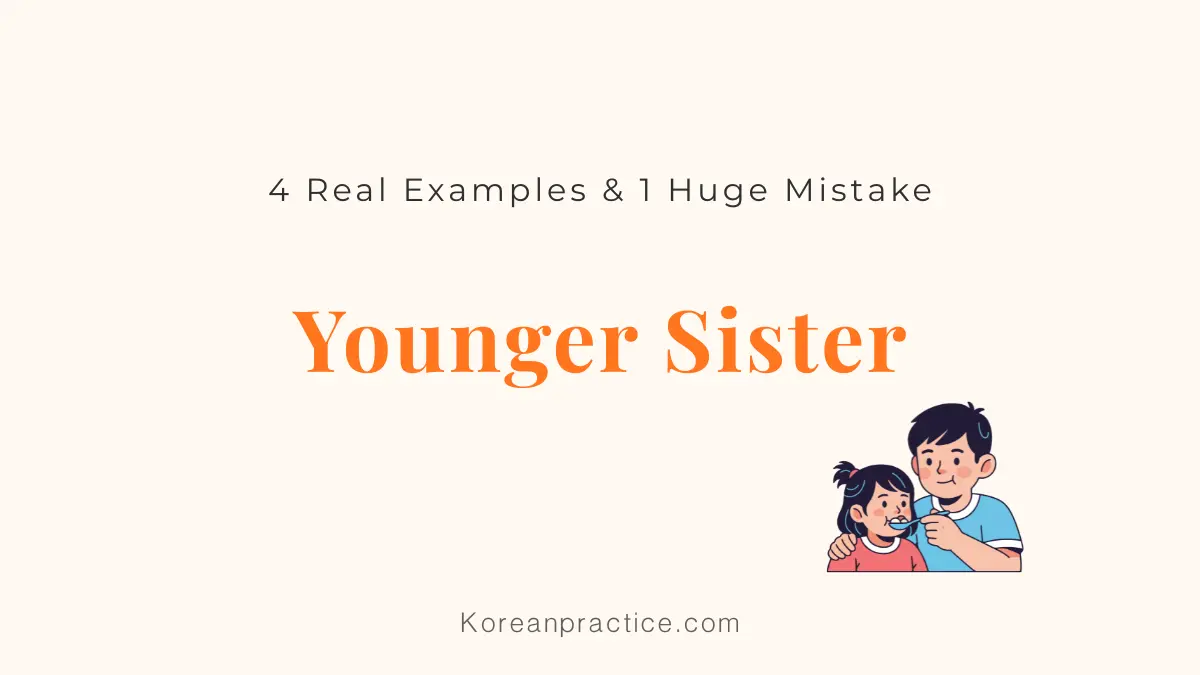
Quick Answer: The standard word for younger sister in Korean is 여동생 (yeo-dong-saeng), and it can be used by both brothers and sisters. However, you should never call her “여동생” to her face!
Check out this quick visual guide to master the core pattern of “younger sister” instantly!
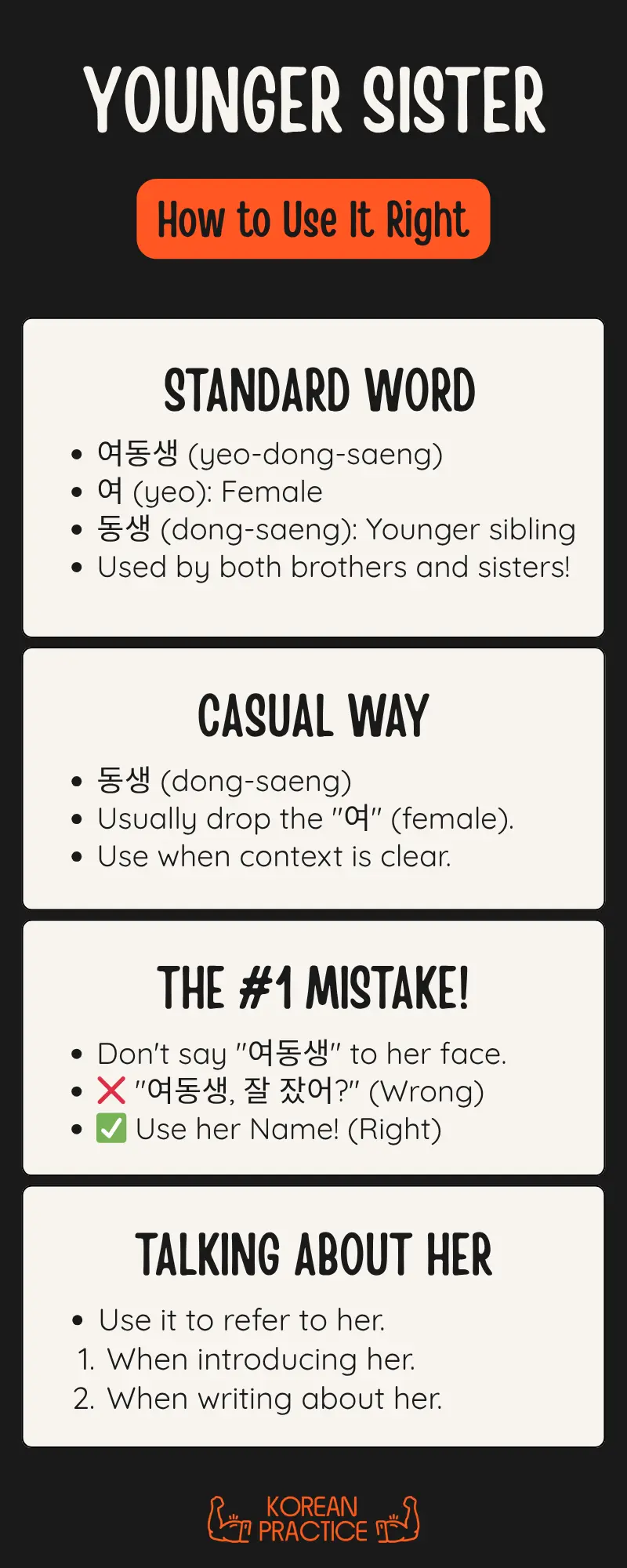
Learning how to call younger sister in Korean doesn’t have to be boring. In this guide, you’ll learn the most common way to say “younger sister” in Korean, plus some fun examples you can actually use. I’ll show you 4 real-life sentences that Koreans use every day!
What You’ll Learn:
The main word for younger sister in Korean language (여동생)
How to use little sister in Korean language in sentences
Different ways to talk about your younger sister
Fun examples with easy breakdowns
Table of Contents
What Does 여동생 Actually Mean?
Let me break down the word younger sister in Korean language for you:
여동생 = 여 + 동생
여 = female
동생 = younger sibling
So basically, 여동생 means “female younger sibling” or just “younger sister”!
Fun Fact: If you want to say “younger brother,” just change 여 to 남 and you get 남동생!
But here’s the cool part: most Koreans just say 동생 for any younger sibling. It’s easier and everyone understands from context!
Original Korean Sentence
어제 여동생이랑 같이 영화를 봤어요.
Pronunciation Guide
어제 (eo-je) 여동생이랑 (yeo-dong-saeng-i-rang) 가치 (ga-chi) 영화를 (yeong-hwa-reul) 봣써요 (bwat-sseo-yo).
Meaning and Context
어제 (yesterday) 여동생 (younger sister) 이랑 (with) 같이 (together) 영화 (movie) 를 (my object is a movie) 보 (to watch) 았 (past tense) 어요 (I’m telling you polite and friendly).
English Translation
I watched a movie with my younger sister yesterday.
Literal Translation
(I) watched movie together with younger sister yesterday.
✍️ Related: Teacher in Korean: The 5 Correct Ways to Address Teachers (Avoid These Common Mistakes!)
Original Korean Sentence
여동생이 정말 귀여워요.
Pronunciation Guide
여동생이 (yeo-dong-saeng-i) 정말 (jeong-mal) 귀여워요 (gwi-yeo-wo-yo).
Meaning and Context
여 (female) 동생 (younger sibling) 이 (my subject is my younger sister) 정말 (really) 귀엽 (to be cute) 어요 (is; I’m telling you polite and friendly).
English Translation
My younger sister is really cute.
Literal Translation
(My) younger sister is really cute.
✍️ Related: Blind Date in Korean: Learn the Word Sogaeting and Korean Dating Culture
Quick Tip: When Do You Use 여동생?
Use younger sister in Korean language (여동생) when:
✅ Talking ABOUT your sister to others
✅ Introducing your sister to someone new
✅ Writing about your sister
Don’t use it when:
❌ Talking directly TO your sister (just use her name!)
❌ In super casual family conversations
Original Korean Sentence
잘 잤어? 아침 먹자.
Pronunciation Guide
잘 (jal) 잣써 (jat-sseo)? 아침 (a-chim) 먹짜 (meok-jja).
Meaning and Context
잘 (well) 자 (to sleep) 았 (past tense) 어 (I’m asking you casually)? 아침 (breakfast) 먹 (to eat) 자 (let’s; in a casual way).
English Translation
Did you sleep well? Let’s have breakfast.
Literal Translation
Slept well? Let’s eat breakfast.
✍️ Related: Body Parts in Korean: A Comprehensive Guide
Original Korean Sentence
내 여동생과 함께 쇼핑하러 갔어요.
Pronunciation Guide
내 (nae) 여동생과 (yeo-dong-saeng-gwa) 함께 (ham-gge) 쇼핑하러 (syo-ping-ha-reo) 갓써요 (gat-sseo-yo).
Meaning and Context
내 (my) 여 (female) 동생 (younger sibling) 과 (with) 함께 (together) 쇼핑 (shopping) 하 (to do) 러 (in order to) 가 (to go) 았 (past tense) 어요 (I’m telling you polite and friendly).
English Translation
I went shopping with my younger sister.
Literal Translation
(I) went in order to do shopping together with my younger sister.
✍️ Related: How to Say Yes and No in Korean – 8 Easy Examples Explained
Korean Sister Words Cheat Sheet
Here are all the Korean words for sister you should know:
For Younger Sister:
- 여동생 (yeo-dong-saeng) = younger sister in Korean language
- 동생 (dong-saeng) = younger sibling (shorter version)
For Older Sister (girls say this):
- 언니 (eon-ni) = older sister (said by girls)
For Older Sister (boys say this):
- 누나 (nu-na) = older sister (said by boys)
See? How to say younger sister in Korean is way easier than the older sister words because everyone uses the same word!
Try It Yourself!
Fill in the blanks with 여동생:
내 _____은 학생이에요. (My younger sister is a student.)
_____이 선물을 줬어요. (My younger sister gave me a gift.)
_____이랑 공원에 갔어요. (I went to the park with my younger sister.)
Answers: 1. 여동생 2. 여동생 3. 여동생
Wrap-up Pop Quiz!
Let’s see if you mastered today’s lesson! Can you solve this quick puzzle? 🧩
FAQs (What You Might Still Wonder About)
1. Can I just say “동생” instead of “여동생”?
Yes! In casual conversation, Koreans often omit 여 and simply say 동생, which means “younger sibling” and can refer to either a sister or brother.
2. Are there different words based on the speaker’s gender?
For younger sister, 여동생 is universal and doesn’t depend on the speaker’s gender. However, for older sister, women use 언니 (eonni) and men use 누나 (nuna).
3. How do I say “my younger sister” in a polite sentence?
A formal example: “저의 여동생은 대학교에 다니고 있어요.” (Jeoui yeodongsaeng-eun daehakgyo-e danigo isseoyo.) → “My younger sister is attending college.”
4. How do I refer to younger sisters in extended or in-law relationships?
Variations include: Step‑younger‑sister: 의붓동생 (uibutdongsaeng) Half‑younger‑sister: 이복동생 (ibokdongsaeng) Sister‑in‑law (husband’s brother’s wife or wife’s younger sister): terms differ depending on context, like 동서 or 처제.
5. How do I say “twin younger sister” in Korean?
You can say 쌍둥이 여동생 (ssang-dung-i yeo-dong-saeng). If she is born even a few minutes after you, she is technically your younger sister in Korea! However, twins in Korea often just call each other by name or friend-like terms since they are the same age.
6. What is the cozy or cute way to call my younger sister?
If you want to sound affectionate, you can add “우리” (uri – our/my) in front of the word, making it 우리 동생 (uri dong-saeng) or 우리 막내 (uri mang-nae) if she is the youngest child in the family. It sounds very warm and loving!
7. Is it okay to use “여동생” when texting or messaging her?
No, even in text messages (like KakaoTalk), you should avoid addressing her as “여동생”. Instead, just type her Name + 아/야 (e.g., “수진아 뭐해?”) or use friendly family nicknames. Remember, “여동생” is only for describing her to other people!
Final words
Mastering family terms like younger sister in Korean language is a small but essential step in learning Korean. It helps you navigate relationships and conversations more naturally.
Start incorporating these terms into your daily practice, and you’ll see improvements in your Korean language skills.
Understanding these nuances will not only help you speak better Korean but also connect more deeply with Korean culture.
Keep practicing, and soon enough, you’ll be using these younger sister in Korean language as if they were your own!