Have you ever noticed a Korean friend or colleague pausing to scan the room before speaking? They are likely practicing a vital social skill called “Nunchi.”
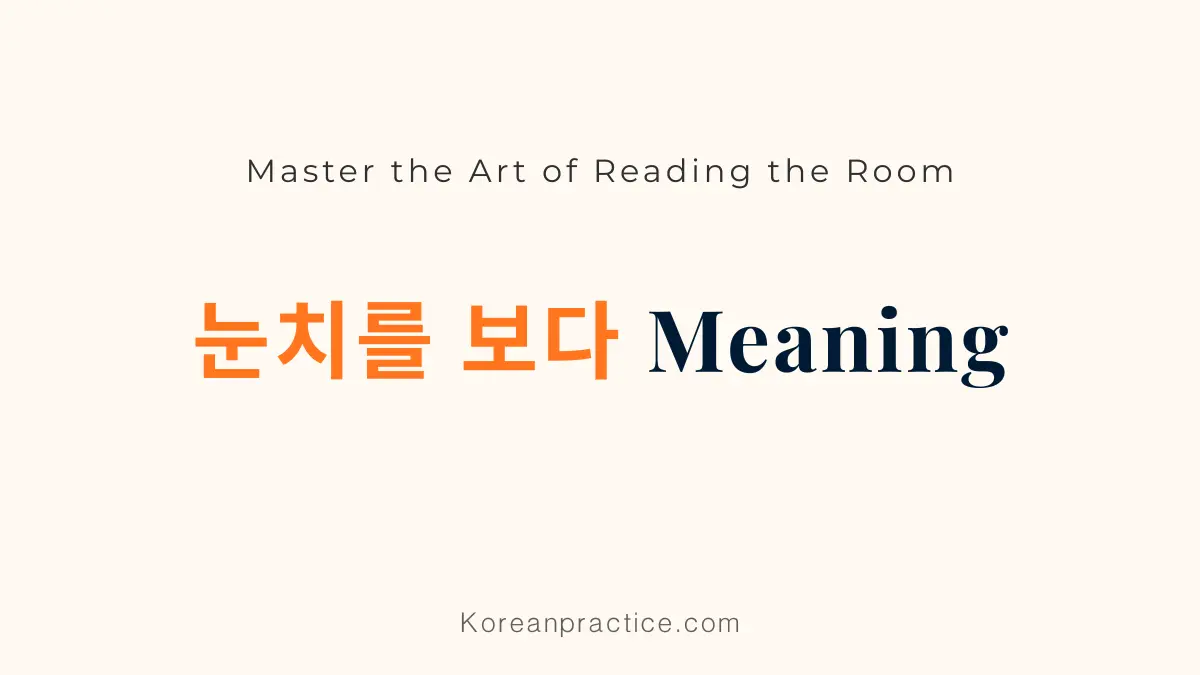
Today, we’ll dive into the 눈치를 보다 meaning in English and why mastering this expression is a game-changer for your Korean fluency.
Table of Contents
What does ‘눈치를 보다’ mean?
The phrase is a combination of two words:
눈치 (Nunchi): The ability to listen and gauge others’ moods or the environment.
보다 (Boda): To see or observe.
When combined, the 눈치를 보다 meaning in English is often translated as “to read the room“ or “to assess the situation.“
It describes the act of observing someone’s reactions or the overall mood to decide how you should act.

Nuances: When and Why to use it?
The core nuance of 눈치 보다 meaning lies in social awareness and harmony. It is commonly used in these contexts:
Avoiding Conflict: Observing others’ moods to ensure you don’t accidentally upset them.
Gauging Timing: Figuring out the “right moment” to speak or ask a question.
Seeking Approval: Checking if your actions are being accepted by those around you.
Do You Speak English in Korean? 9 Easy Ways to Ask (With Examples)
눈치를 보다 Example: See it in Action
To help you understand the 눈치를 보다 example in real-life contexts, here are three scenarios where this phrase is perfectly used:
Navigating the Workplace
In Korean office culture, being mindful of your manager’s mood is a common part of the day.
Original Korean Sentence
상사 눈치를 보면서 일해야 해요.
Pronunciation Guide
상사 (sang-sa) 눈치를 (nun-chi-reul) 보면서 (bo-myeon-seo) 이래야 (i-rae-ya) 해요 (hae-yo).
Meaning and Context
상사 (boss; A person in a higher position at work) 눈치 (sense/awareness): The ability to read others’ feelings or situations without them saying it directly 보면서 (while watching/observing): 보다 (to see/watch) + * 면서 (while) 일해야 해요 (have to work): 일하다 (to work) + * 해야 해요 (have to; I’m telling you polite and friendly)
Pronunciation Patterns for Conjugations
⊳ 하 changes to 해
Grammar
면서: Expresses two actions happening at the same time
해야 해요: Expresses obligation or necessity
Culture
In Korean workplace culture, reading the mood and understanding your boss’s expectations without direct words is considered important.
English Translation
I have to work while being mindful of my boss’s mood.
Literal Translation
While watching boss mood, (I) have to work.
Did You Eat in Korean? Why This Greeting Means More Than Food
Stop playing house with “easy” methods that don’t work.
Isolated vocabulary and grammar won’t help you speak. You need to understand the core structure first.
1. Breakdown: Master Korean sentence structure with our Story Style Breakdown™.
2. Training: Turn that knowledge into an instant reflex through Brain Rewiring™.
Install the Korean Engine in your brain. Move beyond simple memorization and start speaking with confidence.
Choosing the Right Moment
Using your intuition to decide when to speak up during a group conversation.
Original Korean Sentence
그는 눈치를 보며 질문을 했어.
Pronunciation Guide
그는 (geu-neun) 눈치를 (nun-chi-reul) 보며 (bo-myeo) 질무늘 (jil-mu-neul) 햇써 (haet-sseo).
Meaning and Context
그 (he) 는 (my topic is he) 눈치를 보며 (while gauging the mood): 눈치 (sense/awareness) + 를 (my object is the mood) 보다 (to see/watch) + * 며 (while) 질문을 했어 (asked a question; I’m telling you casually): 질문 (question) 을 (my object is question) 했어 (did; I’m telling you casually)
Grammar
며: Connects two actions happening simultaneously
English Translation
He asked a question while carefully gauging the mood.
Literal Translation
While watching mood, he asked a question.
I See in Korean: 3 Real Phrases Koreans Use (Not Just ‘그렇구나’!)
Seeking Permission
A classic scene of a child gauging their parent’s reaction before making a request.
Original Korean Sentence
아이가 엄마 눈치를 보며 장난감을 사달라고 했다.
Pronunciation Guide
아이가 (a-i-ga) 엄마 (eom-ma) 눈치를 (nun-chi-reul) 보며 (bo-myeo) 장난까믈 (jang-nan-gga-meul) 사달라고 (sa-dal-la-go) 햇따 (haet-dda).
Meaning and Context
아이 (child) 가 (I’m going to talk about the child) 엄마 눈치를 보며 (while watching mom’s mood): 엄마 (mom) + 눈치 (sense/awareness) + 보다 (to see/watch) + 며 (while) 장난감 (toy) 을 (object marker) 사달라고 했다 (asked to buy): * 사다 (to buy) + 달라고 했다 (asked for something; I’m narrating)
Grammar
*사달라고 하다: A polite way to ask someone to do something for you
English Translation
The child asked their mom to buy a toy while watching her mood.
Literal Translation
While watching mom mood, child asked to buy toy.
Juseyo Meaning – What ‘주세요’ Means and How to Use It in Korean
“Experience the System, Beyond Just Understanding.”
Stop guessing. Experience the precision of Original Story Style Breakdown™ and the power of Brain Rewiring™ in your own brain.
We don’t just teach you Korean; we re-engineer how you think in it. Sign up to experience our exclusive training sessions and see the results for yourself.
FAQs (What You Might Still Wonder About)
1. What is the difference between “눈치가 있다” and “눈치를 보다”?
While “눈치를 보다” refers to the act of gauging a mood or reading a room, “눈치가 있다” means to have good “Nunchi”—essentially being quick-witted or socially perceptive. One is an action (observing), while the other is a trait (being perceptive).
2. Is “눈치를 보다” always a negative thing?
Not necessarily! While it can mean being overly self-conscious or timid, it is also viewed as a sign of empathy and respect for others’ feelings in Korean society. It shows you are trying to maintain social harmony.
3. Can I use this phrase with my friends?
Yes, but the context changes slightly. If a friend is acting unusually quiet, you might say, “왜 자꾸 내 눈치를 봐?” (Why are you walking on eggshells around me?). It implies the other person is being unnecessarily cautious.
4. Is there a noun form for someone who doesn’t have Nunchi?
Yes! A person who is oblivious to social cues or “reads the room” poorly is often called “눈치가 없다”. In slang, they might be referred to as having “눈치 제로” (Nunchi Zero).
5. How do I say “Don’t worry about what others think”?
A common expression related to this is “다른 사람 눈치 보지 마세요”. This literally translates to “Don’t watch others’ Nunchi,” meaning you should act confidently without worrying about others’ judgments.
6. Is “눈치를 보다” used in formal business settings?
Absolutely. In fact, it is considered a vital skill in Korean workplace culture to understand your boss’s expectations or the company atmosphere without everything being said explicitly.
7. Can “눈치” be used with other verbs?
Yes, “눈치를 채다” is another very common phrase. While “눈치를 보다” is the act of trying to read the mood, “눈치를 채다” means you have successfully “noticed” or “caught on” to a secret or a subtle change in the situation.
Final words
Understanding the 눈치를 보다 meaning in English is about more than just vocabulary—it’s about understanding the Korean cultural focus on empathy and social harmony. By mastering this expression, you can navigate Korean interactions with much more confidence.