
Have you ever come across the Korean phrase ‘마음에 들다‘? While it’s often translated as “to like,” it carries a beautiful, deeper sentiment that is central to the Korean language.
Today, we’ll explore the 마음에 들다 meaning in English and how to use it like a native speaker.
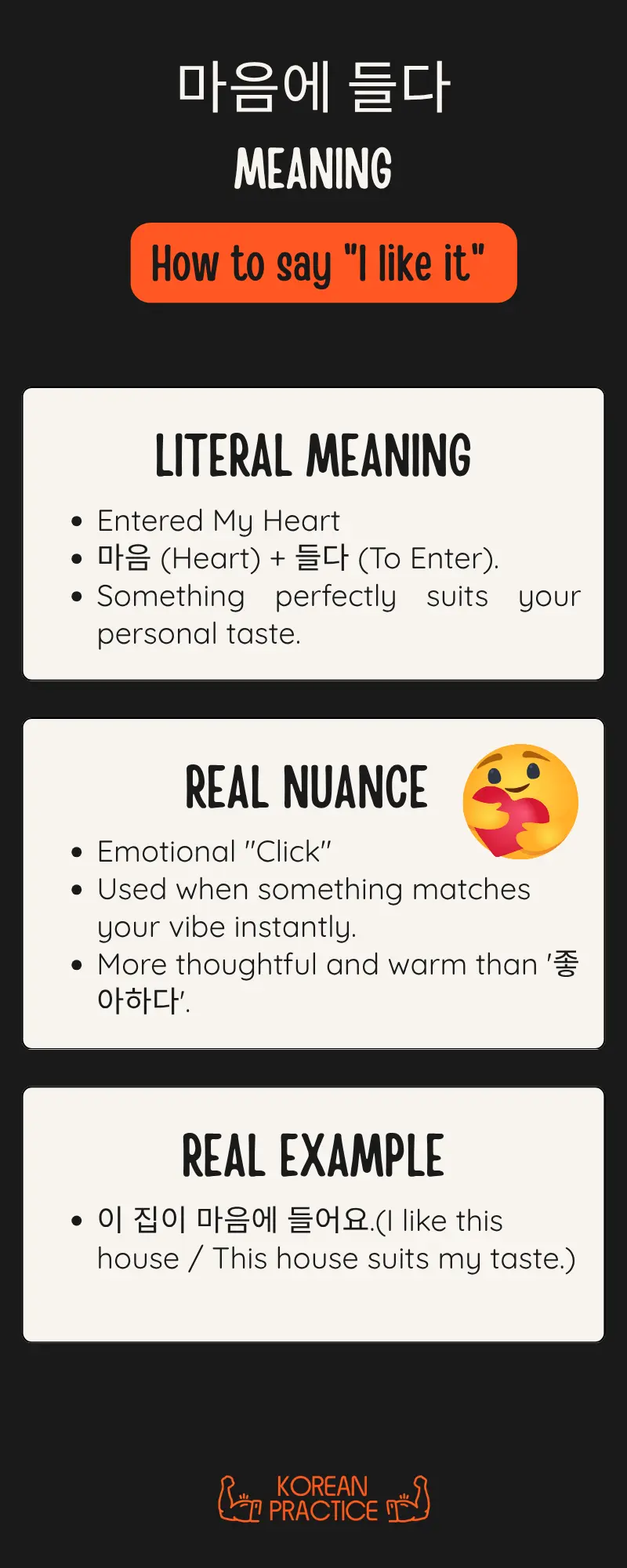
Table of Contents
What does ‘마음에 들다’ actually mean?
To understand this phrase, let’s look at the literal breakdown:
마음 (Ma-eum): Heart, mind, or feelings.
들다 (Deul-da): To enter or go into.
When you put them together, it literally means something has “entered your heart“. It suggests that something isn’t just “good,” but it perfectly suits your personal taste or emotional standards.
[마음에 들다 meaning in English]
“To like,” “to be pleased with,” or “to appeal to one’s taste”.

Nuance: Why use it instead of ‘좋아하다’?
You might wonder about the difference between 마음에 들어요 in English and the standard verb for “to like,” 좋아하다.
Instinctive Connection: ‘마음에 들다’ is used when something “clicks” with you immediately, like a first impression.
Aesthetic Appeal: It is the perfect choice for expressing that a specific style, design, or item matches your vibe.
Emotional Warmth: It sounds more thoughtful and emotional than a simple “I like it”.
Real-Life Examples
Here is how you can use the 마음에 들다 example sentences in daily conversation:
Talking about a new place or item
Original Korean Sentence
이 집이 마음에 들어요.
Pronunciation Guide
이 (i) 지비 (ji-bi) 마으메 (ma-eu-me) 드러요 (deu-reo-yo).
Meaning and Context
이 (this) 집 (house) 이 (my subject is this house) 마음 (heart, feeling) * 에 (at) * 들 (to please, to suit) 어요 (I’m telling you polite and friendly).
Grammar
에: Indicates a metaphorical place where feelings or impressions settle.
들어요: Present tense polite form of 들다 (to enter, to suit).
Culture
In Korean, liking something is often expressed by saying that it “enters the heart,” giving a warm and emotional nuance.
English Translation
I like this house.
Literal Translation
This house suit at (my) heart.
Want to learn another interesting Korean expression? Discover the 3 surprising meanings of 미역국을 먹다 →

When a style or design suits your taste
Original Korean Sentence
새로운 디자인이 마음에 들어요.
Pronunciation Guide
새로운 (sae-ro-un) 디자이니 (di-ja-in-i) 마으메 (ma-eu-me) 드러요 (deu-reo-yo).
Meaning and Context
새로운 (new) 디자인 (design) 이 (my subject is new design) 마음에 들어요 (I like it): 마음 (heart, feeling) + 에 (to) + 들다 (to enter) 어요 (I’m telling you polite and friendly).
English Translation
I like the new design.
Literal Translation
New design enter to (my) heart.
Love Korean dramas? Explore 5 Best Korean Love Story Dramas to Learn Real Dialogue →
Politely hoping someone else likes something
Original Korean Sentence
생일 선물이 마음에 들었으면 좋겠어요.
Pronunciation Guide
생일 (saeng-il) 선무리 (seon-mu-ri) 마으메 (ma-eu-me) 드럿쓰면 (deu-reot-sseu-myeon) 조켓써요 (jo-ket-sseo-yo).
Meaning and Context
생일 (birthday) 선물 (gift) 이 (subject marker) 마음에 들었으면 (if you liked it): 마음 (heart, feeling) + 에 (at) + 들다 (to please, to suit) + 었 (past tense) + * 으면 (if) 좋겠어요 (I hope so): 좋다 (to be good) + 겠 (expressing hope or desire) 어요 (I’m telling you polite and friendly).
Grammar
* In Korean, expressing hope for someone else’s feelings is often done with “-으면 좋겠어요,” showing a thoughtful and polite wish.
English Translation
I hope you liked the birthday gift.
Literal Translation
If birthday gift pleased (your) heart, (that) would be good.
Confused about Korean ages? Understand the Korean Age System and Why Age Matters So Much →
What does “배가 아프다” really mean? Learn 2 meanings of 배가 아프다: pain and jealousy →
마음에 들다 Conjugation Guide
To speak naturally, you need to know the right 마음에 들다 conjugation for different situations.
| Situation | Korean Phrase | English Meaning |
| Polite Present | 마음에 들어요 | I like it / It suits me. |
| Past Tense | 마음에 들었어요 | I liked it. |
| Negative Form | 마음에 안 들어요 | I don’t like it / It’s not my taste. |
| Formal Question | 마음에 드세요? | Do you like it? / Does it suit you?. |
Wrap-up Pop Quiz!
Let’s see if you mastered today’s lesson! Can you solve this quick puzzle? 🧩

FAQs (What You Might Still Wonder About)
1. Is “마음에 들다” used in formal situations?
Yes, it can be! “마음에 들다” is versatile and works in both casual and formal contexts. In polite speech, you’d say “마음에 들어요”, and in formal business or customer service situations, you might hear “마음에 드십니까?” or “마음에 드셨나요?” to show respect.
2. What’s the difference between “좋아하다” and “마음에 들다”?
Great question! “좋아하다” is a general verb for “to like,” while “마음에 들다” has a more emotional or instinctive nuance — it’s like saying something really clicked with your heart. If you’re talking about first impressions or aesthetic taste, “마음에 들다” often sounds more natural.
3. Can I use “마음에 들다” in the past tense?
Yes! If you liked something in the past, just use the past tense form: “마음에 들었어요.”
For example:
그 영화가 정말 마음에 들었어요. (I really liked that movie.)
It’s super common when talking about gifts, experiences, or people you’ve already met.
4. Is there a negative form of “마음에 들다”?
Yes, and it’s very useful! You can say “마음에 안 들어요” to mean “I don’t like it” or “It doesn’t suit my taste.”
For example:
이 색깔이 마음에 안 들어요. (I don’t like this color.)
It sounds natural and not too harsh — great for expressing your preferences politely.
5. Can I use “마음에 들다” to talk about food?
You can, especially when talking about how much you liked the taste or presentation.
Example:
이 요리가 정말 마음에 들어요. (I really like this dish.)
But if you’re just saying it tastes good, “맛있어요” is the more direct way. “마음에 들다” adds a nuance that you liked everything about it, not just the flavor.
🚀 Want to read Korean faster? Check out 4 speed reading strategies that really work →
Final words
Learning the 마음에 들다 meaning in English is a significant step toward sounding like a native speaker. While “좋아하다” is a common starting point, understanding 마음에 들어요 in English allows you to describe your personal tastes and aesthetic preferences with much more emotional depth.
Whether you are talking about gifts, places, or people who made a great first impression, this expression is a must-know. By practicing the various forms of 마음에 들다 conjugation—from the polite present to the past tense—you’ll gain the confidence to express exactly how you feel in any situation. Don’t be afraid to use a 마음에 들다 example next time you’re shopping or receiving a gift!