

The Korean word juseyo meaning (주세요) is one of the first and most useful expressions every learner should know.
It means “please give me” or “please do something for me.” It comes from the verb 주다 (to give) and the polite ending –세요, which makes your request sound kind and respectful.
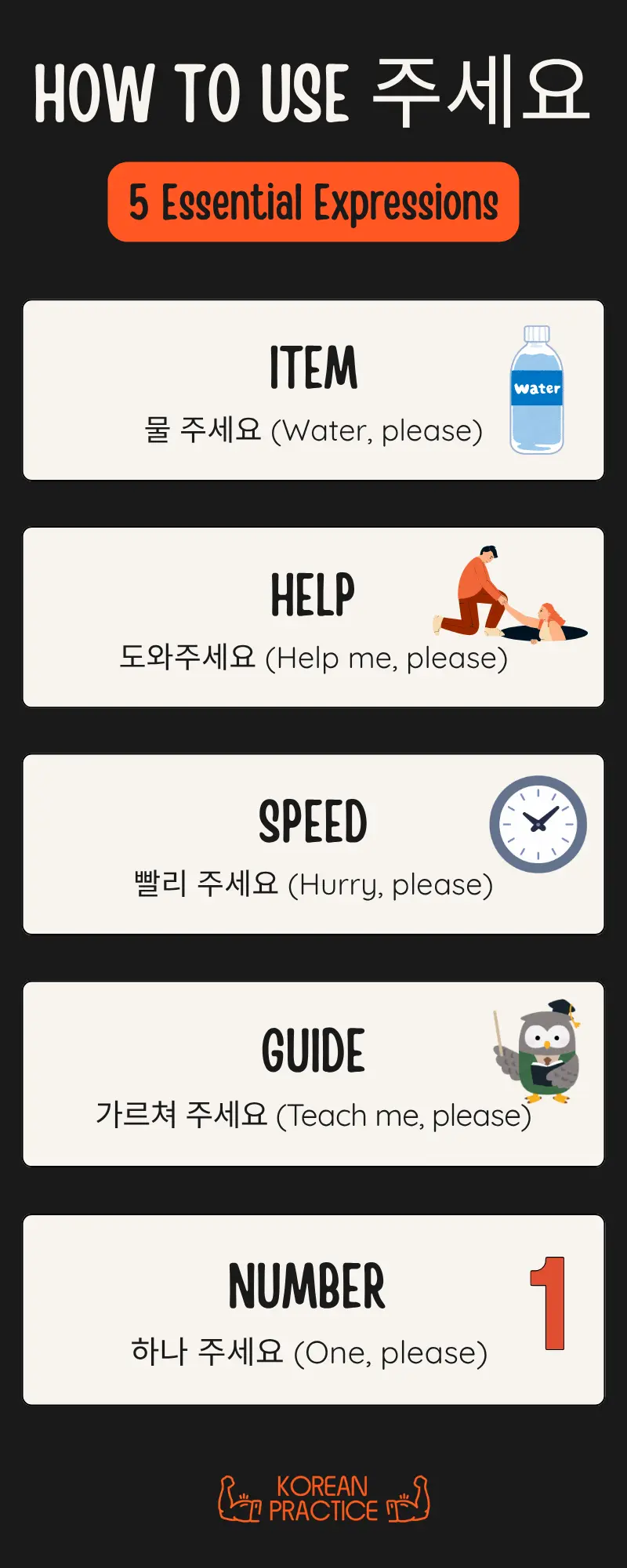
Check out this quick visual guide to master the core pattern of juseyo instantly!
Quick Warm-up Quiz!
Test your skills before diving into the blog post! 🧩 See if your Korean intuition is right on track.
Table of Contents
How “Juseyo” Works in a Sentence
So, the structure is:
주다 (to give) → 주세요 (please give)
In English, you say “please” at the beginning or end of a sentence.
But in Korean, “주세요” is built into the sentence itself, showing both your request and your politeness.
Example Sentences:
Original Korean Sentence
물 한 잔 주세요.
Pronunciation Guide
물 (mul) 한 (han) 잔 (jan) 주세요 (ju-se-yo).
Meaning and Context
물 (water) 한 (one) 잔 (cup) 주 (to give; stem of 주다) 세요 (please).
English Translation
Please give me a glass of water.
Literal Translation
Please give (me) water one cup.
“Juseyo” is more than just a polite word — it’s part of Korean culture of respect.
Using polite language is a big part of everyday life in Korea, and saying “주세요” shows that you care about being respectful to others.
Learning “주세요” Step by Step
Let’s learn how “주세요” changes meaning depending on what words you use before it.
You can think of it as a tool — once you understand how it works, you can build many useful and natural expressions.
In this guide, we’ll learn:
- Asking for something → 물 주세요 (Please give me water)
- Asking quickly → 빨리 주세요 (Please hurry)
- Asking for a number → 하나 주세요 (One, please)
- Asking with emotion → 사랑해 주세요 (Please love me)
Let’s explore each one in detail.
1. Basic Form – “주세요” to Ask for Something
The simplest and most common use of juseyo is when you want to ask for an item politely — at a restaurant, store, or café.
Just put the noun you want in front of “주세요.”
Example:
저는 불고기를 좋아해요. 불고기 두 개 주세요.
I like bulgogi. Please give me two portions of bulgogi.
Example:
이 가방 예뻐요. 이거 주세요.
This bag is pretty. Please give me this one.
In daily life, you’ll hear “주세요” almost everywhere — from ordering coffee to buying clothes.
Example Sentences:
Original Korean Sentence
이 가방 예뻐요. 이거 주세요.
Pronunciation Guide
이 (i) 가방 (ga-bang) 예뻐요 (ye-bbeo-yo). 이거 (i-geo) 주세요 (ju-se-yo).
Meaning and Context
이 (this) 가방 (bag) 예쁘 (to be pretty; stem of 예쁘다) 어요 (is; I’m telling you polite and friendly). 이 (this) 거 (thing) 주 (to give; stem of 주다) 세요 (please).
English Translation
This bag is pretty. Please give me this one.
Literal Translation
This bag is pretty. Please give (me) this thing.
✍️ Related: Want to boost your verb power? Learn 11 must-know Korean verbs in Korean Verbs List – Easy Examples Guide →
🌿 Cultural note
In Korean culture, how you say things matters as much as what you say.
Even if you’re simply asking for water, adding “주세요” turns a demand into a polite request.
Without it, the sentence might sound too direct or even rude.
So, “물!” (Water!) sounds harsh, but “물 주세요.” (Please give me water.) sounds friendly and respectful.

2. Palli Juseyo (빨리 주세요) – “Please Hurry!”
Now let’s learn another useful phrase: palli juseyo (빨리 주세요).
Palli (빨리) means “quickly” or “hurry,” so this phrase literally means “please give it quickly” or “please hurry.”
You might hear it in restaurants, cafés, or even hospitals — anywhere someone is asking politely but wants something soon.
Example:
지금 너무 늦었어요. 커피 빨리 주세요.
I’m really late right now. Please give me the coffee quickly.
Example:
사진을 오늘 안에 보내야 해요. 사진 빨리 주세요.
I need to send the photos today. Please give them to me quickly.
Example Sentences:
Original Korean Sentence
지금 너무 늦었어요. 커피 빨리 주세요.
Pronunciation Guide
지금 (ji-geum) 너무 (neo-mu) 늦었어요 (neu-jeot-sseo-yo). 커피 (keo-pi) 빨리 (ppal-li) 주세요 (ju-se-yo).
Meaning and Context
지금 (now) 너무 (too) 늦 (to be late; stem of 늦다) 었 (past tense) 어요 (is; I’m telling you polite and friendly). 커피 (coffee) 빨리 (quickly) 주 (to give; stem of 주다) 세요 (please).
English Translation
It’s too late now. Please give me coffee quickly.
Literal Translation
(It)’s too late now. Please give (me) coffee quickly.
✍️ Related: Still confused about 이, 그, 저? Master them with 9 Korean Demonstrative Pronouns – Step-by-Step Examples →
🌿 Cultural nuance
“Palli juseyo” is polite, but tone is important.
If you say it softly, it’s perfectly fine.
But if you shout or say it with a strong voice, it can sound impatient or rude.
In Korean society, emotional control and tone are key parts of politeness.
So, when you use “palli juseyo,” think of it as a gentle hurry, not an order.
3. Hana Juseyo (하나 주세요) – “One, Please”
When ordering at a café or restaurant, you’ll often hear people say “하나 주세요” (hana juseyo), which means “one, please.”
This phrase uses Korean numbers with “주세요.”
Example:
아이스 아메리카노 하나 주세요. 따뜻한 라떼도 하나 주세요.
One iced Americano, please. And one hot latte too.
Example:
김밥 하나 주세요. 너무 배고파요.
One kimbap, please. I’m really hungry.
If you want two or three items, you just change the number:
- 둘 주세요 → Two, please.
- 셋 주세요 → Three, please.
Example Sentences:
Original Korean Sentence
김밥 하나 주세요. 너무 배고파요.
Pronunciation Guide
김밥 (gim-bbap) 하나 (ha-na) 주세요 (ju-se-yo). 너무 (neo-mu) 배고파요 (bae-go-pa-yo).
Meaning and Context
김밥 (Gimbap; a Korean rice roll with seaweed, vegetables, and sometimes egg or meat.) 하나 (one) 주 (to give) 세요 (please). 너무 (so, too) 배고프 (to be hungry; stem of 배고프다) 아요 (am; I’m telling you polite and friendly).
English Translation
Please give me one gimbap. I’m so hungry.
Literal Translation
Please give (me) one gimbap. (I)’m so hungry.
✍️ Related: Want to sound cuter in Korean? Try these 15 Cute Korean Words – Easy-to-Follow Examples →
🌿 Usage tip
When ordering, Korean people often raise their hand slightly and say the phrase with a small smile — this shows politeness and friendliness.
It’s part of the nonverbal culture of showing respect when asking for service.
4. Saranghae Juseyo (사랑해 주세요) – “Please Love Me”
Now, let’s move to a more emotional expression: saranghae juseyo (사랑해 주세요).
Saranghae (사랑해) means “I love you.”
So, “saranghae juseyo” means “please love me.”
You’ll hear this phrase in K-dramas, K-pop songs, and sometimes even from fans talking to idols.
Example:
오빠, 나를 사랑해 주세요. 항상 오빠만 생각해요.
Oppa, please love me. I always think about you.
Example:
우리 조금 더 노력해요. 서로 사랑해 주세요.
Let’s try a little harder. Please love each other.
Example Sentences:
Original Korean Sentence
오빠, 나를 사랑해 주세요. 항상 오빠만 생각해요.
Pronunciation Guide
오빠 (o-ppa), 나를 (na-reul) 사랑해 (sa-rang-hae) 주세요 (ju-se-yo). 항상 (hang-sang) 오빠만 (o-ppa-man) 생각해요 (saeng-gak-kae-yo).
Meaning and Context
오빠 (oppa; what a woman calls her older brother or older boyfriend/man she likes.), 나 (me) 를 (my object is me) 사랑하 (to love; stem of 사랑하다) 해 주세요 (please). 항상 (always) 오빠 (oppa) 만 (only) 생각하 (to think; stem of 생각하다) 해요 (I’m telling you polite and friendly).
English Translation
Oppa, please love me. I always think only of you.
Literal Translation
Oppa, please love me. (I) always think only oppa.
✍️ Related: Wondering when and how to bow in Korea? Don’t miss 3 Types of Bow in Korean Culture: When and How to Use →
🌿 Cultural nuance
This version of “juseyo” shows that Korean politeness can also carry deep emotion.
Even when expressing love, Koreans often use polite endings to keep warmth and respect in balance.
In English, “Please love me” sounds dramatic.
But in Korean, “사랑해 주세요” can be both romantic and sincere.
It’s polite, emotional, and culturally natural.
5. More Useful Expressions with “주세요”
Once you understand “juseyo,” you can build hundreds of practical phrases just by adding new words before it.
Here are a few:
| Expression | Meaning | Example Sentence |
|---|---|---|
| 도와주세요 | Please help me | 길을 잃었어요. 도와주세요. (I lost my way. Please help me.) |
| 잠깐만 기다려 주세요 | Please wait a moment | 조금만 기다려 주세요. 바로 돌아올게요. (Please wait just a bit. I’ll be right back.) |
| 천천히 말해 주세요 | Please speak slowly | 한국어가 아직 어려워요. 천천히 말해 주세요. (Korean is still hard for me. Please speak slowly.) |
| 사진 찍어 주세요 | Please take a photo | 저희 가족 사진 찍어 주세요. (Please take a photo of our family.) |
| 문 좀 열어 주세요 | Please open the door | 손이 바빠요. 문 좀 열어 주세요. (My hands are full. Please open the door.) |
Each one shows how flexible “주세요” is — it works with actions, emotions, and objects.
Once you learn the pattern, you can communicate politely in almost any situation.
Cultural Insight – Why “주세요” Matters So Much
Politeness is at the heart of the Korean language.
There are different levels of speech — casual, polite, and formal — and “주세요” belongs to the polite level, which is safe for most situations.
Even young people use it when talking to strangers, teachers, or older people.
It’s one of those words that instantly makes your Korean sound more natural and kind.
Here’s the difference:
| Level | Form | Example |
|---|---|---|
| Casual | 줘 (jwo) | 친구한테: “물 좀 줘.” (To a friend: Give me some water.) |
| Polite | 주세요 (juseyo) | 가게에서: “물 주세요.” (At a store: Please give me water.) |
| Formal | 주십시오 (jusipsio) | 공공장소에서: “조용히 해 주십시오.” (At a public place: Please be quiet.) |
Understanding when to use each form shows not just your grammar skill, but your respect for Korean culture.
Want to master the names of your favorite foods in Korean? Learn them with simple examples here →

FAQs (What You Might Still Wonder About)
Is “주세요” only used when buying something in Korea?
Not at all. While “주세요” is often used in shops (like “물 주세요” — “Please give me water”), it’s also common in everyday life. Koreans use it for actions too — “사진 찍어 주세요” (“Please take a picture”) or “도와주세요” (“Please help me”). It’s one of the most practical expressions you’ll ever learn in Korean grammar for beginners.
What’s the difference between “주세요” and “부탁해요”?
Great question! Both can mean “please,” but there’s a nuance.
“주세요” literally means give me (something) or do (something) for me, and it sounds polite yet casual.
“부탁해요” means I request or ask you to do something, and it feels more formal or emotional — like when you’re asking a favor.
For example:
“문 좀 닫아 주세요.” → Simple polite request.
“이번 일은 꼭 부탁해요.” → A deeper, personal favor.
Can I say “주세요” to my boss or teacher?
In most cases, no. Even though “주세요” is polite, it’s still used mainly among equals or to people slightly older than you. In formal situations, you’d use expressions like “주시겠어요?” or “주십시오.” Korean culture places strong emphasis on hierarchy and respect, so adjusting your speech level is essential.
What’s the difference between “주세요” and “좀 주세요”?
Adding “좀” (literally “a little”) softens the tone.
“물 주세요” sounds like a direct request.
“물 좀 주세요” sounds friendlier and more natural — almost like “Could I have some water, please?”
This small word shows your awareness of Korean politeness and can make you sound much more natural.
Can “주세요” be used in texts or online messages?
Yes, but context matters. In casual chats with friends, “줘” or “좀 줘” is more common. In polite messages or when texting someone older, stick with “주세요.” For example, “사진 파일 보내 주세요.” Using “주세요” in Korean online communication still conveys warmth and respect without sounding stiff.
How can I practice using “주세요” naturally?
Try combining it with verbs you use daily:
“기다려 주세요” — Please wait.
“설명해 주세요” — Please explain.
“추천해 주세요” — Please recommend.
To master the polite request in Korean, practice turning everyday actions into sentences using “주세요.” It’s an easy, effective step to sound more fluent and culturally aware.
Final words
Now you know what “juseyo” really means — not just the dictionary definition, but its emotion, culture, and flexibility.
You learned:
- The real juseyo meaning (“please give / please do”)
- How to use palli juseyo, hana juseyo, and saranghae juseyo naturally
- How to avoid sounding rude by using “주세요” correctly
- Why “주세요” reflects the Korean value of respect
Example summary:
오늘 날씨가 너무 더워요. 시원한 물 한 병 주세요.
It’s really hot today. Please give me a bottle of cold water.
So next time you visit Korea or watch a K-drama, listen closely — you’ll hear “주세요” everywhere.
It’s polite, warm, and one of the keys to speaking real Korean.