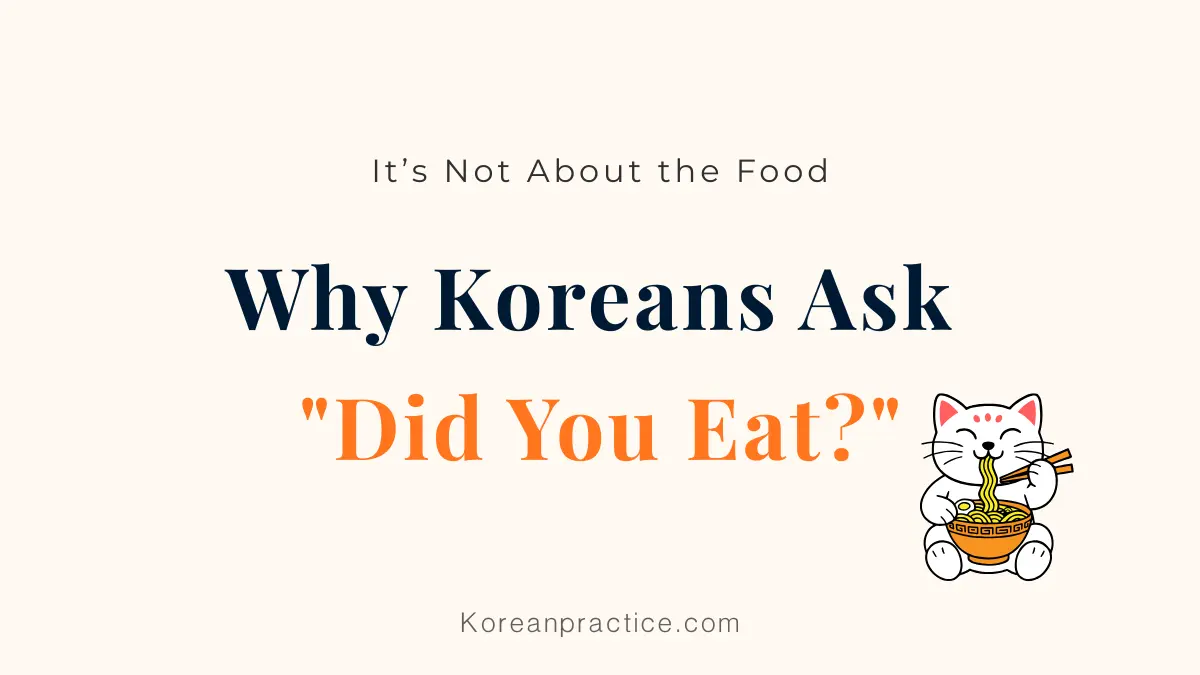
When you start learning Korean, you may hear the phrase “Did you eat?” all the time. In English, this is a normal question about food. But in Korean, “Did you eat in Korean” is not only about food. It is often a friendly greeting, almost like saying “Hello, how are you?”
This makes it one of the most interesting and useful phrases for beginners to learn. In this blog, you will learn how to say “Did you eat in Korean,” why Koreans use it as a greeting, different ways to say it, and many examples.
We will also look at related questions like:
How to say did you eat in Korean
Did you eat already in Korean
Did you eat a lot in Korean
By the end, you will know how to use this phrase like a real Korean speaker!
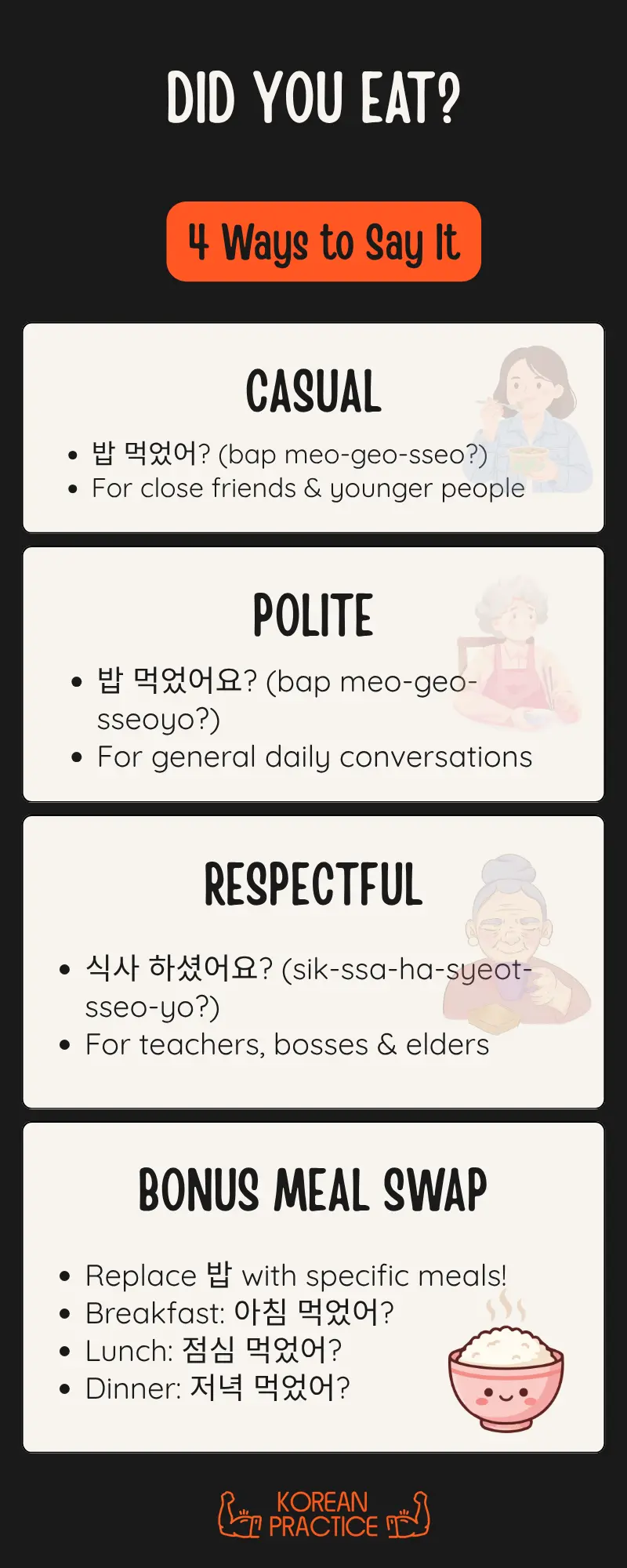
Table of Contents
How to Say “Did You Eat in Korean”
The most common way to say it is:
👉 밥 먹었어? (bap meo-geo-sseo?)
밥 (bap) = rice, but it also means “meal” in Korean.
먹었어 (meogeosseo) = did eat.
So the literal meaning is: “Did you eat rice?” But in everyday life, it simply means “Did you eat?”
This is informal. You can use it with friends or people younger than you.
Original Korean Sentence
A: 밥 먹었어?
B: 응, 먹었어!
Pronunciation Guide
A: 밥 (bap) 먹었어 (meo-geo-sseo)?
B: 응 (eung), 먹었어 (meo-geo-sseo).
Meaning and Context
A: 밥 (meal, rice) 먹 (to eat) 었 (past tense) 어 (I’m asking you casually)?
B: 응 (yes; in a casual way), 먹 (to eat) 었 (past tense) 어 (I’m telling you casually).
English Translation
A: Did you eat?
B: Yes, I ate!
Literal Translation
A: Did you eat meal?
B: Yes, (I) ate!
Taste in Korean: Complete Guide to 5 Flavors
Why Koreans Use “Did You Eat?” as a Greeting
In Korean culture, food is very important. Eating together shows care and friendship. That is why “Did you eat in Korean” is often used like “How are you?”
It does not always mean the speaker wants to know exactly if you ate food. Instead, it shows kindness and concern.
So when someone says 밥 먹었어?, they may just want to say hello in a warm way.
Korean Honorifics Made Simple → Add ‘시’ and instantly sound respectful—see how!
Did You Eat in Korean Language: Formal and Polite Versions
If you want to be polite, you cannot just say 밥 먹었어? to everyone. For older people or strangers, you should use polite speech.
Here are polite versions of Did you eat in Korean language:
밥 먹었어요? (bap meogeosseoyo?) – polite, friendly tone.
식사하셨어요? (siksa hasyeosseoyo?) – very polite and respectful.
Original Korean Sentence
To your teacher: 선생님, 식사하셨어요?
Teacher: 네, 고마워요.
Pronunciation Guide
To your teacher: 선생님 (seon-saeng-nim), 식사하셨어요 (sik-ssa-ha-syeot-sseo-yo)?
Teacher: 네 (ne), 고마워요 (go-ma-wo-yo).
Meaning and Context
To your teacher: 선생님 (teacher), 식사하 (to eat; in polite way) 시 (I show you respect) 었 (past tense) 어요 (I’m asking you polite and friendly)?
Teacher: 네 (yes), 고마워요 (thank you; in a polite way).
English Translation
To your teacher: How are you doing, teacher?
Teacher: Yes, thank you.
Literal Translation
To your teacher: Teacher, Did you eat?
Teacher: Yes, thank you.
7 Delicious Fruits in Korean You’ll Love to Say (with Pictures & Examples!)
Did You Eat Already in Korean
Sometimes you want to ask if someone already ate. You can say:
👉 밥 벌써 먹었어? (bap beolsseo meogeosseo?)
= Did you eat already?
👉 벌써 (beolsseo) means “already.”
Original Korean Sentence
A: 밥 벌써 먹었어?
B: 응, 조금 전에 먹었어.
Pronunciation Guide
A: 밥 (bap) 벌써 (beol-sseo) 먹었어 (meo-geo-sseo)?
B: 응 (eung), 조금 (jo-geum) 전에 (jeo-ne) 먹었어 (meo-geo-sseo).
Meaning and Context
A: 밥 (meal, rice) 벌써 (already) 먹 (to eat) 었 (past tense) 어 (I’m asking you casually)?
B: 응 (yes; in a casual way), 조금 전에 (a little while ago) 먹 (to eat) 었 (past tense) 어 (I’m telling you casually).
English Translation
A: Did you eat already?
B: Yes, I ate a little while ago.
Literal Translation
A: Ate meal already?
B: Yes, ate a little while ago.
Blind Date in Korean (Sogaeting) → Learn the word, the rules, and what to expect.
Did You Eat a Lot in Korean
You may also want to ask if someone ate a lot, like showing care. In Korean, you can say:
👉 밥 많이 먹었어? (bap mani meogeosseo?)
= Did you eat a lot?
👉 많이 (mani) means “a lot.”
Original Korean Sentence
A: 밥 많이 먹었어?
B: 응, 너무 많이 먹어서 배불러!
Pronunciation Guide
A: 밥 (bap) 많이 (ma-ni) 먹었어 (meo-geo-sseo)?
B: 응 (eung), 너무 (neo-mu) 많이 (ma-ni) 먹어서 (meo-geo-seo) 배불러 (bae-bul-leo)!
Meaning and Context
A: 밥 (meal) 많이 (a lot) 먹 (to eat) 었 (past tense) 어 (I’m asking you casually)?
B: 응 (yes), 너무 (too) 많이 (much) 먹 (to eat) 어서 (because) 배불러 (I’m full; in a casual way)!
English Translation
A: Did you eat a lot?
B: Yes, I ate too much, I’m full!
Literal Translation
A: Ate meal a lot?
B: Yes, Since (I) ate too much, I’m full!
6 Korean Table Etiquette Mistakes → Avoid these slips and eat like a local.
More Examples of “Did You Eat in Korean”
Here are more example sentences using different levels of speech:
밥 먹었어? – Did you eat? (casual)
밥 먹었어요? – Did you eat? (polite)
식사하셨어요? – Did you have a meal? (very polite)
밥 벌써 먹었어? – Did you eat already?
밥 많이 먹었어? – Did you eat a lot?
아침 먹었어? – Did you eat breakfast?
점심 먹었어? – Did you eat lunch?
저녁 먹었어? – Did you eat dinner?
As you can see, you can change the word 밥 to 아침 (breakfast), 점심 (lunch), 저녁 (dinner) to be more specific.
Original Korean Sentence
사장님, 여기 물 좀 주세요.
Pronunciation Guide
사장님 (sa-jang-nim), 여기 (yeo-gi) 물 (mul) 좀 (jom) 주세요 (ju-se-yo).
Meaning and Context
사장님 (boss), 여기 (here) 물 (water) 좀 (some) 주 (to give) 세요 (please).
English Translation
Boss, please give me some water here.
Literal Translation
Boss, please give some water here.
Learn Korean – 4 Effective Learning and Practice Strategies

FAQs (What You Might Still Wonder About)
1. Can I answer “밥 먹었어.” even if I didn’t eat rice?
Yes! In Korean, 밥 (bap) means more than “rice.” It often means “meal.” So even if you ate bread, noodles, or pizza, you can still answer with 먹었어 (I ate).
2. Is “Did you eat?” used at any time of the day?
Yes, it can be used in the morning, afternoon, or evening. It does not matter if it is breakfast, lunch, or dinner. The phrase is flexible and always sounds natural.
3. Do Koreans expect you to eat together if they ask this question?
Not always. Sometimes it is just a greeting. But in some cases, it can be an invitation to eat together, especially if the person asks right before mealtime.
4. What is the difference between “밥 먹었어?” and “밥 먹었니?”
밥 먹었어? – casual, friendly, normal tone.
밥 먹었니? – softer, sometimes used by parents or older people talking to children. It sounds caring and gentle.
5. Can I say “밥 먹었어?” in a text message?
Yes! Koreans often use it in texting, chat apps, or phone calls. It is a common way to start a conversation naturally.
6. What if I want to say “Let’s eat” instead of “Did you eat?”
You can say:
밥 먹자! (bap meokja!) – “Let’s eat!” (casual)
밥 같이 먹어요! (bap gachi meogeoyo!) – “Let’s eat together!” (polite)
Final words
The phrase “Did you eat in Korean” is small, but very powerful. It connects grammar, culture, and real life. The next time you meet a Korean friend, try saying 밥 먹었어? You will sound natural, friendly, and caring.
Remember: it is not just about food. It is about showing that you care about the other person. That is why this simple phrase is so special in the Korean language.